

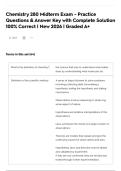
Chemistry 280 Midterm Exam - Practice
Questions & Answer Key with Complete Solution
100% Correct | New 2026 | Graded A+
Save
Terms in this set (44)
What is the definition of chemistry? the science that tries to understand what matter
does by understanding what molecules do.
Definition of the scientific method A series of steps followed to solve problems
including collecting data, formulating a
hypothesis, testing the hypothesis, and stating
conclusions.
Observations involve measuring or observing
some aspect of nature.
Hypotheses are tentative interpretations of the
observations.
Laws summarize the results of a large number of
observations.
Theories are models that explain and give the
underlying causes for observations and laws.
Hypotheses, laws, and theories must be tested
and validated by experiment.
If they are not confirmed, they are revised and
tested through further experimentation.
, Law of Conservation of Mass In a chemical reaction matter is neither created
nor destroyed.
Atomic Theory and how it has created by John Dalton; all matter is composed
changed of atoms
Dalton's theory was a model of the physical
world—it went beyond the laws and observations
of the time to explain these laws and
observations.
definition of matter Matter is anything that occupies space and has
mass. Matter can exist as a solid, liquid, or gas.
Solid matter can be either amorphous (without a
clearly defined shape) or crystalline.
classification of matter Classification of matter: Pure matter is either an
element (a substance that cannot be
decomposed into simpler substances) or a
compound (a substance composed of two or
more elements in fixed definite proportions).
definition of mixture Two or more different substances, the
proportions of which may vary from one sample
to the next.
Questions & Answer Key with Complete Solution
100% Correct | New 2026 | Graded A+
Save
Terms in this set (44)
What is the definition of chemistry? the science that tries to understand what matter
does by understanding what molecules do.
Definition of the scientific method A series of steps followed to solve problems
including collecting data, formulating a
hypothesis, testing the hypothesis, and stating
conclusions.
Observations involve measuring or observing
some aspect of nature.
Hypotheses are tentative interpretations of the
observations.
Laws summarize the results of a large number of
observations.
Theories are models that explain and give the
underlying causes for observations and laws.
Hypotheses, laws, and theories must be tested
and validated by experiment.
If they are not confirmed, they are revised and
tested through further experimentation.
, Law of Conservation of Mass In a chemical reaction matter is neither created
nor destroyed.
Atomic Theory and how it has created by John Dalton; all matter is composed
changed of atoms
Dalton's theory was a model of the physical
world—it went beyond the laws and observations
of the time to explain these laws and
observations.
definition of matter Matter is anything that occupies space and has
mass. Matter can exist as a solid, liquid, or gas.
Solid matter can be either amorphous (without a
clearly defined shape) or crystalline.
classification of matter Classification of matter: Pure matter is either an
element (a substance that cannot be
decomposed into simpler substances) or a
compound (a substance composed of two or
more elements in fixed definite proportions).
definition of mixture Two or more different substances, the
proportions of which may vary from one sample
to the next.


