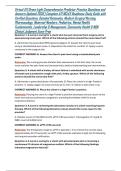
Virtual ATI Green Light Comprehensive Predictor Practice Questions and
Answers Updated 2026 | Complete ATI NCLEX Readiness Study Guide with
Verified Questions, Detailed Rationales, Medical-Surgical Nursing,
Pharmacology, Maternal-Newborn, Pediatrics, Mental Health,
Fundamentals, Leadership & Management, Community Health & NGN
Clinical Judgment Exam Prep
Question 1: A nurse is caring for a client who has just returned from surgery and is
experiencing acute pain. Which of the following actions should the nurse take first?
A. Administer the prescribed PRN opioid analgesic. B. Assess the client's pain level
using a standardized pain scale. C. Reposition the client for comfort. D. Apply a warm
compress to the surgical site.
CORRECT ANSWER: B. Assess the client's pain level using a standardized pain
scale.
Rationale: The nursing process dictates that assessment is the first step; the nurse
must evaluate the pain level and characteristics before implementing any interventions.
Question 2: A client with a history of heart failure is admitted with acute shortness
of breath and a productive cough with pink, frothy sputum. Which of the following
actions should the nurse take first?
A. Administer a prescribed dose of furosemide. B. Place the client in a high-Fowler's
position. C. Apply oxygen via nasal cannula at 2 L/min. D. Obtain a stat chest x-ray.
CORRECT ANSWER: B. Place the client in a high-Fowler's position.
Rationale: Placing the client in a high-Fowler's position decreases venous return to the
heart and reduces pulmonary congestion, providing immediate relief for acute
respiratory distress.
Question 3: A nurse is reviewing the laboratory results of a client receiving heparin
therapy. Which of the following laboratory values should the nurse report to the
provider?
A. Platelet count of 150,000/mm3 B. aPTT of 90 seconds C. Hemoglobin of 14 g/dL D.
WBC count of 6,000/mm3
CORRECT ANSWER: B. aPTT of 90 seconds
Rationale: The therapeutic range for aPTT is typically 1.5 to 2 times the normal value
(approximately 45-70 seconds); an aPTT of 90 seconds indicates a high risk for bleeding
and requires provider notification.
Question 4: A nurse is caring for a client with preeclampsia who is receiving a
continuous IV infusion of magnesium sulfate. Which of the following findings
indicates magnesium toxicity?
,A. Deep tendon reflexes of 2+ B. Urine output of 40 mL/hr C. Respiratory rate of 10
breaths/min D. Blood pressure of 150/90 mm Hg
CORRECT ANSWER: C. Respiratory rate of 10 breaths/min
Rationale: A respiratory rate less than 12 breaths/min is a classic sign of magnesium
sulfate toxicity and requires immediate intervention, including stopping the infusion and
administering calcium gluconate.
Question 5: A nurse is caring for a toddler who has epiglottitis. Which of the
following actions is the priority?
A. Obtain a throat culture. B. Keep the child in a sitting position. C. Administer an oral
antipyretic. D. Inspect the child's throat with a tongue depressor.
CORRECT ANSWER: B. Keep the child in a sitting position.
Rationale: Keeping the child in a sitting position (tripod position) helps maintain a
patent airway; inserting anything into the mouth can trigger laryngospasm and
complete airway obstruction.
Question 6: A nurse is caring for a client with schizophrenia who states, "The
government is tracking my thoughts through the television." Which of the following
responses by the nurse is most appropriate?
A. "That is not possible; the television cannot track your thoughts." B. "It must be
frightening to believe that your thoughts are being tracked." C. "Why do you think the
government would want to track you?" D. "Let's turn off the television so you can feel
safe."
CORRECT ANSWER: B. It must be frightening to believe that your thoughts are being
tracked.
Rationale: This response validates the client's feelings without reinforcing the delusion,
fostering trust and therapeutic communication.
Question 7: A nurse is delegating tasks to an assistive personnel (AP). Which of the
following tasks is appropriate for the AP to perform?
A. Assessing a client's new onset of chest pain. B. Administering an oral dose of
acetaminophen. C. Assisting a stable client with a bed bath. D. Teaching a client about a
new low-sodium diet.
CORRECT ANSWER: C. Assisting a stable client with a bed bath.
Rationale: Assistive personnel can perform basic, non-invasive care tasks for stable
clients, such as bathing, feeding, and ambulating, but cannot assess, administer
medications, or teach.
,Question 8: A nurse is caring for a client who is 1 day postoperative following an
abdominal surgery. The client reports a "popping" sensation at the incision site.
Which of the following actions should the nurse take first?
A. Apply a sterile, saline-soaked dressing to the wound. B. Notify the surgeon
immediately. C. Place the client in a low-Fowler's position with knees bent. D. Assess
the wound for evisceration.
CORRECT ANSWER: C. Place the client in a low-Fowler's position with knees bent.
Rationale: Placing the client in a low-Fowler's position with knees bent reduces tension
on the abdominal suture line, which is the immediate priority if wound dehiscence or
evisceration is suspected.
Question 9: A nurse is caring for a client with chronic obstructive pulmonary
disease (COPD). Which of the following oxygen delivery methods is most
appropriate for this client?
A. Non-rebreather mask at 15 L/min B. Venturi mask at 24% C. Simple face mask at 6
L/min D. Nasal cannula at 4 L/min
CORRECT ANSWER: B. Venturi mask at 24%
Rationale: A Venturi mask delivers a precise, low concentration of oxygen, which is
crucial for clients with COPD to prevent the suppression of their hypoxic drive to
breathe.
Question 10: A nurse is caring for a client taking digoxin. Which of the following
findings should the nurse recognize as an indication of digoxin toxicity?
A. Increased appetite B. Visual disturbances, such as yellow-green halos C. Tachycardia
D. Hypertension
CORRECT ANSWER: B. Visual disturbances, such as yellow-green halos
Rationale: Visual disturbances, including yellow-green halos around lights, are a
classic and specific sign of digoxin toxicity, along with nausea, vomiting, and
bradycardia.
Question 11: A nurse is preparing to administer a blood transfusion. Which of the
following actions is the priority before initiating the transfusion?
A. Prime the IV tubing with normal saline. B. Verify the blood product with another
nurse. C. Obtain the client's baseline vital signs. D. Ensure the client has signed the
consent form.
CORRECT ANSWER: B. Verify the blood product with another nurse.
Rationale: Verifying the blood product, client identity, and compatibility with a second
licensed nurse is the critical safety step to prevent a fatal hemolytic transfusion
reaction.
, Question 12: A client is admitted with a suspected diagnosis of Clostridioides
difficile (C. diff) infection. Which of the following infection control precautions
should the nurse implement?
A. Airborne precautions B. Droplet precautions C. Contact precautions D. Protective
environment
CORRECT ANSWER: C. Contact precautions
Rationale: C. diff is transmitted via the fecal-oral route through spores; contact
precautions, including gloves, gowns, and handwashing with soap and water, are
required.
Question 13: A nurse is caring for a client with a nasogastric (NG) tube. Which of the
following is the most reliable method for verifying initial NG tube placement?
A. Auscultating an air bolus over the epigastrium. B. Measuring the pH of the gastric
aspirate. C. Observing the color of the aspirate. D. Obtaining an x-ray of the abdomen.
CORRECT ANSWER: D. Obtaining an x-ray of the abdomen.
Rationale: An abdominal x-ray is the gold standard and most reliable method for
confirming initial NG tube placement before initiating feedings or medications.
Question 14: A nurse is caring for a client with type 1 diabetes who is experiencing
hypoglycemia. Which of the following findings should the nurse expect?
A. Polyuria B. Diaphoresis and tremors C. Kussmaul respirations D. Fruity breath odor
CORRECT ANSWER: B. Diaphoresis and tremors
Rationale: Diaphoresis, tremors, tachycardia, and confusion are classic sympathetic
nervous system responses to hypoglycemia, whereas the other options are signs of
hyperglycemia or DKA.
Question 15: A nurse is caring for a postpartum client who is experiencing heavy
vaginal bleeding and a boggy uterus. Which of the following actions should the
nurse take first?
A. Administer prescribed oxytocin. B. Massage the uterine fundus. C. Insert a Foley
catheter. D. Notify the healthcare provider.
CORRECT ANSWER: B. Massage the uterine fundus.
Rationale: Massaging the uterine fundus is the immediate, first-line nursing
intervention to stimulate uterine contraction and control postpartum hemorrhage
caused by uterine atony.
Question 16: A nurse is teaching a client about a new prescription for warfarin.
Which of the following statements by the client indicates an understanding of the
teaching?
Answers Updated 2026 | Complete ATI NCLEX Readiness Study Guide with
Verified Questions, Detailed Rationales, Medical-Surgical Nursing,
Pharmacology, Maternal-Newborn, Pediatrics, Mental Health,
Fundamentals, Leadership & Management, Community Health & NGN
Clinical Judgment Exam Prep
Question 1: A nurse is caring for a client who has just returned from surgery and is
experiencing acute pain. Which of the following actions should the nurse take first?
A. Administer the prescribed PRN opioid analgesic. B. Assess the client's pain level
using a standardized pain scale. C. Reposition the client for comfort. D. Apply a warm
compress to the surgical site.
CORRECT ANSWER: B. Assess the client's pain level using a standardized pain
scale.
Rationale: The nursing process dictates that assessment is the first step; the nurse
must evaluate the pain level and characteristics before implementing any interventions.
Question 2: A client with a history of heart failure is admitted with acute shortness
of breath and a productive cough with pink, frothy sputum. Which of the following
actions should the nurse take first?
A. Administer a prescribed dose of furosemide. B. Place the client in a high-Fowler's
position. C. Apply oxygen via nasal cannula at 2 L/min. D. Obtain a stat chest x-ray.
CORRECT ANSWER: B. Place the client in a high-Fowler's position.
Rationale: Placing the client in a high-Fowler's position decreases venous return to the
heart and reduces pulmonary congestion, providing immediate relief for acute
respiratory distress.
Question 3: A nurse is reviewing the laboratory results of a client receiving heparin
therapy. Which of the following laboratory values should the nurse report to the
provider?
A. Platelet count of 150,000/mm3 B. aPTT of 90 seconds C. Hemoglobin of 14 g/dL D.
WBC count of 6,000/mm3
CORRECT ANSWER: B. aPTT of 90 seconds
Rationale: The therapeutic range for aPTT is typically 1.5 to 2 times the normal value
(approximately 45-70 seconds); an aPTT of 90 seconds indicates a high risk for bleeding
and requires provider notification.
Question 4: A nurse is caring for a client with preeclampsia who is receiving a
continuous IV infusion of magnesium sulfate. Which of the following findings
indicates magnesium toxicity?
,A. Deep tendon reflexes of 2+ B. Urine output of 40 mL/hr C. Respiratory rate of 10
breaths/min D. Blood pressure of 150/90 mm Hg
CORRECT ANSWER: C. Respiratory rate of 10 breaths/min
Rationale: A respiratory rate less than 12 breaths/min is a classic sign of magnesium
sulfate toxicity and requires immediate intervention, including stopping the infusion and
administering calcium gluconate.
Question 5: A nurse is caring for a toddler who has epiglottitis. Which of the
following actions is the priority?
A. Obtain a throat culture. B. Keep the child in a sitting position. C. Administer an oral
antipyretic. D. Inspect the child's throat with a tongue depressor.
CORRECT ANSWER: B. Keep the child in a sitting position.
Rationale: Keeping the child in a sitting position (tripod position) helps maintain a
patent airway; inserting anything into the mouth can trigger laryngospasm and
complete airway obstruction.
Question 6: A nurse is caring for a client with schizophrenia who states, "The
government is tracking my thoughts through the television." Which of the following
responses by the nurse is most appropriate?
A. "That is not possible; the television cannot track your thoughts." B. "It must be
frightening to believe that your thoughts are being tracked." C. "Why do you think the
government would want to track you?" D. "Let's turn off the television so you can feel
safe."
CORRECT ANSWER: B. It must be frightening to believe that your thoughts are being
tracked.
Rationale: This response validates the client's feelings without reinforcing the delusion,
fostering trust and therapeutic communication.
Question 7: A nurse is delegating tasks to an assistive personnel (AP). Which of the
following tasks is appropriate for the AP to perform?
A. Assessing a client's new onset of chest pain. B. Administering an oral dose of
acetaminophen. C. Assisting a stable client with a bed bath. D. Teaching a client about a
new low-sodium diet.
CORRECT ANSWER: C. Assisting a stable client with a bed bath.
Rationale: Assistive personnel can perform basic, non-invasive care tasks for stable
clients, such as bathing, feeding, and ambulating, but cannot assess, administer
medications, or teach.
,Question 8: A nurse is caring for a client who is 1 day postoperative following an
abdominal surgery. The client reports a "popping" sensation at the incision site.
Which of the following actions should the nurse take first?
A. Apply a sterile, saline-soaked dressing to the wound. B. Notify the surgeon
immediately. C. Place the client in a low-Fowler's position with knees bent. D. Assess
the wound for evisceration.
CORRECT ANSWER: C. Place the client in a low-Fowler's position with knees bent.
Rationale: Placing the client in a low-Fowler's position with knees bent reduces tension
on the abdominal suture line, which is the immediate priority if wound dehiscence or
evisceration is suspected.
Question 9: A nurse is caring for a client with chronic obstructive pulmonary
disease (COPD). Which of the following oxygen delivery methods is most
appropriate for this client?
A. Non-rebreather mask at 15 L/min B. Venturi mask at 24% C. Simple face mask at 6
L/min D. Nasal cannula at 4 L/min
CORRECT ANSWER: B. Venturi mask at 24%
Rationale: A Venturi mask delivers a precise, low concentration of oxygen, which is
crucial for clients with COPD to prevent the suppression of their hypoxic drive to
breathe.
Question 10: A nurse is caring for a client taking digoxin. Which of the following
findings should the nurse recognize as an indication of digoxin toxicity?
A. Increased appetite B. Visual disturbances, such as yellow-green halos C. Tachycardia
D. Hypertension
CORRECT ANSWER: B. Visual disturbances, such as yellow-green halos
Rationale: Visual disturbances, including yellow-green halos around lights, are a
classic and specific sign of digoxin toxicity, along with nausea, vomiting, and
bradycardia.
Question 11: A nurse is preparing to administer a blood transfusion. Which of the
following actions is the priority before initiating the transfusion?
A. Prime the IV tubing with normal saline. B. Verify the blood product with another
nurse. C. Obtain the client's baseline vital signs. D. Ensure the client has signed the
consent form.
CORRECT ANSWER: B. Verify the blood product with another nurse.
Rationale: Verifying the blood product, client identity, and compatibility with a second
licensed nurse is the critical safety step to prevent a fatal hemolytic transfusion
reaction.
, Question 12: A client is admitted with a suspected diagnosis of Clostridioides
difficile (C. diff) infection. Which of the following infection control precautions
should the nurse implement?
A. Airborne precautions B. Droplet precautions C. Contact precautions D. Protective
environment
CORRECT ANSWER: C. Contact precautions
Rationale: C. diff is transmitted via the fecal-oral route through spores; contact
precautions, including gloves, gowns, and handwashing with soap and water, are
required.
Question 13: A nurse is caring for a client with a nasogastric (NG) tube. Which of the
following is the most reliable method for verifying initial NG tube placement?
A. Auscultating an air bolus over the epigastrium. B. Measuring the pH of the gastric
aspirate. C. Observing the color of the aspirate. D. Obtaining an x-ray of the abdomen.
CORRECT ANSWER: D. Obtaining an x-ray of the abdomen.
Rationale: An abdominal x-ray is the gold standard and most reliable method for
confirming initial NG tube placement before initiating feedings or medications.
Question 14: A nurse is caring for a client with type 1 diabetes who is experiencing
hypoglycemia. Which of the following findings should the nurse expect?
A. Polyuria B. Diaphoresis and tremors C. Kussmaul respirations D. Fruity breath odor
CORRECT ANSWER: B. Diaphoresis and tremors
Rationale: Diaphoresis, tremors, tachycardia, and confusion are classic sympathetic
nervous system responses to hypoglycemia, whereas the other options are signs of
hyperglycemia or DKA.
Question 15: A nurse is caring for a postpartum client who is experiencing heavy
vaginal bleeding and a boggy uterus. Which of the following actions should the
nurse take first?
A. Administer prescribed oxytocin. B. Massage the uterine fundus. C. Insert a Foley
catheter. D. Notify the healthcare provider.
CORRECT ANSWER: B. Massage the uterine fundus.
Rationale: Massaging the uterine fundus is the immediate, first-line nursing
intervention to stimulate uterine contraction and control postpartum hemorrhage
caused by uterine atony.
Question 16: A nurse is teaching a client about a new prescription for warfarin.
Which of the following statements by the client indicates an understanding of the
teaching?