

Social Science Psychology Save
6th edition TCO BCBA Exam
Leave the first rating
Students also studied
Flashcard sets Study guides
6th edition TCO BCBA Exam FIT BCBA Mock Exam BCBA EXAM 6TH EDITION BC
563 terms 161 terms 46 terms 42
Caroline_Latture5 Preview mmaur024 Preview P msarabwv Preview
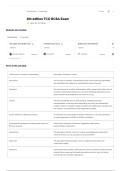
Terms in this set (563)
Three levels of Scientific Understanding Description, Prediction, Control
Description The first level of scientific understanding which involves deriving quantifiable
and classifiable facts (data) from systematically observed events.
Prediction The second level of scientific understanding. When repeat observations show a
consistent relationship between two events, the identified relationship can be
used to predict the probability of one event occurring.
Control The third and highest level of understanding. Established through
experimentation confirming that manipulating one event (the independent
variable) results in a reliable change in another event (dependent variable), and
the change is only attributed to that independent variable.
Code's definition of Behavioral Analyst An individual who holds BCBA or BCaBA certification or who has submitted a
complete application for BCBA or BCaBA certification.
Philosophical Assumptions Underlying the science of Determinism, Empiricism, Parsimony, Pragmatism, Selectionism,
Behavior Analysis Experimentation, Replication.
Determinism The assumption that the world is an orderly, predictable, and lawful place
where all events occur as a product of cause and effect.
Empiricism The assumption that knowledge is built on objective observation and
measurement (data).
Parsimony A philosophical assumption underlying the science of behavior analysis that the
simplest theory requiring the fewest assumptions must be ruled out before
considering more complex explanations.
, Pragmatism A philosophical assumption underlying the science of behavior analysis that
focuses on practical solutions (e.g., if it works, don't fix it), which at the level of
behavior, involves the relation between the setting (A) and the behavior (B) is
because of the consequence (C).
Selectionism A philosophical assumption underlying the science of behavior analysis that
anything that evolves does so because of the consequences of behavior,
meaning that behaviors that result in positive consequences survive and
produce more sophisticated repertoires.
Experimentation A philosophical assumption underlying the science of behavior analysis that a
controlled comparison of the dependent variable under two or more
conditions (independent variables) is required to assess if one event caused
another.
Replication A philosophical assumption underlying the science of behavior analysis that
experiments should be repeated to determine the reliability and usefulness of
their findings and to discover and correct mistakes.
Philosophical Doubt A philosophical assumption underlying the science of behavior analysis that the
truth should always be questioned with healthy skepticism, which means
viewing the results of studies and clinical work with a critical eye.
Private Events Covert events (stimuli) taking place inside the skin that are solely accessible or
detectable by the individual experiencing the event (thoughts, pain, feelings,
ideas, sensations). Influencer by function, just like public events.
Radical Behaviorism A specific type of behaviorism which holds that all human behavior, including
private events, like thinking and feeling, can be understood or explained as a
result of interactions with the environment.
Four branches of Behavior Analysis Behaviorism, Experiemental Analysis of Behavior (EAB), Applied Behavior
Analysis, Professional practice guided by the science of behavioral analysis
Behaviorism A branch of behavior analysis that examines the philosophical, theoretical,
historical, and methodological issues within the science of behavior
Experiemental Analysis of Behavior (EAB) A branch of behavior analysis that deals with research on basic processes and
principles and is mainly conducted in laboratories.
Professional practice guided by the science of A branch of behavior analysis that encompasses various fields of work (not
behavioral analysis necessarily BCBAs/BCaBAs) implementing ABA procedures within their
professions.
BACB's definition of applied behavior analysis (ABA) A science based on the use of learning principles to improve socially important
behavior. ABA practice focuses on assessing the environmental influences on
behavior, implementing assessment-based interventions, and making data-
based decisions. ABA has been used to address the behavioral needs of
consumers in multiple areas, including general and special education,
organizational behavior management, gerontology, and many more. ABA is the
leading evidenced-based treatment approach for ASD and other
developmental disabilities.
Seven dimensions of ABA Behavioral, applied, technological, conceptually systematic, analytic,
generality, effective
6th edition TCO BCBA Exam
Leave the first rating
Students also studied
Flashcard sets Study guides
6th edition TCO BCBA Exam FIT BCBA Mock Exam BCBA EXAM 6TH EDITION BC
563 terms 161 terms 46 terms 42
Caroline_Latture5 Preview mmaur024 Preview P msarabwv Preview
Terms in this set (563)
Three levels of Scientific Understanding Description, Prediction, Control
Description The first level of scientific understanding which involves deriving quantifiable
and classifiable facts (data) from systematically observed events.
Prediction The second level of scientific understanding. When repeat observations show a
consistent relationship between two events, the identified relationship can be
used to predict the probability of one event occurring.
Control The third and highest level of understanding. Established through
experimentation confirming that manipulating one event (the independent
variable) results in a reliable change in another event (dependent variable), and
the change is only attributed to that independent variable.
Code's definition of Behavioral Analyst An individual who holds BCBA or BCaBA certification or who has submitted a
complete application for BCBA or BCaBA certification.
Philosophical Assumptions Underlying the science of Determinism, Empiricism, Parsimony, Pragmatism, Selectionism,
Behavior Analysis Experimentation, Replication.
Determinism The assumption that the world is an orderly, predictable, and lawful place
where all events occur as a product of cause and effect.
Empiricism The assumption that knowledge is built on objective observation and
measurement (data).
Parsimony A philosophical assumption underlying the science of behavior analysis that the
simplest theory requiring the fewest assumptions must be ruled out before
considering more complex explanations.
, Pragmatism A philosophical assumption underlying the science of behavior analysis that
focuses on practical solutions (e.g., if it works, don't fix it), which at the level of
behavior, involves the relation between the setting (A) and the behavior (B) is
because of the consequence (C).
Selectionism A philosophical assumption underlying the science of behavior analysis that
anything that evolves does so because of the consequences of behavior,
meaning that behaviors that result in positive consequences survive and
produce more sophisticated repertoires.
Experimentation A philosophical assumption underlying the science of behavior analysis that a
controlled comparison of the dependent variable under two or more
conditions (independent variables) is required to assess if one event caused
another.
Replication A philosophical assumption underlying the science of behavior analysis that
experiments should be repeated to determine the reliability and usefulness of
their findings and to discover and correct mistakes.
Philosophical Doubt A philosophical assumption underlying the science of behavior analysis that the
truth should always be questioned with healthy skepticism, which means
viewing the results of studies and clinical work with a critical eye.
Private Events Covert events (stimuli) taking place inside the skin that are solely accessible or
detectable by the individual experiencing the event (thoughts, pain, feelings,
ideas, sensations). Influencer by function, just like public events.
Radical Behaviorism A specific type of behaviorism which holds that all human behavior, including
private events, like thinking and feeling, can be understood or explained as a
result of interactions with the environment.
Four branches of Behavior Analysis Behaviorism, Experiemental Analysis of Behavior (EAB), Applied Behavior
Analysis, Professional practice guided by the science of behavioral analysis
Behaviorism A branch of behavior analysis that examines the philosophical, theoretical,
historical, and methodological issues within the science of behavior
Experiemental Analysis of Behavior (EAB) A branch of behavior analysis that deals with research on basic processes and
principles and is mainly conducted in laboratories.
Professional practice guided by the science of A branch of behavior analysis that encompasses various fields of work (not
behavioral analysis necessarily BCBAs/BCaBAs) implementing ABA procedures within their
professions.
BACB's definition of applied behavior analysis (ABA) A science based on the use of learning principles to improve socially important
behavior. ABA practice focuses on assessing the environmental influences on
behavior, implementing assessment-based interventions, and making data-
based decisions. ABA has been used to address the behavioral needs of
consumers in multiple areas, including general and special education,
organizational behavior management, gerontology, and many more. ABA is the
leading evidenced-based treatment approach for ASD and other
developmental disabilities.
Seven dimensions of ABA Behavioral, applied, technological, conceptually systematic, analytic,
generality, effective


