

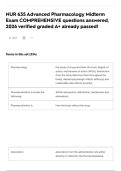
NUR 635 Advanced Pharmacology Midterm
Exam COMPREHENSIVE questions answered,
2026 verified graded A+ already passed!
Save
Terms in this set (334)
Pharmacology the study of drugs and their structure, targets of
action, mechanisms of action (MOA), distribution
(how the body disburses them throughout the
body), desired physiologic effects (efficacy) and
undesirable side effects (toxicity).
Pharmacokinetics includes the ADME (absorption, distribution, metabolism and
following: elimination).
Pharmacokinetics is... How the body effects the drug
Absorption absorption from the administration site either
directly or indirectly into the blood/plasma.
, Distribution reversibly/irreversibly movement of drug from
the bloodstream into the interstitial and
intracellular fluid.
Metabolism drug biotransformation via metabolic pathways,
primarily the liver, or by other tissues.
Elimination how parent drug & its metabolites are eliminated
from the body
Absorption factors · Gastrointestinal pH changes
· Gastric emptying
· Gastric/intestinal enzymes
· Bile acids & biliary function
· Gastrointestinal flora (type and quantity of
bacteria)
· Food & nutrient interactions (most common
interaction influencing GI drug absorption)
· Lipid solubility of the drug
Distribution factors · Membrane permeability: Cross membranes to
site of action
· Blood brain barrier reduces the speed of drug
passage into and out of brain tissue
· Plasma protein binding: drugs bound to plasma
proteins do not cross membranes (Note:
Malnutrition = âalbumin = á free drug = greater
pharmacologic response)
· Aging cause a reduction in production of
plasma proteins
· Lipophilicity of drug: lipophilic drugs
concentrate in adipose tissue; remain in the body
for a longer period of time
Exam COMPREHENSIVE questions answered,
2026 verified graded A+ already passed!
Save
Terms in this set (334)
Pharmacology the study of drugs and their structure, targets of
action, mechanisms of action (MOA), distribution
(how the body disburses them throughout the
body), desired physiologic effects (efficacy) and
undesirable side effects (toxicity).
Pharmacokinetics includes the ADME (absorption, distribution, metabolism and
following: elimination).
Pharmacokinetics is... How the body effects the drug
Absorption absorption from the administration site either
directly or indirectly into the blood/plasma.
, Distribution reversibly/irreversibly movement of drug from
the bloodstream into the interstitial and
intracellular fluid.
Metabolism drug biotransformation via metabolic pathways,
primarily the liver, or by other tissues.
Elimination how parent drug & its metabolites are eliminated
from the body
Absorption factors · Gastrointestinal pH changes
· Gastric emptying
· Gastric/intestinal enzymes
· Bile acids & biliary function
· Gastrointestinal flora (type and quantity of
bacteria)
· Food & nutrient interactions (most common
interaction influencing GI drug absorption)
· Lipid solubility of the drug
Distribution factors · Membrane permeability: Cross membranes to
site of action
· Blood brain barrier reduces the speed of drug
passage into and out of brain tissue
· Plasma protein binding: drugs bound to plasma
proteins do not cross membranes (Note:
Malnutrition = âalbumin = á free drug = greater
pharmacologic response)
· Aging cause a reduction in production of
plasma proteins
· Lipophilicity of drug: lipophilic drugs
concentrate in adipose tissue; remain in the body
for a longer period of time


