

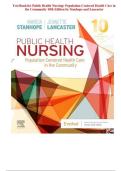
TEST BANK FOR PUBLIC HEALTH NURSING: POPULATION-CENTERED HEALTH CARE IN THE COMMUNITY 10TH EDITION BY STANHOPE & LANCASTER (ALL CHAPTERS 1-44 VERIFIED ANSWERS & RATIONALES)
Master Macro-Level Nursing: The Complete Population-Centered Assessment Toolkit Shifting your clinical mindset from individual bedside acute care to aggregate community health is one of the most challenging transitions in a nursing curriculum. While traditional nursing focuses on a single patient's immediate pathophysiology, public health nursing requires you to analyze entire populations, evaluate complex social determinants of health (SDOH), and design systemic interventions to prevent disease across diverse community settings. To master these complex macro-level frameworks and excel on your examinations, passive reading is rarely enough. You need an active assessment strategy that aligns exactly with your textbook's learning objectives. This Complete Test Bank for Public Health Nursing: Population-Centered Health Care in the Community, 10th Edition by Marcia Stanhope and Jeanette Lancaster is a premium educational resource built directly from the official Elsevier curriculum blueprint. It contains hundreds of professionally verified practice questions, comprehensive answer keys, and clear analytical rationales. Serving as your ultimate active recall guide, this digital download is designed to mirror your instructor’s midterms, final examinations, and the public health segments of the Next Generation NCLEX (NGN) exam. Why the 10th Edition Test Bank is Critical for Your Success The 10th edition of the Stanhope & Lancaster text reflects the latest updates in evidence-based community practice, including evolving global health patterns, updated healthy people benchmarks, disaster management protocols, and contemporary environmental health challenges. This test bank provides direct, chapter-by-chapter reinforcement of these critical shifts. By testing your knowledge with these structured questions, you can identify hidden conceptual gaps, eliminate test anxiety, and learn exactly how to apply core epidemiological and community-oriented frameworks to complex population scenarios. Specialized Community-Focused Question Formats Included: Epidemiological Calculation & Interpretation Items: Questions testing your ability to distinguish and calculate incidence rates, prevalence rates, and mortality indicators. Select All That Apply (SATA) Intervention Drills: Tailored to test multi-faceted public health actions, such as identifying all components of a primary prevention program for vulnerable youth. Vignette-Based Care Coordination Scenarios: Items requiring you to prioritize interventions during a community outbreak, environmental disaster, or localized health crisis. Levels of Prevention Sorting Practice: Exercises designed to sharpen your quick differentiation between primary, secondary, and tertiary interventions—the most heavily tested concept in community nursing. In-Depth Breakdown of High-Yield Core Domains Covered This downloadable testing repository encompasses all 44 chapters of the 10th edition text, systematically mapped across high-yield community domains: 1. Perspectives and Foundations of Public and Community Health Nursing Build an unbreakable foundation in historical and structural public health systems: History and Trends: Tracking the evolution of public health nursing from Lillian Wald and the Henry Street Settlement to modern global health equity initiatives. Public Health Systems and Policy: Understanding the intersection of local, state, and federal health agencies, healthcare economics, and the nurse's role in health advocacy and legislative policy-making. Ethics and Cultural Diversity: Navigating ethical principles (such as utilitarianism vs. egalitarianism) in population choices, and implementing culturally competent care to reduce health disparities. 2. Epidemiology, Environmental Health, and Research Tools Master the objective scientific tools that drive community assessment data collection: Epidemiology in Action: Differentiating between the Epidemiological Triangle components (Agent, Host, and Environment), tracking disease transmission vectors, and implementing surveillance models. Environmental Health Risks: Assessing environmental hazards, applying the "I PREPARE" mnemonic for environmental exposure history collection, and identifying strategies to mitigate lead, radon, or waterborne contaminants. Community Evidence-Based Practice: Utilizing population data registries, nursing research, and community health statistics to design validated public programs. 3. Community Assessment, Education, and Health Promotion Learn how to diagnose and implement changes for aggregates rather than individuals: Community Assessment Process: Executing thorough community assessments using windshield surveys, key informant interviews, focus groups, and secondary demographic data. Health Education and Group Frameworks: Designing effective, literacy-appropriate educational programs, overcoming community barriers to learning, and evaluating behavioral objectives. Program Management & Evaluation: Formulating measurable program goals, tracking formative vs. summative evaluation metrics, and ensuring long-term program sustainability. 4. Managing Vulnerability, Communicable Diseases, and Disasters Conquer high-stakes scenarios involving high-risk aggregates and emergency management systems: Vulnerable Populations: Designing targeted care networks for aggregates experiencing poverty, homelessness, migrant farmworker challenges, substance abuse, or mental health crises. Communicable Disease Control: Managing primary prevention (vaccination campaigns), secondary prevention (tuberculosis screening and contact tracing), and tertiary prevention (directly observed therapy - DOT for active TB cases). Disaster Management Cycle: Mastering the nurse’s specific responsibilities across all four phases: Prevention (mitigation), Preparedness (disaster drilling), Response (triage sorting using START protocols), and Recovery (mental health debriefing). 5. Nursing Practice in Specialized Community Settings School and Occupational Health: Managing childhood chronic illnesses within school tracking tools, identifying occupational ergonomics or chemical hazards, and enforcing workers' safety standards. Home Health and Hospice: Navigating family dynamics during home visits, managing physical safety within client domiciles, and coordinating palliative care modalities. Forensic and Parish Nursing: Understanding specialized nursing roles within legal, faith-based, and correctional institutional environments. Premium Product Benefits for Nursing Students Complete 44-Chapter Coverage: Absolute structural integrity with no missing chapters or hidden omissions. Verified Explanations: Every item includes its designated answer key along with text-verified rationales, saving you from spending hours flipping through pages. Immediate Scannability: Designed with clean formatting and bold key-term styling, allowing for rapid-fire review sessions right before exam blocks. Invest in your community health competence and secure your GPA today. Download the complete Stanhope Public Health Nursing 10th Edition Test Bank, master the logic behind systemic population outcomes, and clear your community nursing course with an A+!
Document information
- Uploaded on
- June 6, 2026
- Number of pages
- 445
- Written in
- 2025/2026
- Type
- Exam (elaborations)
- Contains
- Questions & answers


