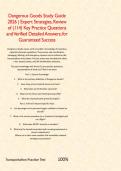
Dangerous Goods Study Guide
2026 | Expert Strategies, Review
of (114) Key Practice Questions
and Verified Detailed Answers; for
Guaranteed Success
Dangerous Goods exams verify a handler's knowledge of hazardous
materials (hazmat) regulations. They ensure safe classification,
packaging, labeling, and emergency response across industries like
transportation and aviation. Practice exams test foundational safety
rules, hazard classes, and UN identification protocols.
Test your knowledge with these 10 core practice questions,
representative of what you'll find in an exam:
Part 1: General Knowledge
1. What is the primary definition of Dangerous Goods?
2. How many primary hazard classes are there?
3. What does an UN Number represent?
4. What are the three main Packing Groups (PG)?
5. What do hazard placards primarily display?
Part 2: Airline & Industry-Specific Rules
6. Can passengers carry personal oxygen cylinders on board an
aircraft?
7. What is the correct procedure for a chemical or biological spill
on a flight?
8. What does NOTOC stand for in aviation?
9. What are the hazards associated with camping equipment or
electric wheelchairs?
Where can a cabin crew member find immediate onboard
emergency procedures?
Transportation Practice Test 100%
,1. When loading dangerous goods:
Taken by: Study Ace Smart
Score
All shipments must be properly restrained to prevent shifting
All shipments must be loaded in accordance of all compatibility requirements,
loading limit, instructions and directional arrows
Do not low dry ice in the same compartment as live animals
All of the above
2. Who is responsible for packaging, labeling and preparing shipping papers for a
carrier?
Shipper
Carrier
Driver
DOT
3. Explain the significance of the Bulk Cargo Shipping Name (BCSN) in the
transportation of dangerous goods by sea.
It identifies the shipper's responsibilities.
It provides a unique identifier for each type of cargo.
It ensures compliance with safety regulations.
It indicates the flowability of the cargo.
4. What is used on board ship which refers to restraint devices such as webbing, steel
chain, wire rope or steel strapping that either ties cargo together or keeps cargo in
contact with the load platform or any blocking device?
, Bracing
Lashing
Blocking
Tomming
5. What is one of the key responsibilities of shippers when transporting dangerous
goods by sea according to the IMDG Code?
To ensure proper labeling of the cargo
To provide training for ship crew
To monitor weather conditions during transit
To maintain a log of all cargo movements
6. Explain the significance of the Rule of Thumb method in assessing securing
arrangements for cargo. Why is it important that the MSLs of lashing devices do not
equal the total weight of the unit?
It ensures that the cargo is not overloaded.
It allows for dynamic forces during transport.
It simplifies the documentation process.
It reduces the need for safety measures.
7. A shipping company is preparing to transport a new type of dangerous good that has
not been previously handled. Based on the IMDG Code, what steps should the
company take to ensure compliance with packing and tank provisions?
Use the same packing methods as for non-dangerous goods.
Consult the IMDG Code for specific packing instructions and conduct a risk
assessment.
, Only label the goods if they are visible during transport.
Skip documentation if the goods are not classified as highly dangerous.
8. Inexpensive or waste material used to protect cargo from shifting during transport
Dunnage
Tariff
Airbill
Pallet
9. The officer in charge has the responsibility for monitoring the stevedoring operation.
Which of the following statements is TRUE? The officer should ensure: 1. The agreed
loading/unloading sequence is being followed by the terminal. 2. Any damage to the
ship is reported. 3. The cargo is loaded, where possible, symmetrically in each hold
and, where necessary, trimmed. 4. Effective communication with the terminal is
maintained. 5. The loading rate does not increase beyond the agreed rate for the
loading plan.
1, 2, 3, and 4 are true
1, 2, 3, 4, and 5 are true
2, 3, 4, and 5 are true
1, 2, 3, and 5 are true
10. What is the angle of repose?
2026 | Expert Strategies, Review
of (114) Key Practice Questions
and Verified Detailed Answers; for
Guaranteed Success
Dangerous Goods exams verify a handler's knowledge of hazardous
materials (hazmat) regulations. They ensure safe classification,
packaging, labeling, and emergency response across industries like
transportation and aviation. Practice exams test foundational safety
rules, hazard classes, and UN identification protocols.
Test your knowledge with these 10 core practice questions,
representative of what you'll find in an exam:
Part 1: General Knowledge
1. What is the primary definition of Dangerous Goods?
2. How many primary hazard classes are there?
3. What does an UN Number represent?
4. What are the three main Packing Groups (PG)?
5. What do hazard placards primarily display?
Part 2: Airline & Industry-Specific Rules
6. Can passengers carry personal oxygen cylinders on board an
aircraft?
7. What is the correct procedure for a chemical or biological spill
on a flight?
8. What does NOTOC stand for in aviation?
9. What are the hazards associated with camping equipment or
electric wheelchairs?
Where can a cabin crew member find immediate onboard
emergency procedures?
Transportation Practice Test 100%
,1. When loading dangerous goods:
Taken by: Study Ace Smart
Score
All shipments must be properly restrained to prevent shifting
All shipments must be loaded in accordance of all compatibility requirements,
loading limit, instructions and directional arrows
Do not low dry ice in the same compartment as live animals
All of the above
2. Who is responsible for packaging, labeling and preparing shipping papers for a
carrier?
Shipper
Carrier
Driver
DOT
3. Explain the significance of the Bulk Cargo Shipping Name (BCSN) in the
transportation of dangerous goods by sea.
It identifies the shipper's responsibilities.
It provides a unique identifier for each type of cargo.
It ensures compliance with safety regulations.
It indicates the flowability of the cargo.
4. What is used on board ship which refers to restraint devices such as webbing, steel
chain, wire rope or steel strapping that either ties cargo together or keeps cargo in
contact with the load platform or any blocking device?
, Bracing
Lashing
Blocking
Tomming
5. What is one of the key responsibilities of shippers when transporting dangerous
goods by sea according to the IMDG Code?
To ensure proper labeling of the cargo
To provide training for ship crew
To monitor weather conditions during transit
To maintain a log of all cargo movements
6. Explain the significance of the Rule of Thumb method in assessing securing
arrangements for cargo. Why is it important that the MSLs of lashing devices do not
equal the total weight of the unit?
It ensures that the cargo is not overloaded.
It allows for dynamic forces during transport.
It simplifies the documentation process.
It reduces the need for safety measures.
7. A shipping company is preparing to transport a new type of dangerous good that has
not been previously handled. Based on the IMDG Code, what steps should the
company take to ensure compliance with packing and tank provisions?
Use the same packing methods as for non-dangerous goods.
Consult the IMDG Code for specific packing instructions and conduct a risk
assessment.
, Only label the goods if they are visible during transport.
Skip documentation if the goods are not classified as highly dangerous.
8. Inexpensive or waste material used to protect cargo from shifting during transport
Dunnage
Tariff
Airbill
Pallet
9. The officer in charge has the responsibility for monitoring the stevedoring operation.
Which of the following statements is TRUE? The officer should ensure: 1. The agreed
loading/unloading sequence is being followed by the terminal. 2. Any damage to the
ship is reported. 3. The cargo is loaded, where possible, symmetrically in each hold
and, where necessary, trimmed. 4. Effective communication with the terminal is
maintained. 5. The loading rate does not increase beyond the agreed rate for the
loading plan.
1, 2, 3, and 4 are true
1, 2, 3, 4, and 5 are true
2, 3, 4, and 5 are true
1, 2, 3, and 5 are true
10. What is the angle of repose?