
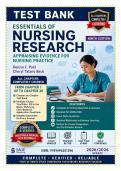
,TEST BANK FOR ESSENTIALS OF NURSING RESEARCH; APPRAISING EVIDENCE
FOR NURSING PRACTICE <NINTH EDITION> BY DENISE F. POLIT & CHERYL
TATANO BECK ALL CHAPTERS COMPLETELY COVERED (FROM CHAPTER 1 UPTO
CHAPTER 20) , ISBN: 9781496351296 |2026/2027 UPDATE |COMPLETE AND VERIFIED
QUESTIONS&ANSWERS WITH RATIONALES
SUMMARIZED EXAM COVERAGE (All Chapters)
Chapter 1: Introduction to Nursing Research and Evidence-Based Practice
Chapter 2: Fundamentals of Research Evidence
Chapter 3: Key Concepts and Steps in Qualitative and Quantitative Research
Chapter 4: Research Problems, Questions, and Hypotheses
Chapter 5: Literature Reviews
Chapter 6: Understanding and Critiquing Research Frameworks
Chapter 7: Ethics in Nursing Research
Chapter 8: Planning Research Studies
Chapter 9: Quantitative Research Designs
Chapter 10: Qualitative Research Designs
Chapter 11: Sampling in Quantitative and Qualitative Research
Chapter 12: Data Collection Methods
Chapter 13: Measurement and Data Quality
Chapter 14: Statistical Analysis in Quantitative Research
Chapter 15: Interpretation in Quantitative Research
Chapter 16: Analysis in Qualitative Research
Chapter 17: Trustworthiness and Integrity in Qualitative Research
Chapter 18: Mixed Methods and Other Special Designs
,Chapter 19: Systematic Reviews and Meta-Analysis
Chapter 20: Disseminating Evidence and Translating Research into Practice
CHAPTER 1: Introduction to Nursing Research and Evidence-Based Practice
Question 1: A newly graduated nurse wonders whether hourly rounding reduces falls on a
medical-surgical unit. Which type of inquiry would best answer this clinical question using
existing research evidence?
a) Tradition-based practice
b) Authority-based practice
c) Evidence-based practice
d) Trial-and-error learning
➢ Correct answer: c) Evidence-based practice
➢ Rationale: Evidence-based practice integrates research findings with clinical
expertise and patient preferences, unlike tradition or authority which lack
systematic evidence.
Question 2: During a staff meeting, a charge nurse states, "We have always turned patients
every two hours, so we should continue." This reflects which source of nursing knowledge?
a) Scientific research
b) Tradition
c) Intuition
d) Trial and error
, ➢ Correct answer: b) Tradition
➢ Rationale: Tradition relies on "the way it has always been done" without
questioning evidence, whereas scientific research systematically tests practices.
Question 3: A nurse manager reads a study showing that bedside shift report improves
patient satisfaction. Before changing unit policy, she evaluates the study's methods and
relevance. This process best describes:
a) Research utilization
b) Ritualistic practice
c) Personal experience
d) Intuitive decision-making
➢ Correct answer: a) Research utilization
➢ Rationale: Research utilization involves applying findings from specific studies to
practice, distinct from broader evidence-based practice which includes multiple
sources.
Question 4: A clinical nurse notices that diabetic patients who receive teach-back methods
have lower readmission rates. She decides to formally investigate this relationship. What is
her primary role as a nurse in research?
a) Consumer of research
b) Primary investigator
c) Research subject
d) Statistician
➢ Correct answer: a) Consumer of research
➢ Rationale: Most nurses are consumers who read and apply research findings,
though some become primary investigators; here she is consuming existing
observations to inform practice.
FOR NURSING PRACTICE <NINTH EDITION> BY DENISE F. POLIT & CHERYL
TATANO BECK ALL CHAPTERS COMPLETELY COVERED (FROM CHAPTER 1 UPTO
CHAPTER 20) , ISBN: 9781496351296 |2026/2027 UPDATE |COMPLETE AND VERIFIED
QUESTIONS&ANSWERS WITH RATIONALES
SUMMARIZED EXAM COVERAGE (All Chapters)
Chapter 1: Introduction to Nursing Research and Evidence-Based Practice
Chapter 2: Fundamentals of Research Evidence
Chapter 3: Key Concepts and Steps in Qualitative and Quantitative Research
Chapter 4: Research Problems, Questions, and Hypotheses
Chapter 5: Literature Reviews
Chapter 6: Understanding and Critiquing Research Frameworks
Chapter 7: Ethics in Nursing Research
Chapter 8: Planning Research Studies
Chapter 9: Quantitative Research Designs
Chapter 10: Qualitative Research Designs
Chapter 11: Sampling in Quantitative and Qualitative Research
Chapter 12: Data Collection Methods
Chapter 13: Measurement and Data Quality
Chapter 14: Statistical Analysis in Quantitative Research
Chapter 15: Interpretation in Quantitative Research
Chapter 16: Analysis in Qualitative Research
Chapter 17: Trustworthiness and Integrity in Qualitative Research
Chapter 18: Mixed Methods and Other Special Designs
,Chapter 19: Systematic Reviews and Meta-Analysis
Chapter 20: Disseminating Evidence and Translating Research into Practice
CHAPTER 1: Introduction to Nursing Research and Evidence-Based Practice
Question 1: A newly graduated nurse wonders whether hourly rounding reduces falls on a
medical-surgical unit. Which type of inquiry would best answer this clinical question using
existing research evidence?
a) Tradition-based practice
b) Authority-based practice
c) Evidence-based practice
d) Trial-and-error learning
➢ Correct answer: c) Evidence-based practice
➢ Rationale: Evidence-based practice integrates research findings with clinical
expertise and patient preferences, unlike tradition or authority which lack
systematic evidence.
Question 2: During a staff meeting, a charge nurse states, "We have always turned patients
every two hours, so we should continue." This reflects which source of nursing knowledge?
a) Scientific research
b) Tradition
c) Intuition
d) Trial and error
, ➢ Correct answer: b) Tradition
➢ Rationale: Tradition relies on "the way it has always been done" without
questioning evidence, whereas scientific research systematically tests practices.
Question 3: A nurse manager reads a study showing that bedside shift report improves
patient satisfaction. Before changing unit policy, she evaluates the study's methods and
relevance. This process best describes:
a) Research utilization
b) Ritualistic practice
c) Personal experience
d) Intuitive decision-making
➢ Correct answer: a) Research utilization
➢ Rationale: Research utilization involves applying findings from specific studies to
practice, distinct from broader evidence-based practice which includes multiple
sources.
Question 4: A clinical nurse notices that diabetic patients who receive teach-back methods
have lower readmission rates. She decides to formally investigate this relationship. What is
her primary role as a nurse in research?
a) Consumer of research
b) Primary investigator
c) Research subject
d) Statistician
➢ Correct answer: a) Consumer of research
➢ Rationale: Most nurses are consumers who read and apply research findings,
though some become primary investigators; here she is consuming existing
observations to inform practice.


