Chamberlain NR 565 Final Exam 2 – Advanced Pharmacology Actual Questions
and Answers (PDF).
NR 565 Advanced Pharmacology Final Exam Practice Bank
Table of Contents
Pharmacokinetics & Pharmacodynamics (1-20)
Cardiovascular & Renal Pharmacology (21-40)
Endocrine Pharmacology (41-65)
Neurology & Psychiatry (66-85)
Infectious Disease & Immunology (86-110)
Respiratory, GI, & Pain Management (111-130)
Special Populations & Evidence-Based Prescribing (131-150)
Select-All-That-Apply (SATA) Practice (151-170)
,SECTION 1: PHARMACOKINETICS & PHARMACODYNAMICS
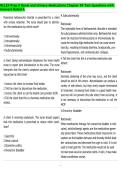
1. A patient is taking two drugs that are highly protein-bound (95% and 97%).
Which pharmacokinetic phenomenon is most likely to occur?
A) Decreased drug half-life
B) Drug displacement and increased free drug concentration
C) Increased drug excretion rate
D) Decreased drug absorption
Answer: B
Rationale: When two highly protein-bound drugs are administered, they compete
for binding sites on albumin. The drug with higher affinity displaces the other,
increasing the free (unbound) concentration of the displaced drug, potentially
leading to toxicity .
2. Drug X has a half-life of 12 hours. Approximately how long will it take to reach
steady state?
A) 24 hours
B) 36 hours
C) 48-60 hours
D) 72 hours
,Answer: C
Rationale: Steady state is achieved after approximately 4-5 half-lives of regular
dosing. For a 12-hour half-life: 4 x 12 = 48 hours; 5 x 12 = 60 hours .
3. A drug that is a strong CYP3A4 inducer would be expected to:
A) Increase the levels of other drugs metabolized by CYP3A4
B) Decrease the levels of other drugs metabolized by CYP3A4
C) Have no effect on drug metabolism
D) Increase its own metabolism only
Answer: B
Rationale: CYP3A4 inducers (e.g., rifampin, carbamazepine, St. John's Wort)
increase the synthesis of metabolic enzymes, leading to accelerated breakdown of
substrate drugs, reducing their serum concentrations and efficacy .
4. An APRN is prescribing a weak base with a pKa of 8.5. In which body
compartment will this drug primarily be absorbed?
A) Stomach (pH 1.5-2.0)
B) Small intestine (pH 6.0-7.5)
C) Blood (pH 7.35-7.45)
D) Adipose tissue
, Answer: B
Rationale: Weak bases are non-ionized (lipid-soluble) and thus well-absorbed in
alkaline environments. The small intestine has a higher pH, allowing the weak
base to remain non-ionized and cross membranes easily .
5. A patient with chronic kidney disease (eGFR 25 mL/min) requires a medication
that is primarily renally excreted. The APRN should:
A) Prescribe the standard dose
B) Increase the dose to reach therapeutic levels
C) Decrease the dose or increase the dosing interval
D) Avoid the medication entirely
Answer: C
Rationale: Reduced GFR impairs renal excretion. To prevent drug accumulation
and toxicity, the dose must be reduced or the interval prolonged based on the
patient's renal function .
6. A medication has a narrow therapeutic index (NTI). This means:
A) The drug has a wide margin of safety
B) Small changes in dose can lead to toxicity or inefficacy
C) The drug is only available intravenously
and Answers (PDF).
NR 565 Advanced Pharmacology Final Exam Practice Bank
Table of Contents
Pharmacokinetics & Pharmacodynamics (1-20)
Cardiovascular & Renal Pharmacology (21-40)
Endocrine Pharmacology (41-65)
Neurology & Psychiatry (66-85)
Infectious Disease & Immunology (86-110)
Respiratory, GI, & Pain Management (111-130)
Special Populations & Evidence-Based Prescribing (131-150)
Select-All-That-Apply (SATA) Practice (151-170)
,SECTION 1: PHARMACOKINETICS & PHARMACODYNAMICS
1. A patient is taking two drugs that are highly protein-bound (95% and 97%).
Which pharmacokinetic phenomenon is most likely to occur?
A) Decreased drug half-life
B) Drug displacement and increased free drug concentration
C) Increased drug excretion rate
D) Decreased drug absorption
Answer: B
Rationale: When two highly protein-bound drugs are administered, they compete
for binding sites on albumin. The drug with higher affinity displaces the other,
increasing the free (unbound) concentration of the displaced drug, potentially
leading to toxicity .
2. Drug X has a half-life of 12 hours. Approximately how long will it take to reach
steady state?
A) 24 hours
B) 36 hours
C) 48-60 hours
D) 72 hours
,Answer: C
Rationale: Steady state is achieved after approximately 4-5 half-lives of regular
dosing. For a 12-hour half-life: 4 x 12 = 48 hours; 5 x 12 = 60 hours .
3. A drug that is a strong CYP3A4 inducer would be expected to:
A) Increase the levels of other drugs metabolized by CYP3A4
B) Decrease the levels of other drugs metabolized by CYP3A4
C) Have no effect on drug metabolism
D) Increase its own metabolism only
Answer: B
Rationale: CYP3A4 inducers (e.g., rifampin, carbamazepine, St. John's Wort)
increase the synthesis of metabolic enzymes, leading to accelerated breakdown of
substrate drugs, reducing their serum concentrations and efficacy .
4. An APRN is prescribing a weak base with a pKa of 8.5. In which body
compartment will this drug primarily be absorbed?
A) Stomach (pH 1.5-2.0)
B) Small intestine (pH 6.0-7.5)
C) Blood (pH 7.35-7.45)
D) Adipose tissue
, Answer: B
Rationale: Weak bases are non-ionized (lipid-soluble) and thus well-absorbed in
alkaline environments. The small intestine has a higher pH, allowing the weak
base to remain non-ionized and cross membranes easily .
5. A patient with chronic kidney disease (eGFR 25 mL/min) requires a medication
that is primarily renally excreted. The APRN should:
A) Prescribe the standard dose
B) Increase the dose to reach therapeutic levels
C) Decrease the dose or increase the dosing interval
D) Avoid the medication entirely
Answer: C
Rationale: Reduced GFR impairs renal excretion. To prevent drug accumulation
and toxicity, the dose must be reduced or the interval prolonged based on the
patient's renal function .
6. A medication has a narrow therapeutic index (NTI). This means:
A) The drug has a wide margin of safety
B) Small changes in dose can lead to toxicity or inefficacy
C) The drug is only available intravenously