

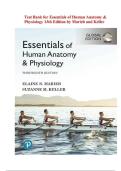
Marieb Essentials of Human Anatomy & Physiology 13e Test Bank (Latest 2022/2026 Pearson Edition Study Guide Bundle) All chapters 1- 16 included
Ace Your A&P Course: The Ultimate Chapter-by-Chapter Examination Resource Mastering the vast vocabulary, intricate structural frameworks, and complex physiological feedback loops of the human body is the single largest hurdle for students in one-semester Anatomy and Physiology (A&P) courses. Whether you are pursuing a career in nursing, physical therapy, radiologic technology, or athletic training, your academic success hinges on your ability to predict and conquer your professor’s exam style. This Complete Test Bank for Essentials of Human Anatomy & Physiology, 13th Edition by Elaine N. Marieb and Suzanne M. Keller is a premium, professionally curated educational resource designed to elevate your study efficiency. Built directly from the official 13th edition textbook blueprint published by Pearson, this comprehensive test bank contains hundreds of rigorously verified questions, definitive answer keys, and structural explanations. It is the ultimate tool to guide your active recall, reinforce your lecture notes, and guarantee top-tier grades on every unit exam and your final cumulative test. Why the 13th Edition Test Bank is Essential for Your Preparation The 13th edition of the Marieb & Keller text introduces critical, three-dimensional updates to anatomical line art, structural subsections, and integrated clinical correlations such as homeostatic imbalances. This test bank reflects every single one of those conceptual shifts. Instead of passively reading your textbook over and over, utilizing a dedicated test bank allows you to practice active testing simulation. This format forces your brain to retrieve information under pressure, exposing your individual cognitive gaps before you sit down for the actual graded exam. Diverse Question Formats to Build Testing Stamina: Conceptual Multiple-Choice Questions: Designed to test your mastery of complex anatomical positioning, directional terms, and biochemical pathways. Rigorous True or False Drills: Perfect for sharpening your eye against tricky phrasing, vocabulary traps, and subtle physiological nuances. Interactive Matching Columns: Tailored to mimic laboratory identification exams, linking specific cellular structures, tissues, bones, or hormones with their precise physiological functions. Essay and Short-Answer Prompts: Providing advanced analytical practice for explaining complex mechanisms like muscle fiber contraction, action potentials, or blood filtration. Comprehensive Chapter-by-Chapter Breakdown Included This complete download is meticulously organized by chapter, allowing you to seamlessly study in lockstep with your course syllabus, lecture schedule, or weekly reading assignments. Chapter 1: The Human Body: An Orientation Lay an unbreakable foundation by mastering the architectural basics of the human organism. Test bank items focus heavily on: Levels of structural organization (chemical, cellular, tissue, organ, organ system, organismal). Precise anatomical terminology, directional terms (superior, deep, proximal), body planes (sagittal, frontal, transverse), and body cavities. Homeostatic regulatory mechanisms, comparing negative feedback loops (such as body temperature and blood pressure maintenance) with rare positive feedback cascades (like blood clotting and labor contractions). Chapter 2: Basic Chemistry Bridge the gap between molecular interactions and macro-level physiology. This section evaluates: Atomic structure, chemical bonds (ionic, covalent, hydrogen), and the vital role of ATP as cellular energy currency. Inorganic compounds (the unique biological properties of water, salts, acids, and bases) and pH scale mechanics. The structure and function of the four major organic macromolecule classes: carbohydrates, lipids, proteins (including enzyme specificity), and nucleic acids (DNA and RNA). Chapter 3: Cells and Tissues Master the microscopic building blocks of life. Test your understanding of: Anatomy of the plasma membrane, cytoplasm, and specialized organelles (mitochondria, ribosomes, lysosomes). Membrane transport systems, distinguishing between passive processes (diffusion, osmosis) and active transport mechanisms (sodium-potassium pumps, vesicular transport). Cell division (mitosis vs. cytokinesis) and a deep-dive identification guide into epithelial, connective, muscle, and nervous tissues. Chapter 4: Skin and Body Membranes Conquer the body's first line of defense. Focus areas include: Classification of epithelial membranes (cutaneous, mucous, serous) and connective synovial membranes. Detailed layers of the integumentary system: the specific strata of the epidermis (corneum, lucidum, granulosum, spinosum, basale) and the papillary/reticular layers of the dermis. Homeostatic imbalances of the skin, including clinical classifications of burns (first-, second-, and third-degree) and skin cancer identification guidelines (the ABCD rule). Chapter 5: The Skeletal System Build a robust structural vocabulary. This chapter provides exhaustive labeling and conceptual help for: Bone histomorphology: compact vs. spongy bone, osteocytes, osteoblasts, osteoclasts, and the Haversian system. Gross anatomy of the axial skeleton (skull, vertebral column, bony thorax) and the appendicular skeleton (pectoral girdle, upper limbs, pelvic girdle, lower limbs). The mechanics of bone growth, remodeling, and fracture repair, alongside a functional classification of structural joints. Chapter 6: The Muscular System Understand how microscopic filaments generate macroscopic force. Key topics include: Microscopic anatomy of skeletal muscle fibers, detailing sarcomeres, myofilaments (actin and myosin), and the sarcoplasmic reticulum. The Sliding Filament Theory: role of calcium ions, acetylcholine (ACh) at the neuromuscular junction, and action potential propagation. Skeletal muscle movements, origins, insertions, and prime movers vs. antagonists. Chapter 7: The Nervous System Master the master control and communication center of the body. Test questions deeply explore: Structural (CNS vs. PNS) and functional (Sensory vs. Motor, Somatic vs. Autonomic) divisions of the nervous system. Neuron anatomy, neuroglia, nerve impulse transmission, action potential generation, and synaptic transmission. Gross anatomy of the brain (cerebrum, diencephalon, brain stem, cerebellum), protection of the CNS (meninges, cerebrospinal fluid), and spinal cord pathways. Chapter 8: Special Senses Unpack the mechanics of human environmental perception. This module tests: Anatomy of the eye, light refraction pathways, photoreceptors (rods and cones), and common visual imbalances (myopia, hyperopia). Anatomy of the ear, mechanics of equilibrium (static vs. dynamic), and the physiological translation of sound waves into neural signals in the cochlea. Chapter 9: The Endocrine System Understand slow-acting chemical messengers. Key evaluations focus on: Hormone action mechanisms (amino acid-based vs. steroid direct gene activation). The major endocrine organs: pituitary, thyroid, parathyroid, adrenal, pineal, and thymus glands, plus the pancreas and gonads. Feedback loops controlling hormone release and clinical manifestations of hypo- or hypersecretion (e.g., diabetes mellitus, hyperthyroidism). Chapter 10: Blood Master the fluid tissue of the cardiovascular system. Focus on: Composition of blood plasma and the structural characteristics/functions of formed elements (erythrocytes, leukocytes, platelets). The multi-step process of hemostasis (vascular spasms, platelet plug formation, coagulation). Human blood groups (ABO and Rh factors) and the clinical consequences of transfusion reactions. Chapter 11: The Cardiovascular System Conquer the complex mechanics of the heart and vasculature. This critical section provides mastery over: Gross anatomy of the heart, internal chambers, valves, and the microscopic structure of cardiac muscle. The pathway of blood flow through the pulmonary and systemic circuits. The intrinsic conduction system of the heart, electrocardiogram (ECG) wave interpretations, cardiac cycle phases, and blood pressure dynamics. Chapter 12: The Lymphatic System and Body Defenses Understand fluid balance and immune warfare. Key themes: Structure and function of lymphatic vessels, lymph nodes, the spleen, and tonsils. Innate (nonspecific) body defenses, including surface barriers, phagocytes, natural killer cells, and the inflammatory response. Adaptive (specific) body defenses: humoral immunity (B cells and antibody production) and cellular immunity (T cells). Chapter 13: The Respiratory System Analyze the gas exchange network. Test materials highlight: Functional anatomy of the respiratory passageways (nasal cavity, pharynx, larynx, trachea, bronchi, and the microscopic alveoli). Mechanics of pulmonary ventilation (inspiration and expiration via pressure volume shifts). Gas transport in the blood (oxygen and carbon dioxide exchange) and neural regulation of respiration rates. Premium Product Benefits Instant Structural Clarity: No missing pages or skipped chapters. You receive a complete, pristine digital archive encompassing the entire textbook course. Verified Accuracy: Every question is paired with its verified correct answer, saving you hours of frantic searching through lecture slides or web search engines. Optimized for Quick Retrieval: Clean layout, bolded key terms, and uniform structure make this text highly scannable for rapid-fire review sessions right before exam day. Invest in your future clinical career today. Download the complete Marieb & Keller Essentials of Human Anatomy & Physiology 13th Edition Test Bank, streamline your remediation sessions, and earn the competitive GPA you need for professional healthcare placement!
Document information
- Uploaded on
- June 4, 2026
- Number of pages
- 591
- Written in
- 2025/2026
- Type
- Exam (elaborations)
- Contains
- Questions & answers


