
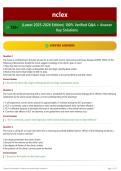
nclex
(Latest 2025-2026 Edition) 100% Verified Q&A + Answer
120+
Key Solutions
VERIFIED ANSWERS
Question 1
The nurse is contributing to the plan of care for a client with chronic obstructive pulmonary disease (COPD). Which of the
following interventions should the nurse suggest including in the client's plan of care?
1.Place the client in low-Fowler's position for meals.
2.Provide the client with a high-carbohydrate diet and high-carbohydrate snacks.
3.Restrict the client's fluid intake to 500 mL daily.
4.Provide the client with small, frequent meals, and schedule a rest period before and after meals.
Correct Answer
2.Provide the client with a high-carbohydrate diet and high-carbohydrate snacks.
Question 2
The nurse has reinforced teaching with a client who is scheduled for electroconvulsive therapy (ECT). Which of the following
statements by the client would indicate a correct understanding of the teaching?
1."I will experience a tonic-clonic seizure for approximately 15 minutes during the ECT procedure."
2."ECT is commonly used to treat depression when several antidepressants have not been effective."
3."ECT is effective because it decreases the level of neurotransmitters in the central nervous system."
4."Common side effects of ECT are diarrhea, a low-grade fever and short-term memory loss."
Correct Answer
2. "ECT is commonly used to treat depression when several antidepressants have not been effective."
Question 3
The nurse is caring for a 6-year-old client who is receiving prescribed skeletal traction. Which of the following would be a
priority for the nurse to monitor?
1.the distance between the client's knees
2.the pull of the traction on the client's pins
3.the degree of flexion of the client's ankles
4.the position of the client's cervical spine on the bed
Correct Answer
2 the pull of the traction on the client's pins
Trusted by thousands of students and professionals worldwide Page 1 of 32
,Question 4
The nurse is caring for a client with dysthymic disorder. Which of the following behaviors would the nurse expect to
observe?
1.grandiose actions
2.reports of auditory hallucinations
3.expansive, pressured speech
4.inability to experience joy or pleasure in life
Correct Answer
4.inability to experience joy or pleasure in life
Question 5
The nurse is caring for a client. Which of the following prescriptions should the nurse clarify? Click the exhibit button for
additional client information.
1.2 g sodium diet
2.implement bed rest
3.furosemide 20 mg, p.o., once daily
4.enalapril 5 mg, p.o., twice daily
Correct Answer
3.furosemide 20 mg, p.o., once daily
Question 6
The nurse is talking with the spouse of a client with left-sided hemiplegia. The spouse tells the nurse, "I scheduled this
appointment because I noticed a sore had developed on my spouse's hip. I feel so guilty because I caused this to happen. I
do not know what to do." Which of the following would be an appropriate initial r esponse for the nurse to make?
1."Have you been offering your spouse fluids at regular time intervals?"
2."How often do you change your spouse's position?"
3."The type of care that you have undertaken is not easy."
4."We will make sure that you have help if this requires special dressings."
Correct Answer
3."The type of care that you have undertaken is not easy."
Question 7
The nurse is assisting to admit a client who has Streptococcal pharyngitis. Which of the following actions should the nurse
take?
1.Wear a surgical mask when checking the client's vital signs.
2.Ensure the assigned room has monitored negative air pressure.
3.Obtain particulate respirator masks for staff members to use when providing client care.
4.Request the dietary department provide disposable dishes and utensils for the client's meals.
Correct Answer
4.Request the dietary department provide disposable dishes and utensils for the client's meals.
Trusted by thousands of students and professionals worldwide Page 2 of 32
,Question 8
The nurse is reinforcing teaching with the parents of a child who is scheduled for surgical repair of hypospadias. The nurse
should reinforce that intended outcomes of the procedure include
1.relief from pain
2.relief from bladder obstruction
3.the ability to void while standing
4.the ability to achieve an erection
Correct Answer
3.the ability to void while standing
Question 9
The nurse has reinforced teaching with a client who is receiving prescribed alendronate. Which of the following statements
by the client would indicate a correct understanding of the teaching?
1."I should take the medication with orange juice."
2."I can take the medication at any time of day."
3."I will avoid taking over-the-counter (OTC) vitamin D supplements."
4."I must sit upright for 30 minutes after taking the medication."
Correct Answer
4. "I must sit upright for 30 minutes after taking the medication."
Question 10
The nurse is caring for a 12-year-old client who has a prescription for lorazepam 0.05 mg/kg, p.o., stat. The client weighs
103 lb (47 kg). The nurse has 2 mg/mL of solution available. How many milliliters should the nurse administer to the client?
Record your answer using one decimal place.
Correct Answer
0.05mg/kgXx/47X2mg/ml=
Question 11
The nurse has reinforced discharge teaching with the parent of a newborn. Which of the following statements by the parent
would require follow-up?
1."I will leave my baby's diaper off when possible if the diaper area starts to become red."
2."I will secure my baby in a rear-facing infant seat in the front seat of the car since there is an airbag there."
3."I should give my baby a pacifier at bedtime to reduce the risk for sudden infant death syndrome (SIDS)."
4."I should squeeze the bulb syringe before inserting it into my baby's mouth when I suction excess secretions."
Correct Answer
3."I should give my baby a pacifier at bedtime to reduce the risk for sudden infant death syndrome (SIDS)."
Trusted by thousands of students and professionals worldwide Page 3 of 32
, Question 12
The nurse is caring for a client with pediculosis. Which of the following infection control precautions should the nurse
implement?
1.Place a thermometer in the client's room to be used with that client only.
2.Wear a surgical mask when assisting the client to bathe.
3.Keep the door to the client's room closed.
4.Remove the gloves after leaving the client's room.
Correct Answer
1.Place a thermometer in the client's room to be used with that client only.
Question 13
The charge nurse in a long-term care facility has completed client care assignments for unlicensed assistive personnel (UAP).
Which of the following statements by the charge nurse would provide the best directions to a UAP regarding the
assignment?
1."Record your assigned clients' vital signs before you take a mid-morning break."
2."Weigh your assigned clients before breakfast with the scale used 1 day ago."
3."Help the clients who eat their meals in the dining room with breakfast."
4."Measure your assigned clients' intake and output regularly."
Correct Answer
2."Weigh your assigned clients before breakfast with the scale used 1 day ago."
Question 14
The nurse in a long-term care facility is making client care assignments for unlicensed assistive personnel (UAP). Which of
the following statements by the nurse would provide UAP with the best directions for the assignment?
1."Clients who are able to ambulate should be assisted to ambulate after meals."
2."Notify me if any client develops an abnormal temperature."
3."Check the meal trays distributed to clients with diabetes mellitus (type 1)."
4."Obtain vital signs first for the client with hypertension and report the results to me."
Correct Answer
1."Clients who are able to ambulate should be assisted to ambulate after meals."
Question 15
The nurse in an outpatient facility has collected the following data regarding the clients' concerns. The nurse should place in
a private room first the client with
1.a productive cough with night sweats
2.diabetes mellitus (type 1) with tingling in both feet
3.red eyes with moderate tearing
4.emphysema with clubbing of the fingernails
Correct Answer
1.a productive cough with night sweats
Trusted by thousands of students and professionals worldwide Page 4 of 32
(Latest 2025-2026 Edition) 100% Verified Q&A + Answer
120+
Key Solutions
VERIFIED ANSWERS
Question 1
The nurse is contributing to the plan of care for a client with chronic obstructive pulmonary disease (COPD). Which of the
following interventions should the nurse suggest including in the client's plan of care?
1.Place the client in low-Fowler's position for meals.
2.Provide the client with a high-carbohydrate diet and high-carbohydrate snacks.
3.Restrict the client's fluid intake to 500 mL daily.
4.Provide the client with small, frequent meals, and schedule a rest period before and after meals.
Correct Answer
2.Provide the client with a high-carbohydrate diet and high-carbohydrate snacks.
Question 2
The nurse has reinforced teaching with a client who is scheduled for electroconvulsive therapy (ECT). Which of the following
statements by the client would indicate a correct understanding of the teaching?
1."I will experience a tonic-clonic seizure for approximately 15 minutes during the ECT procedure."
2."ECT is commonly used to treat depression when several antidepressants have not been effective."
3."ECT is effective because it decreases the level of neurotransmitters in the central nervous system."
4."Common side effects of ECT are diarrhea, a low-grade fever and short-term memory loss."
Correct Answer
2. "ECT is commonly used to treat depression when several antidepressants have not been effective."
Question 3
The nurse is caring for a 6-year-old client who is receiving prescribed skeletal traction. Which of the following would be a
priority for the nurse to monitor?
1.the distance between the client's knees
2.the pull of the traction on the client's pins
3.the degree of flexion of the client's ankles
4.the position of the client's cervical spine on the bed
Correct Answer
2 the pull of the traction on the client's pins
Trusted by thousands of students and professionals worldwide Page 1 of 32
,Question 4
The nurse is caring for a client with dysthymic disorder. Which of the following behaviors would the nurse expect to
observe?
1.grandiose actions
2.reports of auditory hallucinations
3.expansive, pressured speech
4.inability to experience joy or pleasure in life
Correct Answer
4.inability to experience joy or pleasure in life
Question 5
The nurse is caring for a client. Which of the following prescriptions should the nurse clarify? Click the exhibit button for
additional client information.
1.2 g sodium diet
2.implement bed rest
3.furosemide 20 mg, p.o., once daily
4.enalapril 5 mg, p.o., twice daily
Correct Answer
3.furosemide 20 mg, p.o., once daily
Question 6
The nurse is talking with the spouse of a client with left-sided hemiplegia. The spouse tells the nurse, "I scheduled this
appointment because I noticed a sore had developed on my spouse's hip. I feel so guilty because I caused this to happen. I
do not know what to do." Which of the following would be an appropriate initial r esponse for the nurse to make?
1."Have you been offering your spouse fluids at regular time intervals?"
2."How often do you change your spouse's position?"
3."The type of care that you have undertaken is not easy."
4."We will make sure that you have help if this requires special dressings."
Correct Answer
3."The type of care that you have undertaken is not easy."
Question 7
The nurse is assisting to admit a client who has Streptococcal pharyngitis. Which of the following actions should the nurse
take?
1.Wear a surgical mask when checking the client's vital signs.
2.Ensure the assigned room has monitored negative air pressure.
3.Obtain particulate respirator masks for staff members to use when providing client care.
4.Request the dietary department provide disposable dishes and utensils for the client's meals.
Correct Answer
4.Request the dietary department provide disposable dishes and utensils for the client's meals.
Trusted by thousands of students and professionals worldwide Page 2 of 32
,Question 8
The nurse is reinforcing teaching with the parents of a child who is scheduled for surgical repair of hypospadias. The nurse
should reinforce that intended outcomes of the procedure include
1.relief from pain
2.relief from bladder obstruction
3.the ability to void while standing
4.the ability to achieve an erection
Correct Answer
3.the ability to void while standing
Question 9
The nurse has reinforced teaching with a client who is receiving prescribed alendronate. Which of the following statements
by the client would indicate a correct understanding of the teaching?
1."I should take the medication with orange juice."
2."I can take the medication at any time of day."
3."I will avoid taking over-the-counter (OTC) vitamin D supplements."
4."I must sit upright for 30 minutes after taking the medication."
Correct Answer
4. "I must sit upright for 30 minutes after taking the medication."
Question 10
The nurse is caring for a 12-year-old client who has a prescription for lorazepam 0.05 mg/kg, p.o., stat. The client weighs
103 lb (47 kg). The nurse has 2 mg/mL of solution available. How many milliliters should the nurse administer to the client?
Record your answer using one decimal place.
Correct Answer
0.05mg/kgXx/47X2mg/ml=
Question 11
The nurse has reinforced discharge teaching with the parent of a newborn. Which of the following statements by the parent
would require follow-up?
1."I will leave my baby's diaper off when possible if the diaper area starts to become red."
2."I will secure my baby in a rear-facing infant seat in the front seat of the car since there is an airbag there."
3."I should give my baby a pacifier at bedtime to reduce the risk for sudden infant death syndrome (SIDS)."
4."I should squeeze the bulb syringe before inserting it into my baby's mouth when I suction excess secretions."
Correct Answer
3."I should give my baby a pacifier at bedtime to reduce the risk for sudden infant death syndrome (SIDS)."
Trusted by thousands of students and professionals worldwide Page 3 of 32
, Question 12
The nurse is caring for a client with pediculosis. Which of the following infection control precautions should the nurse
implement?
1.Place a thermometer in the client's room to be used with that client only.
2.Wear a surgical mask when assisting the client to bathe.
3.Keep the door to the client's room closed.
4.Remove the gloves after leaving the client's room.
Correct Answer
1.Place a thermometer in the client's room to be used with that client only.
Question 13
The charge nurse in a long-term care facility has completed client care assignments for unlicensed assistive personnel (UAP).
Which of the following statements by the charge nurse would provide the best directions to a UAP regarding the
assignment?
1."Record your assigned clients' vital signs before you take a mid-morning break."
2."Weigh your assigned clients before breakfast with the scale used 1 day ago."
3."Help the clients who eat their meals in the dining room with breakfast."
4."Measure your assigned clients' intake and output regularly."
Correct Answer
2."Weigh your assigned clients before breakfast with the scale used 1 day ago."
Question 14
The nurse in a long-term care facility is making client care assignments for unlicensed assistive personnel (UAP). Which of
the following statements by the nurse would provide UAP with the best directions for the assignment?
1."Clients who are able to ambulate should be assisted to ambulate after meals."
2."Notify me if any client develops an abnormal temperature."
3."Check the meal trays distributed to clients with diabetes mellitus (type 1)."
4."Obtain vital signs first for the client with hypertension and report the results to me."
Correct Answer
1."Clients who are able to ambulate should be assisted to ambulate after meals."
Question 15
The nurse in an outpatient facility has collected the following data regarding the clients' concerns. The nurse should place in
a private room first the client with
1.a productive cough with night sweats
2.diabetes mellitus (type 1) with tingling in both feet
3.red eyes with moderate tearing
4.emphysema with clubbing of the fingernails
Correct Answer
1.a productive cough with night sweats
Trusted by thousands of students and professionals worldwide Page 4 of 32


