
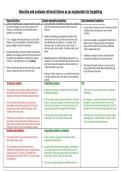
Describe and evaluate retrieval failure as an explanation for forgetting
Retrieval failure Context depending forgetting State dependent forgetting
A form of forgetting which happened when we don’t Occurs when the environment during recall is different
have the necessary cues to access memory. The from the environment you were in when you were Occurs when the state you were in when you learnt
memory is available but not accessible unless a learning. is different from the state you were in when
suitable cue is provided. recalling.
Godden and baddley investigated the effect of the
Cue – a trigger of into that allows us to access the environment on recall. 18 divers from a diving club Carter and cassaday- investigated the effect of p’s
memory, can be meaningful or indirectly linked by were divided into 4 conditions. 1) Learning –land, state on recall. They gave them anti histamine
being encoded at the time of learning. recalling - land, 2) learning- land, recall- water, 3) drugs, which made them feel drowsy (different
learning- water, recall- water, 4) leaning- land, recall- state to awake and alert).
Encoding specificity principle- greater the similarity water.
between the encoding event and the retrieval event 4 different conditions. Results showed that the
the greater the likelihood of recalling the original Repeated measures- all participants took place in 4 mismatched conditions on recall were worse.
memory, if not forgetting occurs- by tulving. condtions. They were presented with 38 words, which
they heard twice then asked to write all words they This shows that state acted as a cue to recall as
When encoding memory we store info that occurred could remember in any order. they recalled more words when the learning and
around it (place we were in or how we felt) recall state were the same.
Findings- Context acted as a cue, recalled more words
if context was the same, 40% lower in non matching
context.
Ecological validity Supporting studies RLA
This study has low ecological validity as the tasks Research by Abernathy supports the idea of context This can be used to improve recall in eyewitness
were artificial and the groups who learned and depending forgetting. testimonies.
recalled in different environments were disrupted.
This was shown when students were found to perform For example, in cognitive interviews the witnesses
This was shown when tasks such as learning better in tests that took place I the same room as the are asked to describe the context in which the
meaningless words were used and divers had to learning of the material and were administer by the incident they have witnessed took place. This will
change environments unlike the groups, which same instructed who had taught the information. help them recall more information about the event.
recalled in the same ones.
Therefore, this increases the validity of the Therefore, this is a strength of the retrieval failure
Therefore we are unable to conclude that the divers explanation, as it is a real life study as well. explanation as it improves EWT in real life, which
were able to recall more due to contextual cues, as will help decrease wrong testimonies.
there could have been other factors that could have
influenced recall so it has low ecological validity.
Godden and baddeley Supporting evidence- Goodwin
The context effect may be related to the kind of There is research support for the effect of state
information being tested. dependent retrieval failure.
This was shown when they replicated the Goodwin who asked male participants to remember a
underwater experiment but used a recognition test list of words when they were either drunk or sober
instead of recall- p’s had to say whether they showed this. They were then asked to recall them 24
recognized a word read to them on the list instead hours later in either a drunk or sober state,
of retrieving it.
The results support godden and baddleys study as
Retrieval failure Context depending forgetting State dependent forgetting
A form of forgetting which happened when we don’t Occurs when the environment during recall is different
have the necessary cues to access memory. The from the environment you were in when you were Occurs when the state you were in when you learnt
memory is available but not accessible unless a learning. is different from the state you were in when
suitable cue is provided. recalling.
Godden and baddley investigated the effect of the
Cue – a trigger of into that allows us to access the environment on recall. 18 divers from a diving club Carter and cassaday- investigated the effect of p’s
memory, can be meaningful or indirectly linked by were divided into 4 conditions. 1) Learning –land, state on recall. They gave them anti histamine
being encoded at the time of learning. recalling - land, 2) learning- land, recall- water, 3) drugs, which made them feel drowsy (different
learning- water, recall- water, 4) leaning- land, recall- state to awake and alert).
Encoding specificity principle- greater the similarity water.
between the encoding event and the retrieval event 4 different conditions. Results showed that the
the greater the likelihood of recalling the original Repeated measures- all participants took place in 4 mismatched conditions on recall were worse.
memory, if not forgetting occurs- by tulving. condtions. They were presented with 38 words, which
they heard twice then asked to write all words they This shows that state acted as a cue to recall as
When encoding memory we store info that occurred could remember in any order. they recalled more words when the learning and
around it (place we were in or how we felt) recall state were the same.
Findings- Context acted as a cue, recalled more words
if context was the same, 40% lower in non matching
context.
Ecological validity Supporting studies RLA
This study has low ecological validity as the tasks Research by Abernathy supports the idea of context This can be used to improve recall in eyewitness
were artificial and the groups who learned and depending forgetting. testimonies.
recalled in different environments were disrupted.
This was shown when students were found to perform For example, in cognitive interviews the witnesses
This was shown when tasks such as learning better in tests that took place I the same room as the are asked to describe the context in which the
meaningless words were used and divers had to learning of the material and were administer by the incident they have witnessed took place. This will
change environments unlike the groups, which same instructed who had taught the information. help them recall more information about the event.
recalled in the same ones.
Therefore, this increases the validity of the Therefore, this is a strength of the retrieval failure
Therefore we are unable to conclude that the divers explanation, as it is a real life study as well. explanation as it improves EWT in real life, which
were able to recall more due to contextual cues, as will help decrease wrong testimonies.
there could have been other factors that could have
influenced recall so it has low ecological validity.
Godden and baddeley Supporting evidence- Goodwin
The context effect may be related to the kind of There is research support for the effect of state
information being tested. dependent retrieval failure.
This was shown when they replicated the Goodwin who asked male participants to remember a
underwater experiment but used a recognition test list of words when they were either drunk or sober
instead of recall- p’s had to say whether they showed this. They were then asked to recall them 24
recognized a word read to them on the list instead hours later in either a drunk or sober state,
of retrieving it.
The results support godden and baddleys study as


