ATI Leadership & Management Exam Review | 2026/2027
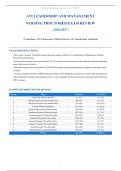
ATI LEADERSHIP AND MANAGEMENT
NURSING PROCTORED EXAM REVIEW
| 2026/2027 |
70 Questions | NGN-Integrated | Official Elsevier ATI Specification Alignment
EXAM SPECIFICATIONS
• This review contains 70 multiple-choice questions aligned with the ATI Leadership and Management Nursing
Proctored Exam blueprint.
• Each question includes four answer options (A–D), a bold cyan correct answer, and a detailed rationale explaining
correct and incorrect choices.
• Questions integrate Next Generation NCLEX (NGN) format including prioritization, delegation, and multi-client
scenarios.
• Content is aligned with the NCSBN Detailed Test Plan, ANA Standards, and Elsevier ATI test bank specifications.
• Recommended: Complete each domain section, review rationales for incorrect answers, and repeat until achieving
≥90% accuracy.
SCORE DISTRIBUTION BY DOMAIN
Domain Topic Questions % of Exam
1 Leadership Theories & Styles Q1–Q5 5 (7.1%)
2 Management Functions & Org Structure Q6–Q10 5 (7.1%)
3 Delegation & Supervision Fundamentals Q11–Q20 10 (14.3%)
4 Legal & Ethical Foundations Q21–Q28 8 (11.4%)
5 Quality Improvement & Patient Safety Q29–Q36 8 (11.4%)
6 Healthcare Finance & Resource Mgmt Q37–Q41 5 (7.1%)
7 Communication & Conflict Resolution Q42–Q47 6 (8.6%)
8 Change Management & Innovation Q48–Q52 5 (7.1%)
9 Strategic Planning & Healthcare Policy Q53–Q56 4 (5.7%)
10 Cultural Competence & Health Equity Q57–Q60 4 (5.7%)
11 Interprofessional Team Dynamics Q61–Q65 5 (7.1%)
12 Documentation & Legal Defensibility Q66–Q70 5 (7.1%)
TOTAL Q1–Q70 70 (100%)
1
, ATI Leadership & Management Exam Review | 2026/2027
DOMAIN 1: Leadership Theories & Styles (Q1–Q5)
1. A nurse manager on a medical-surgical unit regularly holds one-on-one meetings with staff to discuss professional
goals, provides individualized coaching, and empowers nurses to take on unit-based projects. This approach is best
described as which leadership style?
A) Autocratic leadership
B) Transformational leadership
C) Laissez-faire leadership
D) Transactional leadership
Correct Answer: B) Transformational leadership
Rationale: Transformational leadership inspires and empowers followers to exceed expectations through individualized consideration,
intellectual stimulation, inspirational motivation, and idealized influence. Autocratic leadership relies on top-down control; laissez-faire
provides minimal guidance; transactional leadership uses rewards/punishments to maintain the status quo.
2. A charge nurse tells the nursing assistant, "If you complete all vital signs by 0800, I will make sure you get your
preferred lunch break." Which type of power is the charge nurse primarily using?
A) Legitimate power B) Coercive power
C) Referent power D) Reward power
Correct Answer: D) Reward power
Rationale: Reward power is based on the ability to provide incentives or benefits for compliance. Legitimate power derives from formal
position authority; coercive power relies on fear of punishment; referent power stems from personal admiration and respect. Offering a
preferred break in exchange for timely task completion is a classic example of reward-based influence.
3. A nurse leader who assesses the readiness and developmental level of each staff member and adapts their leadership
approach accordingly is applying which leadership theory?
A) Situational Leadership Theory
B) Great Man Theory
C) Quantum Leadership Theory
D) Trait Theory
Correct Answer: A) Situational Leadership Theory
Rationale: Hersey and Blanchard's Situational Leadership Theory proposes that effective leadership requires matching the leader's style
(directing, coaching, supporting, delegating) to the follower's readiness/maturity level. Great Man Theory suggests leaders are born, not
made; Quantum Leadership addresses the complexity of modern healthcare; Trait Theory focuses on inherent leader characteristics.
4. A new graduate nurse respects and seeks guidance from an experienced ICU nurse who is known for clinical
expertise. The new nurse follows recommendations because of the experienced nurse's knowledge. This exemplifies
which type of power?
A) Legitimate power B) Coercive power
C) Expert power D) Referent power
Correct Answer: C) Expert power
Rationale: Expert power is derived from specialized knowledge, skills, and competence. The new graduate seeks the experienced nurse's
guidance specifically because of their clinical expertise, not because of a formal position (legitimate), personal admiration (referent), or
fear of punishment (coercive). Expert power is highly valued in nursing and is earned over time through demonstrated competence.
2
, ATI Leadership & Management Exam Review | 2026/2027
5. A nurse manager who says, "I am the charge nurse, and on this unit, we follow my orders exactly as given," is
demonstrating which leadership style?
A) Democratic leadership
B) Servant leadership
C) Autocratic leadership
D) Transformational leadership
Correct Answer: C) Autocratic leadership
Rationale: Autocratic leadership (also called authoritarian) is characterized by centralized decision-making with minimal input from
subordinates. The leader retains all authority and expects strict compliance. While sometimes necessary in emergencies, this style
generally reduces staff morale and job satisfaction. Democratic leadership solicits input; servant leadership prioritizes follower needs;
transformational leadership inspires growth.
DOMAIN 2: Management Functions & Organizational Structure (Q6–Q10)
6. A nurse manager is developing the unit's annual staffing schedule, identifying required nursing competencies, and
projecting budgetary needs for the upcoming fiscal year. Which management function is primarily being demonstrated?
A) Controlling B) Organizing
C) Planning D) Directing
Correct Answer: C) Planning
Rationale: Planning involves setting goals, developing strategies, and determining resources needed to achieve objectives. Developing
schedules, identifying competencies, and projecting budgets are all forward-looking planning activities. Organizing arranges resources
to implement plans; directing (leading) involves guiding and motivating staff; controlling monitors outcomes and compares them to
goals.
7. In a hospital organizational chart, if the Director of Nursing reports to the Chief Nursing Officer, who reports to the
Hospital CEO, this represents which structural principle?
A) Span of control
B) Unity of command
C) Flat organizational structure
D) Matrix structure
Correct Answer: B) Unity of command
Rationale: Unity of command (also called chain of command) means each employee reports to only one supervisor, establishing a clear
line of authority. Span of control refers to the number of subordinates a manager supervises. A flat structure has few management levels;
a matrix structure involves dual reporting relationships across functional and project lines.
8. A nurse manager supervises 18 registered nurses on a busy medical unit. An experienced RN is assigned as a team
leader over 4 nurses. This organizational design primarily addresses which structural concept?
A) Matrix management
B) Tall hierarchy
C) Span of control
D) Decentralized authority
Correct Answer: C) Span of control
3
ATI LEADERSHIP AND MANAGEMENT
NURSING PROCTORED EXAM REVIEW
| 2026/2027 |
70 Questions | NGN-Integrated | Official Elsevier ATI Specification Alignment
EXAM SPECIFICATIONS
• This review contains 70 multiple-choice questions aligned with the ATI Leadership and Management Nursing
Proctored Exam blueprint.
• Each question includes four answer options (A–D), a bold cyan correct answer, and a detailed rationale explaining
correct and incorrect choices.
• Questions integrate Next Generation NCLEX (NGN) format including prioritization, delegation, and multi-client
scenarios.
• Content is aligned with the NCSBN Detailed Test Plan, ANA Standards, and Elsevier ATI test bank specifications.
• Recommended: Complete each domain section, review rationales for incorrect answers, and repeat until achieving
≥90% accuracy.
SCORE DISTRIBUTION BY DOMAIN
Domain Topic Questions % of Exam
1 Leadership Theories & Styles Q1–Q5 5 (7.1%)
2 Management Functions & Org Structure Q6–Q10 5 (7.1%)
3 Delegation & Supervision Fundamentals Q11–Q20 10 (14.3%)
4 Legal & Ethical Foundations Q21–Q28 8 (11.4%)
5 Quality Improvement & Patient Safety Q29–Q36 8 (11.4%)
6 Healthcare Finance & Resource Mgmt Q37–Q41 5 (7.1%)
7 Communication & Conflict Resolution Q42–Q47 6 (8.6%)
8 Change Management & Innovation Q48–Q52 5 (7.1%)
9 Strategic Planning & Healthcare Policy Q53–Q56 4 (5.7%)
10 Cultural Competence & Health Equity Q57–Q60 4 (5.7%)
11 Interprofessional Team Dynamics Q61–Q65 5 (7.1%)
12 Documentation & Legal Defensibility Q66–Q70 5 (7.1%)
TOTAL Q1–Q70 70 (100%)
1
, ATI Leadership & Management Exam Review | 2026/2027
DOMAIN 1: Leadership Theories & Styles (Q1–Q5)
1. A nurse manager on a medical-surgical unit regularly holds one-on-one meetings with staff to discuss professional
goals, provides individualized coaching, and empowers nurses to take on unit-based projects. This approach is best
described as which leadership style?
A) Autocratic leadership
B) Transformational leadership
C) Laissez-faire leadership
D) Transactional leadership
Correct Answer: B) Transformational leadership
Rationale: Transformational leadership inspires and empowers followers to exceed expectations through individualized consideration,
intellectual stimulation, inspirational motivation, and idealized influence. Autocratic leadership relies on top-down control; laissez-faire
provides minimal guidance; transactional leadership uses rewards/punishments to maintain the status quo.
2. A charge nurse tells the nursing assistant, "If you complete all vital signs by 0800, I will make sure you get your
preferred lunch break." Which type of power is the charge nurse primarily using?
A) Legitimate power B) Coercive power
C) Referent power D) Reward power
Correct Answer: D) Reward power
Rationale: Reward power is based on the ability to provide incentives or benefits for compliance. Legitimate power derives from formal
position authority; coercive power relies on fear of punishment; referent power stems from personal admiration and respect. Offering a
preferred break in exchange for timely task completion is a classic example of reward-based influence.
3. A nurse leader who assesses the readiness and developmental level of each staff member and adapts their leadership
approach accordingly is applying which leadership theory?
A) Situational Leadership Theory
B) Great Man Theory
C) Quantum Leadership Theory
D) Trait Theory
Correct Answer: A) Situational Leadership Theory
Rationale: Hersey and Blanchard's Situational Leadership Theory proposes that effective leadership requires matching the leader's style
(directing, coaching, supporting, delegating) to the follower's readiness/maturity level. Great Man Theory suggests leaders are born, not
made; Quantum Leadership addresses the complexity of modern healthcare; Trait Theory focuses on inherent leader characteristics.
4. A new graduate nurse respects and seeks guidance from an experienced ICU nurse who is known for clinical
expertise. The new nurse follows recommendations because of the experienced nurse's knowledge. This exemplifies
which type of power?
A) Legitimate power B) Coercive power
C) Expert power D) Referent power
Correct Answer: C) Expert power
Rationale: Expert power is derived from specialized knowledge, skills, and competence. The new graduate seeks the experienced nurse's
guidance specifically because of their clinical expertise, not because of a formal position (legitimate), personal admiration (referent), or
fear of punishment (coercive). Expert power is highly valued in nursing and is earned over time through demonstrated competence.
2
, ATI Leadership & Management Exam Review | 2026/2027
5. A nurse manager who says, "I am the charge nurse, and on this unit, we follow my orders exactly as given," is
demonstrating which leadership style?
A) Democratic leadership
B) Servant leadership
C) Autocratic leadership
D) Transformational leadership
Correct Answer: C) Autocratic leadership
Rationale: Autocratic leadership (also called authoritarian) is characterized by centralized decision-making with minimal input from
subordinates. The leader retains all authority and expects strict compliance. While sometimes necessary in emergencies, this style
generally reduces staff morale and job satisfaction. Democratic leadership solicits input; servant leadership prioritizes follower needs;
transformational leadership inspires growth.
DOMAIN 2: Management Functions & Organizational Structure (Q6–Q10)
6. A nurse manager is developing the unit's annual staffing schedule, identifying required nursing competencies, and
projecting budgetary needs for the upcoming fiscal year. Which management function is primarily being demonstrated?
A) Controlling B) Organizing
C) Planning D) Directing
Correct Answer: C) Planning
Rationale: Planning involves setting goals, developing strategies, and determining resources needed to achieve objectives. Developing
schedules, identifying competencies, and projecting budgets are all forward-looking planning activities. Organizing arranges resources
to implement plans; directing (leading) involves guiding and motivating staff; controlling monitors outcomes and compares them to
goals.
7. In a hospital organizational chart, if the Director of Nursing reports to the Chief Nursing Officer, who reports to the
Hospital CEO, this represents which structural principle?
A) Span of control
B) Unity of command
C) Flat organizational structure
D) Matrix structure
Correct Answer: B) Unity of command
Rationale: Unity of command (also called chain of command) means each employee reports to only one supervisor, establishing a clear
line of authority. Span of control refers to the number of subordinates a manager supervises. A flat structure has few management levels;
a matrix structure involves dual reporting relationships across functional and project lines.
8. A nurse manager supervises 18 registered nurses on a busy medical unit. An experienced RN is assigned as a team
leader over 4 nurses. This organizational design primarily addresses which structural concept?
A) Matrix management
B) Tall hierarchy
C) Span of control
D) Decentralized authority
Correct Answer: C) Span of control
3