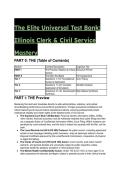
The Elite Universal Test Bank:
Illinois Clerk & Civil Service
Mastery
PART 0: THE (Table of Contents)
Section Content Description Cognitive Tier
PART I The Preview: Mission & Critical Executive Primer
Axioms
PART II The Elite Test Bank Full Assessment
Tier 1 Questions 1–10: Foundational Core Theory
Syntax & Application
Tier 2 Questions 11–20: Complex Variable Analysis
Application & Simulation
Tier 3 Questions 21–30: Grandmaster High-Stakes Synthesis
Synthesis
PART I: THE Preview
Mastering this test bank translates directly to elite administrative, statutory, and judicial
recordkeeping performance across Illinois jurisdictions. It forges procedural compliance and
critical reasoning into second-nature operational instincts, ensuring professionals protect
institutional integrity and citizen rights at the highest levels of civil service.
● The Supreme Court Rule 138 Mandate: Personal identity information (SSNs, DOBs,
minor names, financial accounts) must be ruthlessly redacted from public filings and filed
via a separate Notice of Confidential Information Within Court Filing. Willful violations are
penalized by court-ordered fees, and the duty to redact lies squarely with the filer, not the
clerk.
● The Local Records Act (50 ILCS 205) Protocol: No public record—including ephemeral
emails or text messages detailing public business—may be destroyed without a formal
Disposal Certificate approved by the Local Records Commission, irrespective of physical
or digital formatting.
● The Clerks of Courts Act (705 ILCS 105) Axiom: Court records, post-return search
warrants, and general dockets are universally subject to public inspection unless
expressly sealed by statutory exception or direct judicial order.
● The Mental Health Confidentiality Axiom: Under 740 ILCS 110/4, a minor aged 12 or
older possesses the absolute privilege to object to parental access to their clinical mental
, health records. Over the minor's objection, parents may only access the current condition,
diagnosis, and treatment needs.
● The SUCSS Merit Principle: Under the State Universities Civil Service System (SUCSS),
all appointments and promotions are governed solely by merit, fitness, and validated
examination metrics, precluding subjective or unverified placements. Veterans' preference
points are applied exclusively to passing scores.
PART II: THE ELITE TEST BANK
Tier 1 (Questions 1–10) - Foundational Syntax & Application
Q1: A newly appointed Deputy Clerk is processing a voluminous batch of conventionally filed
civil complaints. According to Illinois Supreme Court Rule 138, which specific data point must
FIRST be identified and redacted from the public document before it is placed in the general
case file? A) The plaintiff’s home address and personal telephone number. B) The names of all
adult witnesses involved in the civil dispute. C) The full individual taxpayer-identification number
of the defendant. D) The year of the plaintiff's date of birth.
● The Answer: C (The full individual taxpayer-identification number of the defendant.)
● Distractor Analysis:
○ A is incorrect: Home addresses and phone numbers are explicitly not classified as
protected personal identity information under the strict definition of Rule 138.
○ B is incorrect: Adult witness names are a matter of public record and do not fall
under the confidentiality protections of this specific Supreme Court rule.
○ D is incorrect: The year of birth is explicitly allowed as a permissible redaction
format under Rule 138; it is the full, exact date of birth that must be redacted from
the public record.
The Mentor's Analysis: Rule 138 strictly shields specific personal identity markers to prevent
identity theft and fraud within the judicial system. By isolating exact identifiers like SSNs and
taxpayer IDs, the clerk ensures the litigant's safety while maintaining the public integrity of the
court record. Professional/Academic Intuition: Never conflate general privacy with
statutory redaction; Rule 138 defines an exact, non-negotiable list of protected data.
Q2: Under the Local Records Act (50 ILCS 205), a municipal clerk intends to destroy physical
paper records after successfully digitizing them into a secure electronic repository. What is the
MOST ACCURATE procedural requirement before the physical records can be lawfully
destroyed? A) The electronic records must be backed up off-site, after which the physical copies
can be destroyed immediately without further approval. B) The clerk must secure a formal
Disposal Certificate approved by the Local Records Commission prior to the destruction of the
physical copies. C) The clerk must wait a minimum of seven years post-digitization before
initiating physical destruction to satisfy audit windows. D) The physical records may be
shredded independently if the digital files are fully accessible to the public via the Freedom of
Information Act (FOIA).
● The Answer: B (The clerk must secure a formal Disposal Certificate approved by the
Local Records Commission prior to the destruction of the physical copies.)
● Distractor Analysis:
○ A is incorrect: Digitization does not automatically bypass the statutory requirement
for external state approval prior to destroying public property.
○ C is incorrect: The seven-year timeline is an arbitrary legacy rule; retention
, schedules are dictated strictly by the specific Application for Authority to Dispose of
Local Records.
○ D is incorrect: FOIA accessibility relates to public disclosure, not the statutory
authorization for records disposal. Disclosure does not equal destruction authority.
The Mentor's Analysis: The transformation of a record's medium from physical to digital does
not extinguish its status as a public record. By adhering to the Local Records Commission's
disposal certification, the clerk ensures absolute legal compliance and avoids criminal liability for
unauthorized destruction of government property. Professional/Academic Intuition: A
record's format is legally irrelevant; disposal authority rests exclusively with the Local
Records Commission.
Q3: The Manual on Recordkeeping dictates the standardization of case numbering across the
Illinois Circuit Courts. If a clerk receives a petition involving an abused or neglected minor, which
case category abbreviation is the MOST APPROPRIATE to assign? A) JV (Juvenile) B) JD
(Juvenile Delinquency) C) JA (Juvenile Abuse and Neglect) D) CV (Civil)
● The Answer: C (JA (Juvenile Abuse and Neglect))
● Distractor Analysis:
○ A is incorrect: The JV classification is a broader categorization that is strictly
forbidden from housing abuse, neglect, or dependency matters under modern
Administrative Office of the Illinois Courts (AOIC) standards.
○ B is incorrect: JD is reserved exclusively for Juvenile Delinquency cases involving
criminal offenses committed by minors, triggering entirely different procedural
tracks.
○ D is incorrect: While technically a civil matter, the specific statutory framework of the
Juvenile Court Act of 1987 demands the distinct JA classification for accurate
statistical reporting and confidentiality management.
The Mentor's Analysis: Case categorization directly impacts confidentiality parameters and
statutory timelines. By isolating abuse and neglect matters under the JA designation, the court
ensures these highly sensitive files are managed under the correct procedural safeguards away
from delinquency matters. Professional/Academic Intuition: Case abbreviations dictate the
lifecycle and confidentiality of the file; precision at intake prevents catastrophic
procedural breaches.
Q4: A citizen submits a FOIA request to a county clerk demanding access to a recently
executed search warrant. According to the Clerks of Courts Act (705 ILCS 105/16) and relevant
Attorney General opinions, when does this document become subject to public inspection? A)
Immediately upon issuance by the presiding judge to guarantee law enforcement transparency.
B) Only after the criminal trial has concluded and a final verdict is rendered. C) Once the warrant
has been successfully executed and formally returned to the court. D) Never, as search
warrants are permanently sealed under criminal justice exemptions.
● The Answer: C (Once the warrant has been successfully executed and formally returned
to the court.)
● Distractor Analysis:
○ A is incorrect: Releasing a warrant prior to execution would compromise the
ongoing law enforcement operation and severely endanger officers.
○ B is incorrect: This delays public access far beyond statutory intent; the record
becomes public long before trial.
○ D is incorrect: Unless specifically sealed by a direct court order, warrants are
deemed public records once returned to the clerk.
The Mentor's Analysis: Transparency in the judicial process is carefully balanced against
Illinois Clerk & Civil Service
Mastery
PART 0: THE (Table of Contents)
Section Content Description Cognitive Tier
PART I The Preview: Mission & Critical Executive Primer
Axioms
PART II The Elite Test Bank Full Assessment
Tier 1 Questions 1–10: Foundational Core Theory
Syntax & Application
Tier 2 Questions 11–20: Complex Variable Analysis
Application & Simulation
Tier 3 Questions 21–30: Grandmaster High-Stakes Synthesis
Synthesis
PART I: THE Preview
Mastering this test bank translates directly to elite administrative, statutory, and judicial
recordkeeping performance across Illinois jurisdictions. It forges procedural compliance and
critical reasoning into second-nature operational instincts, ensuring professionals protect
institutional integrity and citizen rights at the highest levels of civil service.
● The Supreme Court Rule 138 Mandate: Personal identity information (SSNs, DOBs,
minor names, financial accounts) must be ruthlessly redacted from public filings and filed
via a separate Notice of Confidential Information Within Court Filing. Willful violations are
penalized by court-ordered fees, and the duty to redact lies squarely with the filer, not the
clerk.
● The Local Records Act (50 ILCS 205) Protocol: No public record—including ephemeral
emails or text messages detailing public business—may be destroyed without a formal
Disposal Certificate approved by the Local Records Commission, irrespective of physical
or digital formatting.
● The Clerks of Courts Act (705 ILCS 105) Axiom: Court records, post-return search
warrants, and general dockets are universally subject to public inspection unless
expressly sealed by statutory exception or direct judicial order.
● The Mental Health Confidentiality Axiom: Under 740 ILCS 110/4, a minor aged 12 or
older possesses the absolute privilege to object to parental access to their clinical mental
, health records. Over the minor's objection, parents may only access the current condition,
diagnosis, and treatment needs.
● The SUCSS Merit Principle: Under the State Universities Civil Service System (SUCSS),
all appointments and promotions are governed solely by merit, fitness, and validated
examination metrics, precluding subjective or unverified placements. Veterans' preference
points are applied exclusively to passing scores.
PART II: THE ELITE TEST BANK
Tier 1 (Questions 1–10) - Foundational Syntax & Application
Q1: A newly appointed Deputy Clerk is processing a voluminous batch of conventionally filed
civil complaints. According to Illinois Supreme Court Rule 138, which specific data point must
FIRST be identified and redacted from the public document before it is placed in the general
case file? A) The plaintiff’s home address and personal telephone number. B) The names of all
adult witnesses involved in the civil dispute. C) The full individual taxpayer-identification number
of the defendant. D) The year of the plaintiff's date of birth.
● The Answer: C (The full individual taxpayer-identification number of the defendant.)
● Distractor Analysis:
○ A is incorrect: Home addresses and phone numbers are explicitly not classified as
protected personal identity information under the strict definition of Rule 138.
○ B is incorrect: Adult witness names are a matter of public record and do not fall
under the confidentiality protections of this specific Supreme Court rule.
○ D is incorrect: The year of birth is explicitly allowed as a permissible redaction
format under Rule 138; it is the full, exact date of birth that must be redacted from
the public record.
The Mentor's Analysis: Rule 138 strictly shields specific personal identity markers to prevent
identity theft and fraud within the judicial system. By isolating exact identifiers like SSNs and
taxpayer IDs, the clerk ensures the litigant's safety while maintaining the public integrity of the
court record. Professional/Academic Intuition: Never conflate general privacy with
statutory redaction; Rule 138 defines an exact, non-negotiable list of protected data.
Q2: Under the Local Records Act (50 ILCS 205), a municipal clerk intends to destroy physical
paper records after successfully digitizing them into a secure electronic repository. What is the
MOST ACCURATE procedural requirement before the physical records can be lawfully
destroyed? A) The electronic records must be backed up off-site, after which the physical copies
can be destroyed immediately without further approval. B) The clerk must secure a formal
Disposal Certificate approved by the Local Records Commission prior to the destruction of the
physical copies. C) The clerk must wait a minimum of seven years post-digitization before
initiating physical destruction to satisfy audit windows. D) The physical records may be
shredded independently if the digital files are fully accessible to the public via the Freedom of
Information Act (FOIA).
● The Answer: B (The clerk must secure a formal Disposal Certificate approved by the
Local Records Commission prior to the destruction of the physical copies.)
● Distractor Analysis:
○ A is incorrect: Digitization does not automatically bypass the statutory requirement
for external state approval prior to destroying public property.
○ C is incorrect: The seven-year timeline is an arbitrary legacy rule; retention
, schedules are dictated strictly by the specific Application for Authority to Dispose of
Local Records.
○ D is incorrect: FOIA accessibility relates to public disclosure, not the statutory
authorization for records disposal. Disclosure does not equal destruction authority.
The Mentor's Analysis: The transformation of a record's medium from physical to digital does
not extinguish its status as a public record. By adhering to the Local Records Commission's
disposal certification, the clerk ensures absolute legal compliance and avoids criminal liability for
unauthorized destruction of government property. Professional/Academic Intuition: A
record's format is legally irrelevant; disposal authority rests exclusively with the Local
Records Commission.
Q3: The Manual on Recordkeeping dictates the standardization of case numbering across the
Illinois Circuit Courts. If a clerk receives a petition involving an abused or neglected minor, which
case category abbreviation is the MOST APPROPRIATE to assign? A) JV (Juvenile) B) JD
(Juvenile Delinquency) C) JA (Juvenile Abuse and Neglect) D) CV (Civil)
● The Answer: C (JA (Juvenile Abuse and Neglect))
● Distractor Analysis:
○ A is incorrect: The JV classification is a broader categorization that is strictly
forbidden from housing abuse, neglect, or dependency matters under modern
Administrative Office of the Illinois Courts (AOIC) standards.
○ B is incorrect: JD is reserved exclusively for Juvenile Delinquency cases involving
criminal offenses committed by minors, triggering entirely different procedural
tracks.
○ D is incorrect: While technically a civil matter, the specific statutory framework of the
Juvenile Court Act of 1987 demands the distinct JA classification for accurate
statistical reporting and confidentiality management.
The Mentor's Analysis: Case categorization directly impacts confidentiality parameters and
statutory timelines. By isolating abuse and neglect matters under the JA designation, the court
ensures these highly sensitive files are managed under the correct procedural safeguards away
from delinquency matters. Professional/Academic Intuition: Case abbreviations dictate the
lifecycle and confidentiality of the file; precision at intake prevents catastrophic
procedural breaches.
Q4: A citizen submits a FOIA request to a county clerk demanding access to a recently
executed search warrant. According to the Clerks of Courts Act (705 ILCS 105/16) and relevant
Attorney General opinions, when does this document become subject to public inspection? A)
Immediately upon issuance by the presiding judge to guarantee law enforcement transparency.
B) Only after the criminal trial has concluded and a final verdict is rendered. C) Once the warrant
has been successfully executed and formally returned to the court. D) Never, as search
warrants are permanently sealed under criminal justice exemptions.
● The Answer: C (Once the warrant has been successfully executed and formally returned
to the court.)
● Distractor Analysis:
○ A is incorrect: Releasing a warrant prior to execution would compromise the
ongoing law enforcement operation and severely endanger officers.
○ B is incorrect: This delays public access far beyond statutory intent; the record
becomes public long before trial.
○ D is incorrect: Unless specifically sealed by a direct court order, warrants are
deemed public records once returned to the clerk.
The Mentor's Analysis: Transparency in the judicial process is carefully balanced against