

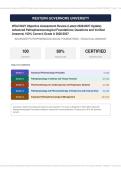
ective Assessment Review (Latest 2026/2027 Update) Advanced Pathopharmacological Foundations| Questions and Verified Answers| 100% Correct| Grade A 2026/2027 2026/2027 | Page 1 | Pas
WESTERN GOVERNORS UNIVERSITY
WGU D027 Objective Assessment Review (Latest 2026/2027 Update)
Advanced Pathopharmacological Foundations| Questions and Verified
Answers| 100% Correct| Grade A 2026/2027
ADVANCED PATHOPHARMACOLOGICAL FOUNDATIONS · Official Exam 2026/2027
100 80% CERTIFIED
QUESTIONS PASSING SCORE RECERTIFICATION
TABLE OF CONTENTS
Section 1 Advanced Pharmacology Principles Q1-Q20
Section 2 Pathophysiology of Cellular and Tissue Function Q21-Q40
Section 3 Pharmacotherapy for Cardiovascular and Respiratory Systems Q41-Q60
Section 4 Pathophysiology and Pharmacotherapy of Endocrine and Immune DisordersQ61-Q80
Section 5 Integrated Pathopharmacological Management Q81-Q100
Instructions: Select the single best answer for each question. This exam is designed for WGU D027 Advanced
Pathopharmacological Foundations objective assessment review preparation. Passing score: 80% (80 questions
correct).
ve Assessment Review (Latest 2026/2027 Update) Advanced Pathopharmacological Foundations| Questions and Verified Answers| 100% Correct| Grade A 2026/2027 - 2026/2027 | Passing Score:
, SECTION 1 | Advanced Pharmacology Principl | Q1-Q20 | WGU D027 Objective Assessment Review (Latest 2026/2027 Update) Advanced Patho
Q1 Question 1 of 100
A 52-year-old male with hypertension is started on lisinopril, an angiotensin-converting enzyme
inhibitor. He presents to the clinic 2 weeks later with a persistent dry cough that is interfering with his
sleep. The nurse understands that this adverse effect is mediated by which pharmacologic
mechanism?
A. Accumulation of bradykinin due to inhibition of its degradation by the angiotensin-converting
enzyme
B. Direct irritation of the respiratory mucosa by the active metabolite of lisinopril
C. Stimulation of angiotensin II type 1 receptors in the bronchial smooth muscle
D. Inhibition of prostaglandin synthesis leading to increased airway reactivity
Correct Answer: A
Rationale:
ACE inhibitors block the degradation of bradykinin, a potent vasodilator that accumulates in the respiratory tract and
causes a persistent dry cough in up to 20 percent of patients. This is not mediated by angiotensin II receptors, a
metabolite, or prostaglandin inhibition. Switching to an ARB typically resolves the cough.
Q2 Question 2 of 100
A 45-year-old female with a history of opioid use disorder is being treated with
buprenorphine-naloxone sublingual tablets. The nurse explains that the naloxone component serves
which primary purpose in this combination formulation?
A. Enhancing the analgesic effects of buprenorphine through synergistic receptor activation
B. Preventing misuse by precipitating withdrawal if the medication is dissolved and injected
intravenously
C. Blocking the euphoric effects of buprenorphine at the mu-opioid receptor when taken as prescribed
D. Reducing the respiratory depression associated with buprenorphine by antagonizing its effects at the
brainstem
Correct Answer: B
Rationale:
Naloxone has poor sublingual bioavailability and is included to deter misuse; if the tablet is crushed and injected,
naloxone blocks opioid receptors and precipitates withdrawal. When taken sublingually as prescribed, naloxone has
minimal systemic effect. It does not enhance analgesia, block buprenorphine orally, or reduce respiratory depression
when taken properly.
ve Assessment Review (Latest 2026/2027 Update) Advanced Pathopharmacological Foundations| Questions and Verified Answers| 100% Correct| Grade A 2026/2027 - 2026/2027 | Passing Score: 8
, Q3 Question 3 of 100
A 67-year-old male taking warfarin for atrial fibrillation is prescribed trimethoprim-sulfamethoxazole for
a urinary tract infection. Three days later, his INR is 6.2. Which cytochrome P450 enzyme interaction
is primarily responsible for this dangerous drug-drug interaction?
A. Sulfamethoxazole induces CYP2C9, increasing the metabolism of warfarin and reducing its
anticoagulant effect
B. Sulfamethoxazole inhibits CYP3A4, increasing the conversion of warfarin to its active enantiomer
C. Trimethoprim inhibits CYP2C9, reducing the metabolism of warfarin and increasing its
anticoagulant effect
D. Trimethoprim induces CYP1A2, accelerating the metabolism of warfarin's inactive metabolites
Correct Answer: C
Rationale:
Trimethoprim inhibits CYP2C9, the primary enzyme responsible for metabolizing the more potent S-enantiomer of
warfarin, leading to elevated INR and bleeding risk. Induction of CYP2C9 would lower INR, not raise it. CYP3A4 and
CYP1A2 are not the primary pathways for warfarin metabolism and do not explain this interaction.
Q4 Question 4 of 100
A 34-year-old female with major depressive disorder has been taking fluoxetine for 6 weeks with
minimal improvement. Her provider decides to switch her to phenelzine, a monoamine oxidase
inhibitor. What is the minimum washout period required before starting phenelzine to avoid serotonin
syndrome?
A. 48 hours to allow adequate clearance of fluoxetine and its metabolites from the system
B. 1 week to permit partial elimination of serotonin reuptake inhibition in the synapses
C. 2 weeks as is standard for switching between any two antidepressant medications
D. 5 weeks due to the long half-life of fluoxetine and its active metabolite norfluoxetine
Correct Answer: D
Rationale:
Fluoxetine has an extremely long half-life (2 to 4 days) and its active metabolite norfluoxetine has a half-life of 7 to 15
days, requiring a minimum 5-week washout before starting an MAOI to prevent serotonin syndrome. Shorter washout
periods are insufficient and could result in a life-threatening serotonergic reaction.
ve Assessment Review (Latest 2026/2027 Update) Advanced Pathopharmacological Foundations| Questions and Verified Answers| 100% Correct| Grade A 2026/2027 - 2026/2027 | Passing Score: 8
, Q5 Question 5 of 100
A 58-year-old male with type 2 diabetes is prescribed metformin. The nurse reviews his laboratory
results and notes his estimated glomerular filtration rate is 28 mL/min. Which action is most
appropriate regarding the metformin prescription?
A. Discontinue metformin due to the increased risk of lactic acidosis at this level of renal
impairment
B. Reduce the dose by half and monitor renal function every 3 months for further decline
C. Continue metformin at the current dose as it does not affect renal function directly
D. Switch to metformin extended-release formulation which is safer in patients with reduced renal function
Correct Answer: A
Rationale:
Metformin is contraindicated when eGFR is below 30 mL/min due to the risk of lactic acidosis, a rare but potentially
fatal complication. Dose reduction is appropriate for eGFR 30 to 45, but not below 30. Extended-release metformin
carries the same renal contraindication. The medication must be stopped and an alternative prescribed.
Q6 Question 6 of 100
A 42-year-old male receives a prescription for sildenafil for erectile dysfunction. He also takes
isosorbide mononitrate for stable angina. The pharmacist contacts the prescriber about a critical
contraindication. Which pathopharmacologic interaction makes this combination dangerous?
A. Sildenafil inhibits the metabolism of nitrates via CYP3A4, leading to toxic nitrate levels and
methemoglobinemia
B. Concurrent use of PDE5 inhibitors and nitrates causes severe hypotension through excessive
cyclic GMP accumulation and vasodilation
C. Isosorbide mononitrate blocks the PDE5 enzyme, reducing the efficacy of sildenafil and increasing
angina risk
D. Sildenafil increases cardiac oxygen demand through reflex tachycardia, worsening the patient's ischemic
symptoms
Correct Answer: B
Rationale:
Nitrates increase cGMP by stimulating guanylate cyclase, while sildenafil prevents cGMP breakdown by inhibiting
PDE5. Together, they cause dangerous accumulation of cGMP, leading to profound vasodilation and life-threatening
hypotension. This is not a metabolic interaction, a blockade of PDE5, or an increase in oxygen demand.
ve Assessment Review (Latest 2026/2027 Update) Advanced Pathopharmacological Foundations| Questions and Verified Answers| 100% Correct| Grade A 2026/2027 - 2026/2027 | Passing Score: 8
WESTERN GOVERNORS UNIVERSITY
WGU D027 Objective Assessment Review (Latest 2026/2027 Update)
Advanced Pathopharmacological Foundations| Questions and Verified
Answers| 100% Correct| Grade A 2026/2027
ADVANCED PATHOPHARMACOLOGICAL FOUNDATIONS · Official Exam 2026/2027
100 80% CERTIFIED
QUESTIONS PASSING SCORE RECERTIFICATION
TABLE OF CONTENTS
Section 1 Advanced Pharmacology Principles Q1-Q20
Section 2 Pathophysiology of Cellular and Tissue Function Q21-Q40
Section 3 Pharmacotherapy for Cardiovascular and Respiratory Systems Q41-Q60
Section 4 Pathophysiology and Pharmacotherapy of Endocrine and Immune DisordersQ61-Q80
Section 5 Integrated Pathopharmacological Management Q81-Q100
Instructions: Select the single best answer for each question. This exam is designed for WGU D027 Advanced
Pathopharmacological Foundations objective assessment review preparation. Passing score: 80% (80 questions
correct).
ve Assessment Review (Latest 2026/2027 Update) Advanced Pathopharmacological Foundations| Questions and Verified Answers| 100% Correct| Grade A 2026/2027 - 2026/2027 | Passing Score:
, SECTION 1 | Advanced Pharmacology Principl | Q1-Q20 | WGU D027 Objective Assessment Review (Latest 2026/2027 Update) Advanced Patho
Q1 Question 1 of 100
A 52-year-old male with hypertension is started on lisinopril, an angiotensin-converting enzyme
inhibitor. He presents to the clinic 2 weeks later with a persistent dry cough that is interfering with his
sleep. The nurse understands that this adverse effect is mediated by which pharmacologic
mechanism?
A. Accumulation of bradykinin due to inhibition of its degradation by the angiotensin-converting
enzyme
B. Direct irritation of the respiratory mucosa by the active metabolite of lisinopril
C. Stimulation of angiotensin II type 1 receptors in the bronchial smooth muscle
D. Inhibition of prostaglandin synthesis leading to increased airway reactivity
Correct Answer: A
Rationale:
ACE inhibitors block the degradation of bradykinin, a potent vasodilator that accumulates in the respiratory tract and
causes a persistent dry cough in up to 20 percent of patients. This is not mediated by angiotensin II receptors, a
metabolite, or prostaglandin inhibition. Switching to an ARB typically resolves the cough.
Q2 Question 2 of 100
A 45-year-old female with a history of opioid use disorder is being treated with
buprenorphine-naloxone sublingual tablets. The nurse explains that the naloxone component serves
which primary purpose in this combination formulation?
A. Enhancing the analgesic effects of buprenorphine through synergistic receptor activation
B. Preventing misuse by precipitating withdrawal if the medication is dissolved and injected
intravenously
C. Blocking the euphoric effects of buprenorphine at the mu-opioid receptor when taken as prescribed
D. Reducing the respiratory depression associated with buprenorphine by antagonizing its effects at the
brainstem
Correct Answer: B
Rationale:
Naloxone has poor sublingual bioavailability and is included to deter misuse; if the tablet is crushed and injected,
naloxone blocks opioid receptors and precipitates withdrawal. When taken sublingually as prescribed, naloxone has
minimal systemic effect. It does not enhance analgesia, block buprenorphine orally, or reduce respiratory depression
when taken properly.
ve Assessment Review (Latest 2026/2027 Update) Advanced Pathopharmacological Foundations| Questions and Verified Answers| 100% Correct| Grade A 2026/2027 - 2026/2027 | Passing Score: 8
, Q3 Question 3 of 100
A 67-year-old male taking warfarin for atrial fibrillation is prescribed trimethoprim-sulfamethoxazole for
a urinary tract infection. Three days later, his INR is 6.2. Which cytochrome P450 enzyme interaction
is primarily responsible for this dangerous drug-drug interaction?
A. Sulfamethoxazole induces CYP2C9, increasing the metabolism of warfarin and reducing its
anticoagulant effect
B. Sulfamethoxazole inhibits CYP3A4, increasing the conversion of warfarin to its active enantiomer
C. Trimethoprim inhibits CYP2C9, reducing the metabolism of warfarin and increasing its
anticoagulant effect
D. Trimethoprim induces CYP1A2, accelerating the metabolism of warfarin's inactive metabolites
Correct Answer: C
Rationale:
Trimethoprim inhibits CYP2C9, the primary enzyme responsible for metabolizing the more potent S-enantiomer of
warfarin, leading to elevated INR and bleeding risk. Induction of CYP2C9 would lower INR, not raise it. CYP3A4 and
CYP1A2 are not the primary pathways for warfarin metabolism and do not explain this interaction.
Q4 Question 4 of 100
A 34-year-old female with major depressive disorder has been taking fluoxetine for 6 weeks with
minimal improvement. Her provider decides to switch her to phenelzine, a monoamine oxidase
inhibitor. What is the minimum washout period required before starting phenelzine to avoid serotonin
syndrome?
A. 48 hours to allow adequate clearance of fluoxetine and its metabolites from the system
B. 1 week to permit partial elimination of serotonin reuptake inhibition in the synapses
C. 2 weeks as is standard for switching between any two antidepressant medications
D. 5 weeks due to the long half-life of fluoxetine and its active metabolite norfluoxetine
Correct Answer: D
Rationale:
Fluoxetine has an extremely long half-life (2 to 4 days) and its active metabolite norfluoxetine has a half-life of 7 to 15
days, requiring a minimum 5-week washout before starting an MAOI to prevent serotonin syndrome. Shorter washout
periods are insufficient and could result in a life-threatening serotonergic reaction.
ve Assessment Review (Latest 2026/2027 Update) Advanced Pathopharmacological Foundations| Questions and Verified Answers| 100% Correct| Grade A 2026/2027 - 2026/2027 | Passing Score: 8
, Q5 Question 5 of 100
A 58-year-old male with type 2 diabetes is prescribed metformin. The nurse reviews his laboratory
results and notes his estimated glomerular filtration rate is 28 mL/min. Which action is most
appropriate regarding the metformin prescription?
A. Discontinue metformin due to the increased risk of lactic acidosis at this level of renal
impairment
B. Reduce the dose by half and monitor renal function every 3 months for further decline
C. Continue metformin at the current dose as it does not affect renal function directly
D. Switch to metformin extended-release formulation which is safer in patients with reduced renal function
Correct Answer: A
Rationale:
Metformin is contraindicated when eGFR is below 30 mL/min due to the risk of lactic acidosis, a rare but potentially
fatal complication. Dose reduction is appropriate for eGFR 30 to 45, but not below 30. Extended-release metformin
carries the same renal contraindication. The medication must be stopped and an alternative prescribed.
Q6 Question 6 of 100
A 42-year-old male receives a prescription for sildenafil for erectile dysfunction. He also takes
isosorbide mononitrate for stable angina. The pharmacist contacts the prescriber about a critical
contraindication. Which pathopharmacologic interaction makes this combination dangerous?
A. Sildenafil inhibits the metabolism of nitrates via CYP3A4, leading to toxic nitrate levels and
methemoglobinemia
B. Concurrent use of PDE5 inhibitors and nitrates causes severe hypotension through excessive
cyclic GMP accumulation and vasodilation
C. Isosorbide mononitrate blocks the PDE5 enzyme, reducing the efficacy of sildenafil and increasing
angina risk
D. Sildenafil increases cardiac oxygen demand through reflex tachycardia, worsening the patient's ischemic
symptoms
Correct Answer: B
Rationale:
Nitrates increase cGMP by stimulating guanylate cyclase, while sildenafil prevents cGMP breakdown by inhibiting
PDE5. Together, they cause dangerous accumulation of cGMP, leading to profound vasodilation and life-threatening
hypotension. This is not a metabolic interaction, a blockade of PDE5, or an increase in oxygen demand.
ve Assessment Review (Latest 2026/2027 Update) Advanced Pathopharmacological Foundations| Questions and Verified Answers| 100% Correct| Grade A 2026/2027 - 2026/2027 | Passing Score: 8


