

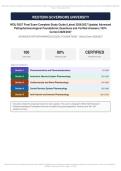
WGU D027 Final Exam Complete Study Guide (Latest 2026/2027 Update) Advanced Pathopharmacological Foundations| Questions and Verified Answers| 100% Correct 2026/2027 2026/2027
| Page 1 | Passing Score: 80%
WESTERN GOVERNORS UNIVERSITY
WGU D027 Final Exam Complete Study Guide (Latest 2026/2027 Update) Advanced
Pathopharmacological Foundations| Questions and Verified Answers| 100%
Correct 2026/2027
ADVANCED PATHOPHARMACOLOGICAL FOUNDATIONS - Official Exam 2026/2027
100 80% CERTIFIED
QUESTIONS PASSING SCORE RECERTIFICATION
TABLE OF CONTENTS
Section 1 Pharmacokinetics and Pharmacodynamics Q1-Q20
Section 2 Autonomic Nervous System Pharmacology Q21-Q40
Section 3 Cardiovascular and Renal Pharmacology Q41-Q60
Section 4 Central Nervous System Pharmacology Q61-Q80
Section 5 Anti-infective and Immune Pharmacology Q81-Q100
Instructions: Select the single best answer for each question. This exam is designed for WGU D027 Advanced
Pathopharmacological Foundations final exam complete study guide preparation. Passing score: 80% (80
questions correct).
WGU D027 Final Exam Complete Study Guide (Latest 2026/2027 Update) Advanced Pathopharmacological Foundations| Questions and Verified Answers| 100% Correct 2026/2027 --
2026/2027 | Passing Score: 80% | Page 1 of TOTAL
, SECTION 1 | Pharmacokinetics and Pharmacodynamics | Q1-Q20 | WGU D027 Final Exam Complete Study Guide
(Latest 2026/2027 Update) Advanced Pathopharmacological Foundations| Questions and Verified Answers| 100%
Q1 Question 1 of 100
A 54-year-old man with hypertension is started on metoprolol, a medication with a high
first-pass hepatic metabolism. The PMHNP understands that drugs with extensive first-pass
metabolism require higher oral doses to achieve the same systemic effect as intravenous
administration. Which pharmacokinetic parameter best describes the fraction of drug that
reaches systemic circulation unchanged after oral administration?
A. Volume of distribution
B. Bioavailability
C. Clearance
D. Half-life
Correct Answer: B
Rationale:
Bioavailability is the pharmacokinetic parameter that describes the fraction of an
administered dose of unchanged drug that reaches the systemic circulation. For drugs with high
first-pass metabolism, such as metoprolol, oral bioavailability is significantly reduced
because the liver metabolizes a large portion before the drug enters systemic circulation.
Volume of distribution describes drug distribution, not absorption.
Q2 Question 2 of 100
A 67-year-old woman with chronic kidney disease has a creatinine clearance of 25 mL/min.
The PMHNP needs to adjust the dose of gentamicin, which is primarily eliminated by the
kidneys. Which pharmacokinetic phase is most directly affected by this patient's renal
impairment?
A. Absorption
B. Distribution
C. Metabolism
D. Elimination
Correct Answer: D
Rationale:
Elimination is the pharmacokinetic phase most directly affected by renal impairment because
gentamicin is primarily excreted unchanged by the kidneys. Reduced creatinine clearance
indicates impaired glomerular filtration, leading to decreased renal elimination and potential
drug accumulation. Absorption, distribution, and metabolism are less directly affected by
renal dysfunction for this particular medication.
WGU D027 Final Exam Complete Study Guide (Latest 2026/2027 Update) Advanced Pathopharmacological Foundations| Questions and Verified Answers| 100% Correct 2026/2027 --
2026/2027 | Passing Score: 80% | Page 2 of TOTAL
, Q3 Question 3 of 100
A 42-year-old man is taking warfarin for atrial fibrillation. He is recently prescribed
fluconazole for a fungal infection. The PMHNP recognizes that fluconazole inhibits the
cytochrome P450 enzyme CYP2C9, which metabolizes warfarin. Which effect is most likely to
occur when these two medications are combined?
A. Decreased warfarin levels and reduced anticoagulant effect
B. Increased warfarin levels and elevated INR due to inhibited metabolism
C. No change in warfarin levels because they use different metabolic pathways
D. Increased warfarin metabolism and shortened half-life
Correct Answer: B
Rationale:
Fluconazole inhibits CYP2C9, the primary enzyme responsible for warfarin metabolism, leading
to increased warfarin plasma levels and an elevated international normalized ratio. This is a
classic cytochrome P450 enzyme inhibition interaction that increases the risk of bleeding.
Decreased warfarin levels would occur with enzyme induction, not inhibition.
Q4 Question 4 of 100
A 38-year-old woman is prescribed a medication with a half-life of 12 hours. The PMHNP
explains that it takes approximately five half-lives to reach steady-state plasma
concentrations. How many hours will it take for this medication to reach steady state
with regular dosing?
A. 24 hours
B. 36 hours
C. 48 hours
D. 60 hours
Correct Answer: D
Rationale:
Steady state is reached after approximately five half-lives of consistent dosing. With a half-
life of 12 hours, five half-lives equals 60 hours. At steady state, the rate of drug
administration equals the rate of elimination, and plasma drug concentrations remain
relatively stable between doses. This principle guides dosing interval decisions and timing of
therapeutic drug monitoring.
WGU D027 Final Exam Complete Study Guide (Latest 2026/2027 Update) Advanced Pathopharmacological Foundations| Questions and Verified Answers| 100% Correct 2026/2027 --
2026/2027 | Passing Score: 80% | Page 3 of TOTAL
, Q5 Question 5 of 100
A 61-year-old man with heart failure has significant peripheral edema and ascites. He is
prescribed a highly protein-bound medication. The PMHNP considers how the patient's fluid
overload may affect drug distribution. Which pharmacokinetic parameter describes the
theoretical volume into which a drug distributes in the body?
A. Bioavailability
B. Volume of distribution
C. Clearance
D. Steady-state concentration
Correct Answer: B
Rationale:
Volume of distribution is the pharmacokinetic parameter that describes the theoretical volume
into which a drug appears to distribute in the body. In patients with significant edema and
ascites, the volume of distribution for water-soluble drugs may increase, potentially reducing
plasma concentrations. Bioavailability refers to the fraction of drug reaching systemic
circulation, not distribution volume.
Q6 Question 6 of 100
A 45-year-old woman with epilepsy is taking phenytoin, which follows nonlinear or zero-
order pharmacokinetics at therapeutic doses. The PMHNP understands that small increases
in dose can produce disproportionately large increases in plasma concentration. Which
statement best explains the mechanism behind this nonlinear kinetics?
A. Phenytoin has a very short half-life at all doses
B. Phenytoin induces its own metabolism at higher doses
C. The metabolic enzymes responsible for phenytoin elimination become saturated at
therapeutic concentrations, shifting from first-order to zero-order kinetics
D. Phenytoin is exclusively eliminated by the kidneys without hepatic involvement
Correct Answer: C
Rationale:
Phenytoin exhibits nonlinear pharmacokinetics because the hepatic enzymes responsible for its
metabolism, primarily CYP2C9 and CYP2C19, become saturated at therapeutic concentrations. Once
saturated, metabolism shifts from first-order kinetics, where elimination rate is proportional
to concentration, to zero-order kinetics, where elimination proceeds at a constant rate
regardless of concentration. This causes disproportionate increases in plasma levels with
small dose increases.
WGU D027 Final Exam Complete Study Guide (Latest 2026/2027 Update) Advanced Pathopharmacological Foundations| Questions and Verified Answers| 100% Correct 2026/2027 --
2026/2027 | Passing Score: 80% | Page 4 of TOTAL
| Page 1 | Passing Score: 80%
WESTERN GOVERNORS UNIVERSITY
WGU D027 Final Exam Complete Study Guide (Latest 2026/2027 Update) Advanced
Pathopharmacological Foundations| Questions and Verified Answers| 100%
Correct 2026/2027
ADVANCED PATHOPHARMACOLOGICAL FOUNDATIONS - Official Exam 2026/2027
100 80% CERTIFIED
QUESTIONS PASSING SCORE RECERTIFICATION
TABLE OF CONTENTS
Section 1 Pharmacokinetics and Pharmacodynamics Q1-Q20
Section 2 Autonomic Nervous System Pharmacology Q21-Q40
Section 3 Cardiovascular and Renal Pharmacology Q41-Q60
Section 4 Central Nervous System Pharmacology Q61-Q80
Section 5 Anti-infective and Immune Pharmacology Q81-Q100
Instructions: Select the single best answer for each question. This exam is designed for WGU D027 Advanced
Pathopharmacological Foundations final exam complete study guide preparation. Passing score: 80% (80
questions correct).
WGU D027 Final Exam Complete Study Guide (Latest 2026/2027 Update) Advanced Pathopharmacological Foundations| Questions and Verified Answers| 100% Correct 2026/2027 --
2026/2027 | Passing Score: 80% | Page 1 of TOTAL
, SECTION 1 | Pharmacokinetics and Pharmacodynamics | Q1-Q20 | WGU D027 Final Exam Complete Study Guide
(Latest 2026/2027 Update) Advanced Pathopharmacological Foundations| Questions and Verified Answers| 100%
Q1 Question 1 of 100
A 54-year-old man with hypertension is started on metoprolol, a medication with a high
first-pass hepatic metabolism. The PMHNP understands that drugs with extensive first-pass
metabolism require higher oral doses to achieve the same systemic effect as intravenous
administration. Which pharmacokinetic parameter best describes the fraction of drug that
reaches systemic circulation unchanged after oral administration?
A. Volume of distribution
B. Bioavailability
C. Clearance
D. Half-life
Correct Answer: B
Rationale:
Bioavailability is the pharmacokinetic parameter that describes the fraction of an
administered dose of unchanged drug that reaches the systemic circulation. For drugs with high
first-pass metabolism, such as metoprolol, oral bioavailability is significantly reduced
because the liver metabolizes a large portion before the drug enters systemic circulation.
Volume of distribution describes drug distribution, not absorption.
Q2 Question 2 of 100
A 67-year-old woman with chronic kidney disease has a creatinine clearance of 25 mL/min.
The PMHNP needs to adjust the dose of gentamicin, which is primarily eliminated by the
kidneys. Which pharmacokinetic phase is most directly affected by this patient's renal
impairment?
A. Absorption
B. Distribution
C. Metabolism
D. Elimination
Correct Answer: D
Rationale:
Elimination is the pharmacokinetic phase most directly affected by renal impairment because
gentamicin is primarily excreted unchanged by the kidneys. Reduced creatinine clearance
indicates impaired glomerular filtration, leading to decreased renal elimination and potential
drug accumulation. Absorption, distribution, and metabolism are less directly affected by
renal dysfunction for this particular medication.
WGU D027 Final Exam Complete Study Guide (Latest 2026/2027 Update) Advanced Pathopharmacological Foundations| Questions and Verified Answers| 100% Correct 2026/2027 --
2026/2027 | Passing Score: 80% | Page 2 of TOTAL
, Q3 Question 3 of 100
A 42-year-old man is taking warfarin for atrial fibrillation. He is recently prescribed
fluconazole for a fungal infection. The PMHNP recognizes that fluconazole inhibits the
cytochrome P450 enzyme CYP2C9, which metabolizes warfarin. Which effect is most likely to
occur when these two medications are combined?
A. Decreased warfarin levels and reduced anticoagulant effect
B. Increased warfarin levels and elevated INR due to inhibited metabolism
C. No change in warfarin levels because they use different metabolic pathways
D. Increased warfarin metabolism and shortened half-life
Correct Answer: B
Rationale:
Fluconazole inhibits CYP2C9, the primary enzyme responsible for warfarin metabolism, leading
to increased warfarin plasma levels and an elevated international normalized ratio. This is a
classic cytochrome P450 enzyme inhibition interaction that increases the risk of bleeding.
Decreased warfarin levels would occur with enzyme induction, not inhibition.
Q4 Question 4 of 100
A 38-year-old woman is prescribed a medication with a half-life of 12 hours. The PMHNP
explains that it takes approximately five half-lives to reach steady-state plasma
concentrations. How many hours will it take for this medication to reach steady state
with regular dosing?
A. 24 hours
B. 36 hours
C. 48 hours
D. 60 hours
Correct Answer: D
Rationale:
Steady state is reached after approximately five half-lives of consistent dosing. With a half-
life of 12 hours, five half-lives equals 60 hours. At steady state, the rate of drug
administration equals the rate of elimination, and plasma drug concentrations remain
relatively stable between doses. This principle guides dosing interval decisions and timing of
therapeutic drug monitoring.
WGU D027 Final Exam Complete Study Guide (Latest 2026/2027 Update) Advanced Pathopharmacological Foundations| Questions and Verified Answers| 100% Correct 2026/2027 --
2026/2027 | Passing Score: 80% | Page 3 of TOTAL
, Q5 Question 5 of 100
A 61-year-old man with heart failure has significant peripheral edema and ascites. He is
prescribed a highly protein-bound medication. The PMHNP considers how the patient's fluid
overload may affect drug distribution. Which pharmacokinetic parameter describes the
theoretical volume into which a drug distributes in the body?
A. Bioavailability
B. Volume of distribution
C. Clearance
D. Steady-state concentration
Correct Answer: B
Rationale:
Volume of distribution is the pharmacokinetic parameter that describes the theoretical volume
into which a drug appears to distribute in the body. In patients with significant edema and
ascites, the volume of distribution for water-soluble drugs may increase, potentially reducing
plasma concentrations. Bioavailability refers to the fraction of drug reaching systemic
circulation, not distribution volume.
Q6 Question 6 of 100
A 45-year-old woman with epilepsy is taking phenytoin, which follows nonlinear or zero-
order pharmacokinetics at therapeutic doses. The PMHNP understands that small increases
in dose can produce disproportionately large increases in plasma concentration. Which
statement best explains the mechanism behind this nonlinear kinetics?
A. Phenytoin has a very short half-life at all doses
B. Phenytoin induces its own metabolism at higher doses
C. The metabolic enzymes responsible for phenytoin elimination become saturated at
therapeutic concentrations, shifting from first-order to zero-order kinetics
D. Phenytoin is exclusively eliminated by the kidneys without hepatic involvement
Correct Answer: C
Rationale:
Phenytoin exhibits nonlinear pharmacokinetics because the hepatic enzymes responsible for its
metabolism, primarily CYP2C9 and CYP2C19, become saturated at therapeutic concentrations. Once
saturated, metabolism shifts from first-order kinetics, where elimination rate is proportional
to concentration, to zero-order kinetics, where elimination proceeds at a constant rate
regardless of concentration. This causes disproportionate increases in plasma levels with
small dose increases.
WGU D027 Final Exam Complete Study Guide (Latest 2026/2027 Update) Advanced Pathopharmacological Foundations| Questions and Verified Answers| 100% Correct 2026/2027 --
2026/2027 | Passing Score: 80% | Page 4 of TOTAL


