
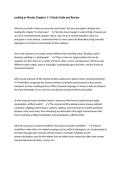
Looking at Movies Chapters 1–3 Study Guide and Review
What do you think of when you hear the word movie? Has your perception changed since
reading this chapter? In what ways? - ✔✔Yes they have changed. I used to think of movies just
as a form of entertainment, popular culture, and a form of commercialization. Now, my
perception is much diverse. I understand that it is more about the filmmakers using cinematic
language to in movies to communicate to their audience.
How is the experience of seeing a movie different from watching a play? Reading a book?
Viewing a painting or a photograph? - ✔✔There is only one stage/medium that can be
analyzed. In a film, there are a variety of frames, shots, scenes, and sequences. There are also
different camera angles, ways of using light, manipulating space and time, and the illusion of
movement involved.
Why has the grammar of film evolved to allow audiences to absorb movie meaning intuitively? -
✔✔Filmmakers recognized the viewers tendency to identify subconsciously to the cameras
viewpoint. So they created grammar of film (cinematic language). It draws on how we interpret
the visual information in our real lives and absorb meaning intuitively and quickly.
In what ways do movies minimize viewers' awareness that they are experiencing a highly
manipulated, artificial reality? - ✔✔The commercial film-making process stresses polished
continuity of lighting, performance, costume, makeup, and movement to smooth transitions
between shots and scenes, thus minimizing any distractions that might remind viewers that
they're watching a highly manipulated, and manipulative, artificial reality.
What do we mean by cultural invisibility? How about cinematic invisibility? - ✔✔Cultural
invisibility is when there are implied meanings (social, political, ideological, etc.) implemented in
the films messages that resonate with the viewers. Cinematic invisibility are the
systems/techniques used by film-makers that are hidden from viewers but affect how viewers
interpret/perceive characters, scenes, etc.
, What is the difference between implicit and explicit meaning? - ✔✔Implicit are underlying
meanings in a films story. Explicit are surface-level meanings that are explicitly stated in the
story.
How might your previous experiences of a particular actor influence your reaction to a new
movie featuring the same performer? - ✔✔An actor previously viewed may shape a viewers
expectations for a film. For example, I am a huge fan of Will Smith from watching The Pursuit of
Happiness. If a new Will Smith movie comes out I may have a biased perception of the film and
like it because of him playing the role or I may even high expectations and when I see the film I
could possibly not like it because they were too high.
What are some of the other expectations that can affect the way viewers react to a movie? -
✔✔Other expectations could include: how the film was promoted (talk show hosts, networking
with other actors/actresses,etc.), the trailer of the film can be how it was promoted/advertised
too and other commercialization techniques (Jurassic World action figures in happy meals at
McDonald's).
What are you looking for when you do a formal analysis of a movie scene? What are some other
alternative approaches to analysis and what sorts of meaning might they uncover? - ✔✔You
dissect the complete synthesis of cinematography, sound, composition, design, movement,
performance and editing conducted by creative artists.
Other alternative approaches include cultural analysis, feminist approaches, linguistic analysis,
and stylistic or political approaches.
Cultural - focuses on how the movie reflects on popular culture.
Feminist approach - focuses on how women are perceived and shaped in the film.
Linguistic analysis - explore the history and culture of the language used in the film (i.e. slang).
Stylistic approach - design focus
Political approach - political messages, contexts, etc.
What do you think of when you hear the word movie? Has your perception changed since
reading this chapter? In what ways? - ✔✔Yes they have changed. I used to think of movies just
as a form of entertainment, popular culture, and a form of commercialization. Now, my
perception is much diverse. I understand that it is more about the filmmakers using cinematic
language to in movies to communicate to their audience.
How is the experience of seeing a movie different from watching a play? Reading a book?
Viewing a painting or a photograph? - ✔✔There is only one stage/medium that can be
analyzed. In a film, there are a variety of frames, shots, scenes, and sequences. There are also
different camera angles, ways of using light, manipulating space and time, and the illusion of
movement involved.
Why has the grammar of film evolved to allow audiences to absorb movie meaning intuitively? -
✔✔Filmmakers recognized the viewers tendency to identify subconsciously to the cameras
viewpoint. So they created grammar of film (cinematic language). It draws on how we interpret
the visual information in our real lives and absorb meaning intuitively and quickly.
In what ways do movies minimize viewers' awareness that they are experiencing a highly
manipulated, artificial reality? - ✔✔The commercial film-making process stresses polished
continuity of lighting, performance, costume, makeup, and movement to smooth transitions
between shots and scenes, thus minimizing any distractions that might remind viewers that
they're watching a highly manipulated, and manipulative, artificial reality.
What do we mean by cultural invisibility? How about cinematic invisibility? - ✔✔Cultural
invisibility is when there are implied meanings (social, political, ideological, etc.) implemented in
the films messages that resonate with the viewers. Cinematic invisibility are the
systems/techniques used by film-makers that are hidden from viewers but affect how viewers
interpret/perceive characters, scenes, etc.
, What is the difference between implicit and explicit meaning? - ✔✔Implicit are underlying
meanings in a films story. Explicit are surface-level meanings that are explicitly stated in the
story.
How might your previous experiences of a particular actor influence your reaction to a new
movie featuring the same performer? - ✔✔An actor previously viewed may shape a viewers
expectations for a film. For example, I am a huge fan of Will Smith from watching The Pursuit of
Happiness. If a new Will Smith movie comes out I may have a biased perception of the film and
like it because of him playing the role or I may even high expectations and when I see the film I
could possibly not like it because they were too high.
What are some of the other expectations that can affect the way viewers react to a movie? -
✔✔Other expectations could include: how the film was promoted (talk show hosts, networking
with other actors/actresses,etc.), the trailer of the film can be how it was promoted/advertised
too and other commercialization techniques (Jurassic World action figures in happy meals at
McDonald's).
What are you looking for when you do a formal analysis of a movie scene? What are some other
alternative approaches to analysis and what sorts of meaning might they uncover? - ✔✔You
dissect the complete synthesis of cinematography, sound, composition, design, movement,
performance and editing conducted by creative artists.
Other alternative approaches include cultural analysis, feminist approaches, linguistic analysis,
and stylistic or political approaches.
Cultural - focuses on how the movie reflects on popular culture.
Feminist approach - focuses on how women are perceived and shaped in the film.
Linguistic analysis - explore the history and culture of the language used in the film (i.e. slang).
Stylistic approach - design focus
Political approach - political messages, contexts, etc.


