
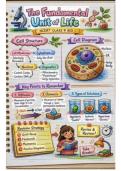
CellCell TheoryUnicellular OrganismMulticellular OrganismPlasma MembraneCell WallCytoplasmNucleusDNACell OrganellesMitochondriaEndoplasmic Reticulum (ER)RibosomesGolgi ApparatusLysosomesVacuolesDiffusionOsmosisSelective
Here is a summary of "The Fundamental Unit of Life" (Class 9 Science): The Fundamental Unit of Life – Summary The cell is known as the fundamental unit of life because all living organisms are made up of cells. It is the smallest structural and functional unit that can perform all life processes. The discovery of cells was made by Robert Hooke in 1665 when he observed a thin slice of cork under a microscope. Later, Antonie van Leeuwenhoek observed living cells. The cell theory was proposed by Matthias Schleiden and Theodor Schwann, stating that all living organisms are composed of cells and that the cell is the basic unit of life. Cells vary in shape and size depending on their function. Some organisms, such as bacteria and Amoeba, are unicellular (made up of one cell), while humans, animals, and plants are multicellular (made up of many cells). Each cell contains different structures called organelles that perform specific functions. The outer boundary of a cell is the plasma membrane or cell membrane. It is selectively permeable, allowing only certain substances to enter or leave the cell. Plant cells have an additional rigid covering called the cell wall, which provides shape, protection, and support. Inside the cell is a jelly-like substance called cytoplasm. It contains various cell organelles that carry out important life functions. The nucleus is the control center of the cell and contains genetic material (DNA). It regulates growth, reproduction, and all cellular activities. Other important organelles include mitochondria, known as the "powerhouse of the cell," because they produce energy through respiration. The endoplasmic reticulum (ER) helps in the transport of materials within the cell. The rough ER contains ribosomes and is involved in protein synthesis, while the smooth ER synthesizes fats and lipids. Ribosomes are tiny structures responsible for making proteins. The Golgi apparatus modifies, packages, and transports proteins and other materials. Lysosomes contain digestive enzymes that break down waste materials and worn-out organelles. Vacuoles store food, water, and waste products. In plant cells, vacuoles are usually large and help maintain cell turgidity. Plant cells also contain plastids. Chloroplasts, a type of plastid, contain chlorophyll and are responsible for photosynthesis, the process by which plants prepare their food using sunlight. Animal cells lack chloroplasts and cell walls. Cells exchange substances with their environment through processes such as diffusion and osmosis. Diffusion is the movement of substances from a region of higher concentration to lower concentration. Osmosis is the movement of water through a selectively permeable membrane from a region of higher water concentration to lower water concentration. In conclusion, the cell is the basic building block of life. Its organelles work together to perform essential functions such as nutrition, respiration, growth, excretion, and reproduction. Understanding cells helps us understand how living organisms function and survive.
Document information
- School year
- 3
- Uploaded on
- June 1, 2026
- Number of pages
- 10
- Written in
- 2025/2026
- Type
- Class notes
- Professor(s)
- Student
- Contains
- All classes


