

Terms in this set (41)
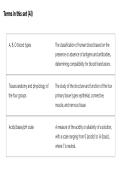
A, B, O blood types The classification of human blood based on the
presence or absence of antigens and antibodies,
determining compatibility for blood transfusions.
Tissues anatomy and physiology of The study of the structure and function of the four
the four groups primary tissue types: epithelial, connective,
muscle, and nervous tissue.
Acids/bases/pH scale A measure of the acidity or alkalinity of a solution,
with a scale ranging from 0 (acidic) to 14 (basic),
where 7 is neutral.
, Atoms and subatomic particles Atoms are the basic units of matter, composed of
subatomic particles: protons, neutrons, and
electrons.
ATP and energy Adenosine triphosphate (ATP) is the primary
energy carrier in cells, providing energy for
various cellular processes.
Homeostasis The process by which biological systems maintain
stability while adjusting to changing external
conditions.
A, B, O blood types The classification of human blood based on the
presence or absence of antigens and antibodies,
determining compatibility for blood transfusions.
Tissues anatomy and physiology of The study of the structure and function of the four
the four groups primary tissue types: epithelial, connective,
muscle, and nervous tissue.
Acids/bases/pH scale A measure of the acidity or alkalinity of a solution,
with a scale ranging from 0 (acidic) to 14 (basic),
where 7 is neutral.
, Atoms and subatomic particles Atoms are the basic units of matter, composed of
subatomic particles: protons, neutrons, and
electrons.
ATP and energy Adenosine triphosphate (ATP) is the primary
energy carrier in cells, providing energy for
various cellular processes.
Homeostasis The process by which biological systems maintain
stability while adjusting to changing external
conditions.



