
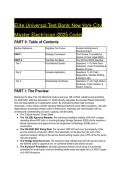
Elite Universal Test Bank: New York City
Master Electrician (2025 Code)
PART 0: Table of Contents
Section Reference Cognitive Tier Focus Content Architecture &
Structural Intent
PART I Strategic Framework The Preview, Foundational
Axioms, & Core Legal Matrix
PART II The Elite Test Bank The 30-Point MCQ Gauntlet
- Tier 1 Foundational Syntax Questions 1–10: Hard Deck
Definitions, Code Thresholds &
Baseline Physics
- Tier 2 Complex Application Questions 11–20: Field
Diagnostics, Variable Shifting,
& Design Logic
- Tier 3 Grandmaster Synthesis Questions 21–30: High-Stakes
Synthesis, Code Clashes, &
System Failures
PART I: The Preview
Mastering the New York City Electrical Code (Local Law 128 of 2024, adopting and amending
the 2020 NEC, effective December 21, 2025) directly separates the licensed Master Electrician
from the legal liability of a catastrophic failure. By internalizing these rigid municipal
thresholds—which strictly override standard National Electrical Code (NEC) baselines—the elite
diagnostician structurally protects urban infrastructure, replacing rote memorization with an
architectural understanding of power, capacity, and life-safety.
● The "Critical Axioms" Cheat Sheet
● The 110.2(B) Approval Mandate: Any electrical installation totaling 1000 kVA or larger,
operating above 600 Volts, or involving Energy Storage Systems (ESS) strictly requires a
formal submission and approval from the Department of Buildings (DOB) prior to
construction.
● The 230.42(E) SEC Sizing Rule: For services 1000 kVA and over, the ampacity of the
service-entrance conductors (SEC) must absolutely not be less than the sum of the
maximum ampere ratings of the service disconnecting means, plus 125% of the fire pump
full-load amperes.
● The Voltage Drop Hard Limit: The maximum total voltage drop from the service point to
the farthest outlet is capped at 5% on combined feeders and branch circuits.
● The Aluminum Prohibition: Standard aluminum branch circuit wiring is functionally
prohibited for small loads; minimum dwelling feeder sizes are rigidly set to 8 AWG Copper
or 6 AWG Aluminum.
,Component / Standard NYC 2025 Code Threshold / Application Parameter
Mandate
Low Voltage Work Under 50 Volts Requires Low Voltage Installer
Certification.
Fire Pump Routing 2-Hour Fire Resistance Rating Mandatory for single-source
indoor routing.
1000kVA+ Clearances 12 Inches from Floor Elevates live parts above flood
zones.
Cu Busbar < 1200A 1000 Amperes / sq. inch Standard switchboard density
(unventilated).
Al Busbar 1201-2000A 525 Amperes / sq. inch Derated density for trapped
thermal loads.
PART II: The Elite Test Bank
Tier 1 - Foundational Syntax & Application
Q1: A New York City Master Electrician is contracted to upgrade a commercial high-rise
electrical service. The existing service is rated at 800 kVA, and the new design will add a 300
kVA transformer to support a data center floor. Based on the principles of the 2025 NYC
Electrical Code, which action regarding municipal filing is the MOST ACCURATE? A) The
contractor may proceed with a standard minor electrical work permit, as the newly added load is
strictly under the 1000 kVA threshold. B) The contractor must file an electrical plan review solely
because the new design includes a mission-critical data center. C) The contractor must submit a
formal application for approval to the commissioner, as the addition brings the total installation
to 1000 kVA or larger. D) The contractor is exempt from plan review if the operating voltage
remains below 600V nominal.
● The Answer: C (The contractor must submit a formal application for approval to the
commissioner, as the addition brings the total installation to 1000 kVA or larger.)
● Distractor Analysis:
○ A is incorrect: The 110.2(B) threshold applies to the total aggregate capacity of the
installation, not just the isolated 300 kVA addition.
○ B is incorrect: The regulatory trigger is the 1000 kVA capacity limit, not the
occupancy type or the presence of a data center.
○ D is incorrect: Exceeding 600V is an independent trigger for special installation
approval, but reaching 1000 kVA triggers the rigorous Electrical Plan Review (EPR)
regardless of it being a low-voltage service.
The Mentor's Analysis: The NYC Department of Buildings heavily monitors massive power
concentrations to prevent grid destabilization and fire hazards in dense vertical environments.
When facing a service upgrade, the immediate priority is calculating the final aggregate kVA. By
utilizing the 110.2(B) Special Installations rule, you bypass the common trap of isolated
component permitting. Professional/Academic Intuition: Any change bringing a facility's total
service to 1000 kVA or greater automatically triggers mandatory EAB/EPR review.
Q2: When calculating the maximum allowable voltage drop for a newly constructed residential
dwelling unit in Brooklyn, an engineer routes a 100-amp feeder to a subpanel, followed by a
20-amp branch circuit to a distant kitchen receptacle. Under NYC amendments, what is the
maximum permissible total voltage drop from the service point to that specific receptacle? A) 3%
total combined drop B) 4% on the feeder, 2% on the branch circuit C) 5% total on both feeders
, and branch circuits combined D) Voltage drop is solely a manufacturer recommendation and not
a strict NYC Code requirement.
● The Answer: C (5% total on both feeders and branch circuits combined)
● Distractor Analysis:
○ A is incorrect: 3% is the NEC and NYC maximum allowable limit for a branch circuit
independently, not the total combined run.
○ B is incorrect: A 4% feeder drop combined with a 2% branch drop equals 6%,
violating the strict municipal cap.
○ D is incorrect: While the baseline NEC often treats voltage drop as an Informational
Note, the New York City Electrical Code explicitly amends this into a mandatory
legal requirement for energy conservation and equipment safety.
The Mentor's Analysis: Excessive voltage drop forces motors to draw higher amperage to
achieve the same wattage, exponentially increasing thermal stress on wire insulation. When
facing long conduit runs in multi-family dwellings, the immediate priority is up-sizing the wire
gauge to mitigate resistance. By utilizing the 5% combined hard cap, you bypass the common
trap of relying on minimum ampacity charts alone. Professional/Academic Intuition: Ampacity
ensures the wire won't melt; voltage drop ensures the equipment won't burn out. NYC strictly
enforces the 5% combined maximum from service point to farthest outlet.
Q3: A contractor is wiring a new single-family dwelling and wishes to use cost-effective
aluminum wiring. Based on the strict NYC Electrical Code amendments regarding conductor
materials, which installation is the MOST APPROPRIATE and legally compliant? A) Utilizing 12
AWG solid aluminum for general-purpose 20A branch lighting circuits. B) Utilizing 10 AWG
copper-clad aluminum for dedicated 15A receptacle circuits. C) Utilizing 6 AWG aluminum
conductors for the dwelling unit's main electrical feeder. D) Utilizing 8 AWG aluminum
conductors to feed a remote 50A subpanel.
● The Answer: C (Utilizing 6 AWG aluminum conductors for the dwelling unit's main
electrical feeder.)
● Distractor Analysis:
○ A is incorrect: NYC strictly prohibits the use of aluminum conductors for standard
small branch circuits due to historical fire hazards caused by thermal expansion and
galvanic corrosion.
○ B is incorrect: 10 AWG is insufficient for aluminum or copper-clad aluminum branch
circuits in NYC; the absolute minimum size permitted for limited load exceptions is 8
AWG.
○ D is incorrect: 8 AWG is the minimum size for copper feeders in a dwelling. The
absolute minimum size for an aluminum feeder is 6 AWG.
The Mentor's Analysis: Aluminum possesses a higher coefficient of thermal expansion than
copper, causing it to loosen under screw terminals over time, resulting in high-resistance arcing
faults. When facing budget constraints on residential wiring, the immediate priority is restricting
aluminum to heavy, large-gauge feeder applications where specialized, torque-rated lugs are
utilized. By utilizing minimum 6 AWG Al for feeders, you bypass the trap of catastrophic
branch-circuit fires. Professional/Academic Intuition: Never use aluminum for standard
residential branch circuits; reserve it exclusively for main feeders starting at 6 AWG minimum.
Q4: A licensed Master Electrician is designing a custom service switchboard rated at 1200
Amperes. To ensure adequate cross-sectional area for heat dissipation, how MUST the
unventilated copper busbars be sized according to Table 230.42 of the NYC Electrical Code? A)
750 Amperes per square inch B) 1000 Amperes per square inch C) 800 Amperes per square
inch D) 1200 Amperes per square inch
Master Electrician (2025 Code)
PART 0: Table of Contents
Section Reference Cognitive Tier Focus Content Architecture &
Structural Intent
PART I Strategic Framework The Preview, Foundational
Axioms, & Core Legal Matrix
PART II The Elite Test Bank The 30-Point MCQ Gauntlet
- Tier 1 Foundational Syntax Questions 1–10: Hard Deck
Definitions, Code Thresholds &
Baseline Physics
- Tier 2 Complex Application Questions 11–20: Field
Diagnostics, Variable Shifting,
& Design Logic
- Tier 3 Grandmaster Synthesis Questions 21–30: High-Stakes
Synthesis, Code Clashes, &
System Failures
PART I: The Preview
Mastering the New York City Electrical Code (Local Law 128 of 2024, adopting and amending
the 2020 NEC, effective December 21, 2025) directly separates the licensed Master Electrician
from the legal liability of a catastrophic failure. By internalizing these rigid municipal
thresholds—which strictly override standard National Electrical Code (NEC) baselines—the elite
diagnostician structurally protects urban infrastructure, replacing rote memorization with an
architectural understanding of power, capacity, and life-safety.
● The "Critical Axioms" Cheat Sheet
● The 110.2(B) Approval Mandate: Any electrical installation totaling 1000 kVA or larger,
operating above 600 Volts, or involving Energy Storage Systems (ESS) strictly requires a
formal submission and approval from the Department of Buildings (DOB) prior to
construction.
● The 230.42(E) SEC Sizing Rule: For services 1000 kVA and over, the ampacity of the
service-entrance conductors (SEC) must absolutely not be less than the sum of the
maximum ampere ratings of the service disconnecting means, plus 125% of the fire pump
full-load amperes.
● The Voltage Drop Hard Limit: The maximum total voltage drop from the service point to
the farthest outlet is capped at 5% on combined feeders and branch circuits.
● The Aluminum Prohibition: Standard aluminum branch circuit wiring is functionally
prohibited for small loads; minimum dwelling feeder sizes are rigidly set to 8 AWG Copper
or 6 AWG Aluminum.
,Component / Standard NYC 2025 Code Threshold / Application Parameter
Mandate
Low Voltage Work Under 50 Volts Requires Low Voltage Installer
Certification.
Fire Pump Routing 2-Hour Fire Resistance Rating Mandatory for single-source
indoor routing.
1000kVA+ Clearances 12 Inches from Floor Elevates live parts above flood
zones.
Cu Busbar < 1200A 1000 Amperes / sq. inch Standard switchboard density
(unventilated).
Al Busbar 1201-2000A 525 Amperes / sq. inch Derated density for trapped
thermal loads.
PART II: The Elite Test Bank
Tier 1 - Foundational Syntax & Application
Q1: A New York City Master Electrician is contracted to upgrade a commercial high-rise
electrical service. The existing service is rated at 800 kVA, and the new design will add a 300
kVA transformer to support a data center floor. Based on the principles of the 2025 NYC
Electrical Code, which action regarding municipal filing is the MOST ACCURATE? A) The
contractor may proceed with a standard minor electrical work permit, as the newly added load is
strictly under the 1000 kVA threshold. B) The contractor must file an electrical plan review solely
because the new design includes a mission-critical data center. C) The contractor must submit a
formal application for approval to the commissioner, as the addition brings the total installation
to 1000 kVA or larger. D) The contractor is exempt from plan review if the operating voltage
remains below 600V nominal.
● The Answer: C (The contractor must submit a formal application for approval to the
commissioner, as the addition brings the total installation to 1000 kVA or larger.)
● Distractor Analysis:
○ A is incorrect: The 110.2(B) threshold applies to the total aggregate capacity of the
installation, not just the isolated 300 kVA addition.
○ B is incorrect: The regulatory trigger is the 1000 kVA capacity limit, not the
occupancy type or the presence of a data center.
○ D is incorrect: Exceeding 600V is an independent trigger for special installation
approval, but reaching 1000 kVA triggers the rigorous Electrical Plan Review (EPR)
regardless of it being a low-voltage service.
The Mentor's Analysis: The NYC Department of Buildings heavily monitors massive power
concentrations to prevent grid destabilization and fire hazards in dense vertical environments.
When facing a service upgrade, the immediate priority is calculating the final aggregate kVA. By
utilizing the 110.2(B) Special Installations rule, you bypass the common trap of isolated
component permitting. Professional/Academic Intuition: Any change bringing a facility's total
service to 1000 kVA or greater automatically triggers mandatory EAB/EPR review.
Q2: When calculating the maximum allowable voltage drop for a newly constructed residential
dwelling unit in Brooklyn, an engineer routes a 100-amp feeder to a subpanel, followed by a
20-amp branch circuit to a distant kitchen receptacle. Under NYC amendments, what is the
maximum permissible total voltage drop from the service point to that specific receptacle? A) 3%
total combined drop B) 4% on the feeder, 2% on the branch circuit C) 5% total on both feeders
, and branch circuits combined D) Voltage drop is solely a manufacturer recommendation and not
a strict NYC Code requirement.
● The Answer: C (5% total on both feeders and branch circuits combined)
● Distractor Analysis:
○ A is incorrect: 3% is the NEC and NYC maximum allowable limit for a branch circuit
independently, not the total combined run.
○ B is incorrect: A 4% feeder drop combined with a 2% branch drop equals 6%,
violating the strict municipal cap.
○ D is incorrect: While the baseline NEC often treats voltage drop as an Informational
Note, the New York City Electrical Code explicitly amends this into a mandatory
legal requirement for energy conservation and equipment safety.
The Mentor's Analysis: Excessive voltage drop forces motors to draw higher amperage to
achieve the same wattage, exponentially increasing thermal stress on wire insulation. When
facing long conduit runs in multi-family dwellings, the immediate priority is up-sizing the wire
gauge to mitigate resistance. By utilizing the 5% combined hard cap, you bypass the common
trap of relying on minimum ampacity charts alone. Professional/Academic Intuition: Ampacity
ensures the wire won't melt; voltage drop ensures the equipment won't burn out. NYC strictly
enforces the 5% combined maximum from service point to farthest outlet.
Q3: A contractor is wiring a new single-family dwelling and wishes to use cost-effective
aluminum wiring. Based on the strict NYC Electrical Code amendments regarding conductor
materials, which installation is the MOST APPROPRIATE and legally compliant? A) Utilizing 12
AWG solid aluminum for general-purpose 20A branch lighting circuits. B) Utilizing 10 AWG
copper-clad aluminum for dedicated 15A receptacle circuits. C) Utilizing 6 AWG aluminum
conductors for the dwelling unit's main electrical feeder. D) Utilizing 8 AWG aluminum
conductors to feed a remote 50A subpanel.
● The Answer: C (Utilizing 6 AWG aluminum conductors for the dwelling unit's main
electrical feeder.)
● Distractor Analysis:
○ A is incorrect: NYC strictly prohibits the use of aluminum conductors for standard
small branch circuits due to historical fire hazards caused by thermal expansion and
galvanic corrosion.
○ B is incorrect: 10 AWG is insufficient for aluminum or copper-clad aluminum branch
circuits in NYC; the absolute minimum size permitted for limited load exceptions is 8
AWG.
○ D is incorrect: 8 AWG is the minimum size for copper feeders in a dwelling. The
absolute minimum size for an aluminum feeder is 6 AWG.
The Mentor's Analysis: Aluminum possesses a higher coefficient of thermal expansion than
copper, causing it to loosen under screw terminals over time, resulting in high-resistance arcing
faults. When facing budget constraints on residential wiring, the immediate priority is restricting
aluminum to heavy, large-gauge feeder applications where specialized, torque-rated lugs are
utilized. By utilizing minimum 6 AWG Al for feeders, you bypass the trap of catastrophic
branch-circuit fires. Professional/Academic Intuition: Never use aluminum for standard
residential branch circuits; reserve it exclusively for main feeders starting at 6 AWG minimum.
Q4: A licensed Master Electrician is designing a custom service switchboard rated at 1200
Amperes. To ensure adequate cross-sectional area for heat dissipation, how MUST the
unventilated copper busbars be sized according to Table 230.42 of the NYC Electrical Code? A)
750 Amperes per square inch B) 1000 Amperes per square inch C) 800 Amperes per square
inch D) 1200 Amperes per square inch


