

Written by students who passed Immediately available after payment Read online or as PDF Wrong document? Swap it for free 4.6 TrustPilot
logo-home
Document preview thumbnail
Preview 2 out of 11 pages
Exam (elaborations)

68W Combat Medic Module 1 Comprehensive AIT Study Guide 2026 | 150+ Army EMT Exam Questions and Answers on EMS Operations, Medical Ethics, Patient Handling, Anatomy & Physiology, Respiratory Care and Developmental Assessment | U.S. Army 68W Certification

Document preview thumbnail
Preview 2 out of 11 pages

This 68W Combat Medic Module 1 Comprehensive AIT Study Guide 2026 contains more than 150 detailed Army EMT and Combat Medic exam questions with verified answers covering EMS provider levels, medical ethics and legal responsibilities, patient handling and transportation, anatomy and physiology, respiratory and cardiovascular systems, developmental assessment, stress management, emergency patient movement, pediatric care, and foundational emergency medical services concepts. The document provides extensive review material on Emergency Medical Responders (EMR), Emergency Medical Technicians (EMT), Advanced EMTs (AEMT), paramedic responsibilities, negligence, abandonment, assault, battery, patient confidentiality, lifting and carrying techniques, spinal immobilization devices, blood circulation, homeostasis, respiratory physiology, shock, and patient assessment principles commonly tested during Army 68W Advanced Individual Training (AIT), NREMT preparation, and military medical certification programs. The study guide is organized in a structured question-and-answer format specifically designed to strengthen military medical knowledge, emergency patient care competency, legal and ethical awareness, anatomy and physiology understanding, and certification examination performance. Students and combat medics will review major concepts including EMS provider scope of practice, acute stress reactions, delayed stress reactions, cumulative stress, tort law, intentional torts, negligence standards, abandonment, assault, battery, false imprisonment, defamation, patient confidentiality, and professional responsibilities within prehospital emergency care. The material also explores practical EMS operations involving patient lifting techniques, power lifts, squat lifts, power grips, emergency patient movement, urgent and non-urgent extrication procedures, and safe patient transportation methods. Major topics covered throughout the document include wheeled stretchers, portable stretchers, scoop stretchers, basket stretchers, bariatric stretchers, stair chairs, long backboards, vacuum mattresses, Kendrick Extrication Devices (KEDs), pediatric examination approaches, developmental milestones, infant reflexes, communication strategies across age groups, and age-specific patient assessment considerations. The guide also reviews infant, toddler, preschool, school-age, adolescent, middle-adulthood, and late-adulthood developmental characteristics while reinforcing age-appropriate communication and examination techniques used by EMS professionals. Additional sections focus extensively on anatomy, physiology, and emergency medicine fundamentals, including blood circulation pathways, coronary circulation, major arteries, pathophysiology, homeostasis, pH regulation, hypovolemia, aerobic and anaerobic metabolism, oxygen transport, respiratory physiology, tidal volume, minute volume, ventilation-perfusion (V/Q) matching, preload, afterload, contractility, hypoxia, hypercapnia, autonomic nervous system regulation, cerebral spinal fluid, meninges, reflex development, and pediatric vital signs. The document further reinforces essential EMT concepts involving respiratory function, cardiovascular performance, neurologic protection, oxygen delivery, and physiologic responses to illness and injury. This resource is especially valuable for Army 68W Combat Medic candidates, EMT students, Advanced EMT students, military healthcare trainees, National Registry EMT candidates, emergency medical responders, nursing students, physician assistant students, military medical personnel, and individuals preparing for combat medic certification examinations or emergency medical careers. It is highly suitable for Army AIT preparation, NREMT review, EMS foundations coursework, anatomy and physiology study, patient assessment training, military medical education, and independent healthcare learning. The EMS, anatomy, physiology, and patient-care concepts discussed throughout this review align with widely recognized emergency medical services and healthcare education literature, including: Emergency Care and Transportation of the Sick and Injured by the American Academy of Orthopaedic Surgeons (AAOS) Nancy Caroline’s Emergency Care in the Streets by Nancy Caroline Prehospital Emergency Care by Joseph J. Mistovich and Keith J. Karren Combat Medic Specialist (68W) Training Program published by the U.S. Army Medical Center of Excellence Core topics such as EMS operations, patient assessment, medical ethics, respiratory physiology, cardiovascular anatomy, pediatric care, patient movement, emergency medical response, developmental psychology, and anatomy and physiology are also supported by standards and educational guidance published by NREMT, NAEMT, AHA, CDC, NHTSA, and the U.S. Army Medical Department. Keywords 68W Combat Medic, Army AIT, Army EMT, Module 1, EMS operations, EMR, EMT, AEMT, paramedic, NREMT preparation, combat medic study guide, medical ethics, negligence, abandonment, assault, battery, false imprisonment, defamation, patient confidentiality, intentional tort, legal responsibilities, stress management, acute stress reaction, delayed stress reaction, cumulative stress, patient lifting techniques, power lift, squat lift, power grip, patient transportation, emergency moves, urgent moves, non urgent moves, wheeled stretcher, scoop stretcher, basket stretcher, stair chair, KED, spinal immobilization, pediatric assessment, infant examination, toddler examination, adolescent assessment, developmental milestones, Moro reflex, rooting reflex, sucking reflex, palmar reflex, anatomy and physiology, cardiovascular system, blood circulation, coronary arteries, aorta, carotid artery, femoral artery, pathophysiology, homeostasis, hypovolemia, aerobic metabolism, anaerobic metabolism, respiratory physiology, tidal volume, minute volume, ventilation, respiration, hypoxia, hypercapnia, preload, afterload, contractility, VQ match, autonomic nervous system, meninges, cerebrospinal fluid, toddler vital signs, emergency medical services, military medicine, EMT certification review

Content preview

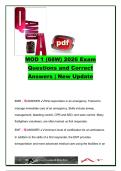
MOD 1 (68W) 2026 Exam
Questions and Correct
Answers | New Update


EMR - ANSWER ✔✔first responders in an emergency. Trained to

manage immediate care of an emergency. Skills include airway

management, bleeding control, CPR and AED, and seen control. Many

firefighters volunteers, are often trained us first responder.


EMT - ANSWER ✔✔minimum level of certification for an ambulance.

In addition to the skills of a first responder, the EMT provides

transportation and more advanced medical care using the facilities in an

, ambulance. The role of the EMT is to stabilize the patients conditions

until arrival at the hospital or treatment will be provided .


AEMT - ANSWER ✔✔In addition to the skills of an EMT, the EMT can

administer much more medications. These include both oral and

intravenous medications.


paramedic - ANSWER ✔✔The paramedic provides the highest level

of prehospital care. These include advance intravenous, administering a

wide variety of medications, and advanced life support.


What are the symptoms of stress? - ANSWER ✔✔Anxiety, irritability,

nausea, guilt, isolation, loss of concentration, appetite, and interest in life


Acute stress reaction - ANSWER ✔✔Occurs immediately after and

emotionally traumatic event


Delayed stress reaction - ANSWER ✔✔Occurs after delayed period

after an incident


Cumulative stress reaction - ANSWER ✔✔Occurs as a result of little

stress reactions overtime


What is a tort? Give an example. - ANSWER ✔✔Wrongful act, injury,

or damage. Negligence.

Document information

Uploaded on
May 30, 2026
Number of pages
11
Written in
2025/2026
Type
Exam (elaborations)
Contains
Questions & answers
$18.99

Wrong document? Swap it for free Within 14 days of purchase and before downloading, you can choose a different document. You can simply spend the amount again.
Written by students who passed
Immediately available after payment
Read online or as PDF

Seller avatar
Reputation scores are based on the amount of documents a seller has sold for a fee and the reviews they have received for those documents. There are three levels: Bronze, Silver and Gold. The better the reputation, the more your can rely on the quality of the sellers work.
JOSHCLAY
3.5
(85)
Sold
395
Followers
15
Items
20743
Last sold
5 days ago


Why students choose Stuvia

Created by fellow students, verified by reviews

Quality you can trust: written by students who passed their tests and reviewed by others who've used these notes.

Didn't get what you expected? Choose another document

No worries! You can instantly pick a different document that better fits what you're looking for.

Pay as you like, start learning right away

No subscription, no commitments. Pay the way you're used to via credit card and download your PDF document instantly.

Student with book image

“Bought, downloaded, and aced it. It really can be that simple.”

Alisha Student

Working on your references?

Create accurate citations in APA, MLA and Harvard with our free citation generator.

Working on your references?

Frequently asked questions

