

Written by students who passed Immediately available after payment Read online or as PDF Wrong document? Swap it for free 4.6 TrustPilot
logo-home
Document preview thumbnail
Preview 2 out of 9 pages
Exam (elaborations)

68W Combat Medic Module 1 EMS Operations and Professional Responsibilities 2026 Study Guide | 100+ Army EMT Exam Questions and Answers on EMS Systems, Medical Direction, Infection Control, Stress Management & Hazardous Materials | 68W AIT

Document preview thumbnail
Preview 2 out of 9 pages

This 68W Combat Medic Module 1 EMS Operations and Professional Responsibilities 2026 Study Guide contains more than 100 comprehensive Army EMT and Combat Medic exam questions with verified answers covering EMS system foundations, medical direction, infection control, patient advocacy, quality improvement, hazardous materials awareness, stress management, communicable diseases, personal protective equipment (PPE), scene safety, and professional EMT responsibilities. The document provides detailed review material on National Registry standards, EMS protocols, standing orders, medical oversight, transfer of care, bloodborne pathogens, airborne diseases, OSHA regulations, Ryan White CARE Act requirements, critical incident stress management, and hazardous materials response principles commonly tested during Army 68W Advanced Individual Training (AIT), EMT certification courses, and emergency medical services examinations. The study guide is organized in a structured question-and-answer format specifically designed to strengthen EMS operational knowledge, infection prevention competency, patient care understanding, scene safety awareness, and military medical exam preparation. Students and combat medics will review major concepts including the history of EMS standards, the role of the National Registry of Emergency Medical Technicians (NREMT), enhanced 911 systems, medical directors, patient advocacy responsibilities, transfer of care procedures, quality improvement programs, protocol implementation, standing orders, online and offline medical direction, and evidence-based medicine. The material also explores professional EMT responsibilities related to communication, documentation, patient outcomes, and medical oversight in prehospital emergency care. Major topics covered throughout the document include infection control principles, standard precautions, bloodborne pathogens, airborne pathogens, hepatitis, tuberculosis (TB), SARS, personal protective equipment (PPE), N95 respirator requirements, OSHA standards, contamination prevention, disease exposure reporting procedures, and Ryan White CARE Act notification requirements. The guide also reviews exposure determination timelines, designated officer responsibilities, emergency responder health protection measures, and best practices for reducing occupational exposure to infectious diseases in EMS environments. Additional sections focus extensively on EMT stress management and behavioral health concepts, including General Adaptation Syndrome (GAS), acute stress reactions, delayed stress reactions (PTSD), cumulative stress reactions, burnout, critical incident stress management (CISM), and psychological responses to traumatic events. Students will also review the five stages of death and dying—denial, anger, bargaining, depression, and acceptance—as well as coping mechanisms and wellness strategies used by EMS professionals. The document further reinforces hazardous materials awareness, decontamination procedures, self-contained breathing apparatus (SCBA) use, hazardous materials recognition, scene safety priorities, and emergency response decision-making through the principles of retreat, regroup, and reevaluate during dangerous incidents. This resource is especially valuable for Army 68W Combat Medic candidates, EMT students, Advanced EMT students, military healthcare trainees, National Registry EMT candidates, emergency medical responders, firefighters, law enforcement personnel, nursing students, and individuals preparing for combat medic certification examinations or emergency medical careers. It is highly suitable for Army AIT preparation, NREMT review, EMS operations coursework, infection control training, occupational safety education, and independent healthcare study. The EMS operations, infection control, and emergency medical concepts discussed throughout this review align with widely recognized EMS and healthcare education literature, including: Emergency Care and Transportation of the Sick and Injured by the American Academy of Orthopaedic Surgeons (AAOS) Nancy Caroline’s Emergency Care in the Streets by Nancy Caroline EMS Systems, Roles and Responsibilities educational standards published by the National Highway Traffic Safety Administration (NHTSA) Combat Medic Specialist (68W) Training Program published by the U.S. Army Medical Center of Excellence Core topics such as EMS operations, medical direction, infection prevention, hazardous materials response, stress management, patient advocacy, scene safety, and occupational health are also supported by standards and educational guidance published by NREMT, OSHA, CDC, NAEMT, FEMA, and the U.S. Army Medical Department. Keywords 68W Combat Medic, Army EMT, EMS operations, EMS systems, NREMT, medical director, medical direction, standing orders, online medical control, offline medical control, patient advocacy, transfer of care, quality improvement, evidence based medicine, EMS protocols, enhanced 911, EMT responsibilities, infection control, bloodborne pathogens, airborne pathogens, standard precautions, OSHA, PPE, personal protective equipment, hepatitis B, hepatitis C, tuberculosis, TB exposure, SARS, N95 respirator, Ryan White CARE Act, disease exposure reporting, scene safety, contamination, decontamination, hazardous materials, hazmat awareness, SCBA, communicable diseases, occupational safety, EMT stress management, General Adaptation Syndrome, acute stress reaction, PTSD, delayed stress reaction, cumulative stress reaction, burnout, critical incident stress management, CISM, critical incident stress debriefing, stages of grief, denial, anger, bargaining, depression, acceptance, military medicine, emergency medical services, Army AIT, EMT certification review, combat medic study guide

Content preview

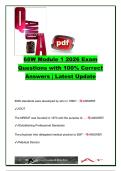
68W Module 1 2026 Exam
Questions with 100% Correct
Answers | Latest Update


EMS standards were developed by who in 1996? - ANSWER

✔✔DOT


The NREMT was founded in 1970 with the purpose of... - ANSWER

✔✔Establishing Professional Standards


The physician who delegated medical practice to EMT - ANSWER

✔✔Medical Director

, The Evaluation and Improvement in an EMS system is known as.. -

ANSWER ✔✔Quality Improvement


System with the capability of identifying the location of the caller -

ANSWER ✔✔enhanced 911


Your first responsibility as an EMT at any call.. - ANSWER

✔✔Personal safety


One of your responsibilities as an EMT that deals with building rapport

and understanding of patient's condition - ANSWER ✔✔Patient

Advocacy

When you pass information about the patient to hospital personnel, you

are fulfilling the EMT responsibility of - ANSWER ✔✔Transfer of care


Continuous self-review with the purpose of identifying aspects of the

system that require improvement - ANSWER ✔✔quality improvement


List of steps, such as assessments and interventions written by the

Medical Direction - ANSWER ✔✔protocols


Oversight of the patient care aspects of an EMS system by the Medical

Director - ANSWER ✔✔medical direction

Document information

Uploaded on
May 30, 2026
Number of pages
9
Written in
2025/2026
Type
Exam (elaborations)
Contains
Questions & answers
$18.99

Wrong document? Swap it for free Within 14 days of purchase and before downloading, you can choose a different document. You can simply spend the amount again.
Written by students who passed
Immediately available after payment
Read online or as PDF

Seller avatar
Reputation scores are based on the amount of documents a seller has sold for a fee and the reviews they have received for those documents. There are three levels: Bronze, Silver and Gold. The better the reputation, the more your can rely on the quality of the sellers work.
JOSHCLAY
3.5
(85)
Sold
395
Followers
15
Items
20743
Last sold
5 days ago


Why students choose Stuvia

Created by fellow students, verified by reviews

Quality you can trust: written by students who passed their tests and reviewed by others who've used these notes.

Didn't get what you expected? Choose another document

No worries! You can instantly pick a different document that better fits what you're looking for.

Pay as you like, start learning right away

No subscription, no commitments. Pay the way you're used to via credit card and download your PDF document instantly.

Student with book image

“Bought, downloaded, and aced it. It really can be that simple.”

Alisha Student

Working on your references?

Create accurate citations in APA, MLA and Harvard with our free citation generator.

Working on your references?

Frequently asked questions

