

Written by students who passed Immediately available after payment Read online or as PDF Wrong document? Swap it for free 4.6 TrustPilot
logo-home
Document preview thumbnail
Preview 3 out of 23 pages
Exam (elaborations)

68W Combat Medic Module 1 Anatomy and Physiology 2026 Study Guide | 350+ Army EMT Exam Questions and Answers on Anatomy, Physiology, Shock, Cardiovascular System, Respiratory System & Patient Assessment | 68W AIT Certification

Document preview thumbnail
Preview 3 out of 23 pages

This 68W Combat Medic Module 1 Anatomy and Physiology 2026 Study Guide contains more than 350 comprehensive Army EMT and Combat Medic exam questions with verified answers covering anatomy and physiology, medical terminology, respiratory anatomy, cardiovascular physiology, shock recognition, nervous system function, musculoskeletal anatomy, endocrine regulation, cellular metabolism, blood circulation, patient positioning, and emergency medical assessment principles. The document provides detailed review material on body systems, anatomical terminology, planes and directional terms, respiratory mechanics, cardiac output, blood pressure regulation, oxygen transport, perfusion, fluid compartments, and shock pathophysiology commonly tested during Army 68W Advanced Individual Training (AIT), EMT certification courses, National Registry preparation, and military medical training programs. The study guide is organized in a structured question-and-answer format specifically designed to strengthen foundational medical knowledge, anatomy comprehension, physiology competency, patient assessment skills, and military medical exam preparation. Students and combat medics will review major concepts including anatomical position, body planes, abdominal quadrants, proximal and distal relationships, musculoskeletal structures, spinal anatomy, respiratory physiology, gas exchange, cardiovascular circulation, nervous system regulation, homeostasis, endocrine function, cellular metabolism, and emergency patient positioning. The material also explores critical EMT concepts such as dyspnea, tachypnea, bradypnea, apnea, hypoventilation, perfusion, oxygenation, minute volume, tidal volume, ventilation-perfusion matching, and shock recognition. Major topics covered throughout the document include cervical, thoracic, lumbar, sacral, and coccygeal vertebrae; upper and lower extremity anatomy; pelvis and acetabulum structures; respiratory structures including the nasopharynx, oropharynx, larynx, trachea, bronchi, alveoli, diaphragm, and intercostal muscles; cardiovascular anatomy including the myocardium, atria, ventricles, aorta, coronary arteries, and major pulse points; and neurological structures involving the central nervous system, peripheral nervous system, autonomic nervous system, hypothalamus, and medulla oblongata. The guide also reviews blood components, cardiac output, stroke volume, preload, afterload, contractility, blood pressure regulation, capillary exchange, hydrostatic pressure, plasma oncotic pressure, and oxygen delivery mechanisms. Additional sections focus extensively on shock physiology and emergency medicine concepts, including hypovolemic shock, distributive shock, cardiogenic shock, obstructive shock, loss of vascular tone, excessive capillary permeability, blood volume regulation, sympathetic nervous system responses, compensation mechanisms, and clinical shock indicators such as tachycardia, tachypnea, delayed capillary refill, altered mental status, diaphoresis, and pale skin. The document further reinforces essential combat medic knowledge involving fluid compartments, intracellular and intravascular fluid balance, cellular energy production (ATP), aerobic and anaerobic metabolism, electrolyte regulation, and trauma-related disruptions to respiratory and cardiovascular function. This resource is especially valuable for Army 68W Combat Medic candidates, EMT students, Advanced EMT students, military healthcare trainees, National Registry EMT candidates, emergency medical responders, nursing students, physician assistant students, military medical personnel, and individuals preparing for combat medic certification examinations or emergency medical careers. It is highly suitable for Army AIT preparation, NREMT review, EMT coursework, military medical education, anatomy and physiology courses, patient assessment training, and independent healthcare study. The anatomy, physiology, and emergency medical concepts discussed throughout this review align with widely recognized EMS and medical education literature, including: Emergency Care and Transportation of the Sick and Injured by the American Academy of Orthopaedic Surgeons (AAOS) Nancy Caroline’s Emergency Care in the Streets by Nancy Caroline Principles of Anatomy and Physiology by Gerard J. Tortora and Bryan Derrickson Combat Medic Specialist (68W) Training Program published by the U.S. Army Medical Center of Excellence Core topics such as anatomy and physiology, shock management, respiratory function, cardiovascular physiology, nervous system regulation, patient assessment, perfusion, oxygenation, cellular metabolism, and emergency medical care are also supported by standards and educational guidance published by NREMT, NAEMT, AHA, American Red Cross, and the U.S. Army Medical Department. Keywords 68W Combat Medic, Army EMT, 68W Module 1, anatomy and physiology, EMT study guide, Army AIT, NREMT preparation, patient assessment, medical terminology, anatomical position, body planes, abdominal quadrants, musculoskeletal system, cervical vertebrae, thoracic vertebrae, lumbar vertebrae, sacral vertebrae, coccyx, respiratory system, cardiovascular system, nervous system, endocrine system, renal system, respiratory physiology, gas exchange, alveoli, trachea, bronchi, diaphragm, tidal volume, minute volume, perfusion, oxygenation, homeostasis, hypothalamus, medulla oblongata, sympathetic nervous system, parasympathetic nervous system, myocardium, cardiac output, stroke volume, preload, afterload, contractility, blood pressure, capillary exchange, plasma oncotic pressure, hydrostatic pressure, shock physiology, hypovolemic shock, distributive shock, cardiogenic shock, obstructive shock, cellular metabolism, ATP, aerobic metabolism, anaerobic metabolism, fluid compartments, combat medic training, military medicine, emergency medical services, EMT certification review

Content preview

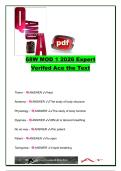
68W MOD 1 2026 Expert
Verifed Ace the Text


Therm - ANSWER ✔✔heat


Anatomy - ANSWER ✔✔The study of body structure


Physiology - ANSWER ✔✔The study of body function


Dyspnea - ANSWER ✔✔difficult or labored breathing


No air way - ANSWER ✔✔No patient


Patent - ANSWER ✔✔to open


Tachypnea - ANSWER ✔✔rapid breathing

,bradypnea - ANSWER ✔✔slow breathing


apnea - ANSWER ✔✔absence of breathing


eupnea - ANSWER ✔✔normal breathing


CPAP - ANSWER ✔✔continuous positive airway pressure


Anotomical Position - ANSWER ✔✔Body straight, face foward, arms

at side, palms foward.


plane - ANSWER ✔✔a flat surface formed when slicing through a

solid object


Midline - ANSWER ✔✔An imaginary line drawn down the center of

the body, dividing it into right and left halves.


lateral line - ANSWER ✔✔Farther away from midline. Down the side.


bilateral - ANSWER ✔✔both sides of body.


unilateral - ANSWER ✔✔pertaining to one side of the body


midaxillary line - ANSWER ✔✔An imaginary vertical line that starts at

the middle of the axilla (armpit) and extends down the side of the chest.


Anterior - ANSWER ✔✔front of the body


Posterior - ANSWER ✔✔back of body

, Proximal - ANSWER ✔✔Nearer to the trunk of the body (Torso)


Distal - ANSWER ✔✔Farther from the trunk of the body (torso)


Palmar - ANSWER ✔✔pertaining to the palm of the hand


plantar - ANSWER ✔✔sole of foot


midclavicular line - ANSWER ✔✔imaginary vertical line bisecting the

middle of the clavicle in each hemithorax (dividing chest into regions)


frontal plane (coronal plane) - ANSWER ✔✔Divides the body into

front and back portions.


sagittal plane - ANSWER ✔✔divides body into left and right


traverse plane (horizontal plane) - ANSWER ✔✔divides the body into

upper and lower portions


abdominal quadrants - ANSWER ✔✔Four divisions of the abdomen

used to pinpoint the location of a pain or injury (ruq, rlq, luq, llq)


Superior - ANSWER ✔✔Higher on the body, nearer to the head


Inferior - ANSWER ✔✔Lower on the body, farther from the head


Right Upper Quadrant (RUQ) - ANSWER ✔✔gallbladder and liver


3
COPYRIGHT©JOSHCLAY 2025/2026. YEAR PUBLISHED 2026. COMPANY REGISTRATION NUMBER: 619652435. TERMS OF USE. PRIVACY
STATEMENT. ALL RIGHTS RESERVED


Document information

Uploaded on
May 30, 2026
Number of pages
23
Written in
2025/2026
Type
Exam (elaborations)
Contains
Questions & answers
$18.99

Wrong document? Swap it for free Within 14 days of purchase and before downloading, you can choose a different document. You can simply spend the amount again.
Written by students who passed
Immediately available after payment
Read online or as PDF

Seller avatar
Reputation scores are based on the amount of documents a seller has sold for a fee and the reviews they have received for those documents. There are three levels: Bronze, Silver and Gold. The better the reputation, the more your can rely on the quality of the sellers work.
JOSHCLAY
3.5
(85)
Sold
395
Followers
15
Items
20743
Last sold
5 days ago


Why students choose Stuvia

Created by fellow students, verified by reviews

Quality you can trust: written by students who passed their tests and reviewed by others who've used these notes.

Didn't get what you expected? Choose another document

No worries! You can instantly pick a different document that better fits what you're looking for.

Pay as you like, start learning right away

No subscription, no commitments. Pay the way you're used to via credit card and download your PDF document instantly.

Student with book image

“Bought, downloaded, and aced it. It really can be that simple.”

Alisha Student

Working on your references?

Create accurate citations in APA, MLA and Harvard with our free citation generator.

Working on your references?

Frequently asked questions
