

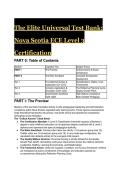
The Elite Universal Test Bank:
Nova Scotia ECE Level 3
Certification
PART 0: Table of Contents
Section Cognitive Tier Subject Focus
PART I The Preview Critical Axioms & Exam
Architecture
PART II The Elite Test Bank Complete 60-Question
Assessment
Tier 1 Foundational Syntax & Classifications, Ratios, Core
Application (Q1–Q15) Frameworks
Tier 2 Complex Application & The Reflective Planning Cycle,
Simulation (Q16–Q35) Quality Growth Plans
Tier 3 Grandmaster Synthesis High-Stakes Compliance,
(Q36–Q60) Multi-Variable Pedagogy
PART I: The Preview
Mastery of this test bank translates directly to elite pedagogical leadership and administrative
compliance within Nova Scotia's regulated early learning sector. These rigorous assessments
forge theoretical frameworks into precise, real-world clinical and operational competence,
eliminating novice hesitation.
The "Critical Axioms" Cheat Sheet
● The Certification Mandate: A Level 3 Classification inherently requires a Bachelor’s
degree in early childhood education (or an approved degree combined with a Level 2
diploma) and represents the apex of pedagogical authority.
● The Ratio Hard-Deck: Full-day infant ratios are strictly 1:4 (maximum group size 10).
Toddler ratios are 1:6 (maximum group size 18). In any mixed-age configuration, the
mandated ratio defaults entirely to the youngest child present.
● The Quality Matters Doctrine: Provincial funding is strictly tethered to the Quality
Growth Plan (QGP), demanding continuous improvement across four distinct elements:
Leadership, Staffing, Learning Environments, and Relationships.
● The Framework Axiom: Under the Capable, Confident, and Curious framework, children
are recognized as active constructors of knowledge, and educators operate as
co-researchers utilizing the Reflective Planning Cycle.
, ● Nutritional Sovereignty: Full-fat milk (3.25%) is legally mandated for children under two
years of age. Honey is strictly prohibited for any child under 12 months.
PART II: THE ELITE TEST BANK
Tier 1: Foundational Syntax & Application
Q1: An applicant submits documentation indicating the successful completion of a 900-hour
post-secondary Early Childhood Education diploma approved by the Director. Based on the
Classification Services guidelines, which classification is the MOST ACCURATE for this
individual? A) Entry-Level Classification B) Level 1 Classification C) Level 2 Classification D)
Level 3 Classification
● The Answer: C (Level 2 Classification)
● Distractor Analysis:
○ A is incorrect: Entry-Level requires only the completion of Orientation Training or
comparable courses, not a full 900-hour diploma.
○ B is incorrect: Level 1 requires orientation training plus specific coursework and 250
hours of workplace experience, falling short of a full diploma.
○ D is incorrect: Level 3 strictly requires a Bachelor's degree in an approved ECE
discipline. A diploma alone is insufficient.
The Mentor's Analysis: Classification tiers dictate the legal scope of practice within a regulated
facility. By verifying the exact credential threshold (a 900-hour approved diploma), the
administrator aligns the applicant with Level 2 Classification. Professional/Academic Intuition:
The diploma secures Level 2; the Bachelor's degree unlocks Level 3.
Q2: A licensed full-day child care center is organizing a dedicated room for infants. According to
the Early Learning and Child Care Regulations, what is the MAXIMUM allowable group size and
staff-to-child ratio for this specific demographic? A) Ratio of 1:6 with a maximum group size of
18 B) Ratio of 1:4 with a maximum group size of 10 C) Ratio of 1:7 with a maximum group size
of 24 D) Ratio of 1:5 with a maximum group size of 15
● The Answer: B (Ratio of 1:4 with a maximum group size of 10)
● Distractor Analysis:
○ A is incorrect: This is the legal threshold for a full-day toddler program.
○ C is incorrect: This is the threshold for a full-day program containing preschoolers
and toddlers older than 30 months.
○ D is incorrect: This ratio represents an analytical error not found in Nova Scotia
regulations.
The Mentor's Analysis: Infant care carries the highest regulatory scrutiny due to absolute
vulnerability. By strictly adhering to the 1:4 ratio and cap of 10, the practitioner bypasses the
severe legal trap of over-enrollment. Professional/Academic Intuition: Infant ratios never
exceed 1:4. Any deviation is an immediate regulatory violation.
Q3: The Capable, Confident, and Curious curriculum framework identifies four specific Learning
Goals. Which of the following is NOT one of these recognized foundational goals? A) Well-being
B) Discovery and Invention C) Rote Memorization and Recall D) Personal and Social
Responsibility
● The Answer: C (Rote Memorization and Recall)
● Distractor Analysis:
○ A is incorrect: Well-being is a primary goal ensuring physical and emotional health.
, ○ B is incorrect: Discovery and Invention is a primary goal promoting exploration and
flexible thinking.
○ D is incorrect: Personal and Social Responsibility is a primary goal fostering
empathy and community belonging.
The Mentor's Analysis: The Nova Scotia framework vehemently rejects pedagogical models
based on passive instruction. By identifying Rote Memorization and Recall as an obsolete
metric, the educator aligns with the modern constructivist approach. Professional/Academic
Intuition: The framework prioritizes how a child thinks (discovery) over what a child repeats
(rote memory).
Q4: A Level 3 Educator is drafting a Quality Growth Plan (QGP) to secure provincial funding.
The plan must focus on the four key elements of the Quality Matters initiative. Which action
BEST represents the "Leadership" element? A) Increasing the frequency of sensory bin
sanitation. B) Implementing a professional, pedagogical, and administrative management
structure that values program personnel. C) Redesigning the outdoor play space to include
more natural materials. D) Hosting a monthly potluck to foster friendships among enrolled
families.
● The Answer: B (Implementing a professional, pedagogical, and administrative
management structure that values program personnel)
● Distractor Analysis:
○ A is incorrect: Sanitation falls under basic compliance and health/safety, not the
overarching Leadership element.
○ C is incorrect: This action falls squarely under the "Learning Environments"
element.
○ D is incorrect: This is an application of the "Relationships" element.
The Mentor's Analysis: Funding eligibility relies on continuous, documented improvement. By
targeting administrative and pedagogical management, the director directly satisfies the
Leadership parameter of the QGP. Professional/Academic Intuition: Leadership in ECE is not
merely supervision; it is the deliberate architecture of pedagogical and administrative
excellence.
Q5: According to the Standards for Food and Nutrition in Regulated Child Care Settings, a
facility cook is preparing the weekly menu. Which fluid provision is legally MANDATORY for
children under the age of two years? A) Fortified soy beverage B) Skim milk (0% MF) to prevent
early childhood obesity C) Full-fat milk (3.25% MF) D) 100% pasteurized fruit juice, limited to
once per day
● The Answer: C (Full-fat milk (3.25% MF))
● Distractor Analysis:
○ A is incorrect: While soy may be used for specific dietary allergies with parent
permission, full-fat cow's milk is the baseline regulatory standard.
○ B is incorrect: Skim milk deprives the developing brain of essential dietary fats
required before age two.
○ D is incorrect: Juice is strictly limited to a maximum of two times a week, not daily,
and is never a substitute for milk for this age group.
The Mentor's Analysis: Neurological development in the first 24 months requires high lipid
intake. By strictly serving Full-fat milk (3.25% MF), the facility maintains adherence to Health
Canada and provincial regulations. Professional/Academic Intuition: Do not impose adult
dietary fat restrictions on infants; 3.25% MF is the non-negotiable standard.
Q6: An educator observes an 11-month-old infant struggling with a mild cough. A parent
requests that the educator administer a small amount of honey mixed with warm water to soothe
Nova Scotia ECE Level 3
Certification
PART 0: Table of Contents
Section Cognitive Tier Subject Focus
PART I The Preview Critical Axioms & Exam
Architecture
PART II The Elite Test Bank Complete 60-Question
Assessment
Tier 1 Foundational Syntax & Classifications, Ratios, Core
Application (Q1–Q15) Frameworks
Tier 2 Complex Application & The Reflective Planning Cycle,
Simulation (Q16–Q35) Quality Growth Plans
Tier 3 Grandmaster Synthesis High-Stakes Compliance,
(Q36–Q60) Multi-Variable Pedagogy
PART I: The Preview
Mastery of this test bank translates directly to elite pedagogical leadership and administrative
compliance within Nova Scotia's regulated early learning sector. These rigorous assessments
forge theoretical frameworks into precise, real-world clinical and operational competence,
eliminating novice hesitation.
The "Critical Axioms" Cheat Sheet
● The Certification Mandate: A Level 3 Classification inherently requires a Bachelor’s
degree in early childhood education (or an approved degree combined with a Level 2
diploma) and represents the apex of pedagogical authority.
● The Ratio Hard-Deck: Full-day infant ratios are strictly 1:4 (maximum group size 10).
Toddler ratios are 1:6 (maximum group size 18). In any mixed-age configuration, the
mandated ratio defaults entirely to the youngest child present.
● The Quality Matters Doctrine: Provincial funding is strictly tethered to the Quality
Growth Plan (QGP), demanding continuous improvement across four distinct elements:
Leadership, Staffing, Learning Environments, and Relationships.
● The Framework Axiom: Under the Capable, Confident, and Curious framework, children
are recognized as active constructors of knowledge, and educators operate as
co-researchers utilizing the Reflective Planning Cycle.
, ● Nutritional Sovereignty: Full-fat milk (3.25%) is legally mandated for children under two
years of age. Honey is strictly prohibited for any child under 12 months.
PART II: THE ELITE TEST BANK
Tier 1: Foundational Syntax & Application
Q1: An applicant submits documentation indicating the successful completion of a 900-hour
post-secondary Early Childhood Education diploma approved by the Director. Based on the
Classification Services guidelines, which classification is the MOST ACCURATE for this
individual? A) Entry-Level Classification B) Level 1 Classification C) Level 2 Classification D)
Level 3 Classification
● The Answer: C (Level 2 Classification)
● Distractor Analysis:
○ A is incorrect: Entry-Level requires only the completion of Orientation Training or
comparable courses, not a full 900-hour diploma.
○ B is incorrect: Level 1 requires orientation training plus specific coursework and 250
hours of workplace experience, falling short of a full diploma.
○ D is incorrect: Level 3 strictly requires a Bachelor's degree in an approved ECE
discipline. A diploma alone is insufficient.
The Mentor's Analysis: Classification tiers dictate the legal scope of practice within a regulated
facility. By verifying the exact credential threshold (a 900-hour approved diploma), the
administrator aligns the applicant with Level 2 Classification. Professional/Academic Intuition:
The diploma secures Level 2; the Bachelor's degree unlocks Level 3.
Q2: A licensed full-day child care center is organizing a dedicated room for infants. According to
the Early Learning and Child Care Regulations, what is the MAXIMUM allowable group size and
staff-to-child ratio for this specific demographic? A) Ratio of 1:6 with a maximum group size of
18 B) Ratio of 1:4 with a maximum group size of 10 C) Ratio of 1:7 with a maximum group size
of 24 D) Ratio of 1:5 with a maximum group size of 15
● The Answer: B (Ratio of 1:4 with a maximum group size of 10)
● Distractor Analysis:
○ A is incorrect: This is the legal threshold for a full-day toddler program.
○ C is incorrect: This is the threshold for a full-day program containing preschoolers
and toddlers older than 30 months.
○ D is incorrect: This ratio represents an analytical error not found in Nova Scotia
regulations.
The Mentor's Analysis: Infant care carries the highest regulatory scrutiny due to absolute
vulnerability. By strictly adhering to the 1:4 ratio and cap of 10, the practitioner bypasses the
severe legal trap of over-enrollment. Professional/Academic Intuition: Infant ratios never
exceed 1:4. Any deviation is an immediate regulatory violation.
Q3: The Capable, Confident, and Curious curriculum framework identifies four specific Learning
Goals. Which of the following is NOT one of these recognized foundational goals? A) Well-being
B) Discovery and Invention C) Rote Memorization and Recall D) Personal and Social
Responsibility
● The Answer: C (Rote Memorization and Recall)
● Distractor Analysis:
○ A is incorrect: Well-being is a primary goal ensuring physical and emotional health.
, ○ B is incorrect: Discovery and Invention is a primary goal promoting exploration and
flexible thinking.
○ D is incorrect: Personal and Social Responsibility is a primary goal fostering
empathy and community belonging.
The Mentor's Analysis: The Nova Scotia framework vehemently rejects pedagogical models
based on passive instruction. By identifying Rote Memorization and Recall as an obsolete
metric, the educator aligns with the modern constructivist approach. Professional/Academic
Intuition: The framework prioritizes how a child thinks (discovery) over what a child repeats
(rote memory).
Q4: A Level 3 Educator is drafting a Quality Growth Plan (QGP) to secure provincial funding.
The plan must focus on the four key elements of the Quality Matters initiative. Which action
BEST represents the "Leadership" element? A) Increasing the frequency of sensory bin
sanitation. B) Implementing a professional, pedagogical, and administrative management
structure that values program personnel. C) Redesigning the outdoor play space to include
more natural materials. D) Hosting a monthly potluck to foster friendships among enrolled
families.
● The Answer: B (Implementing a professional, pedagogical, and administrative
management structure that values program personnel)
● Distractor Analysis:
○ A is incorrect: Sanitation falls under basic compliance and health/safety, not the
overarching Leadership element.
○ C is incorrect: This action falls squarely under the "Learning Environments"
element.
○ D is incorrect: This is an application of the "Relationships" element.
The Mentor's Analysis: Funding eligibility relies on continuous, documented improvement. By
targeting administrative and pedagogical management, the director directly satisfies the
Leadership parameter of the QGP. Professional/Academic Intuition: Leadership in ECE is not
merely supervision; it is the deliberate architecture of pedagogical and administrative
excellence.
Q5: According to the Standards for Food and Nutrition in Regulated Child Care Settings, a
facility cook is preparing the weekly menu. Which fluid provision is legally MANDATORY for
children under the age of two years? A) Fortified soy beverage B) Skim milk (0% MF) to prevent
early childhood obesity C) Full-fat milk (3.25% MF) D) 100% pasteurized fruit juice, limited to
once per day
● The Answer: C (Full-fat milk (3.25% MF))
● Distractor Analysis:
○ A is incorrect: While soy may be used for specific dietary allergies with parent
permission, full-fat cow's milk is the baseline regulatory standard.
○ B is incorrect: Skim milk deprives the developing brain of essential dietary fats
required before age two.
○ D is incorrect: Juice is strictly limited to a maximum of two times a week, not daily,
and is never a substitute for milk for this age group.
The Mentor's Analysis: Neurological development in the first 24 months requires high lipid
intake. By strictly serving Full-fat milk (3.25% MF), the facility maintains adherence to Health
Canada and provincial regulations. Professional/Academic Intuition: Do not impose adult
dietary fat restrictions on infants; 3.25% MF is the non-negotiable standard.
Q6: An educator observes an 11-month-old infant struggling with a mild cough. A parent
requests that the educator administer a small amount of honey mixed with warm water to soothe


