
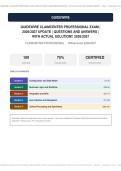
GUIDEWIRE CLAIMCENTER PROFESSIONAL EXAM | 2026/2027 UPDATE | QUESTIONS AND ANSWERS | WITH ACTUAL SOLUTION!! 2026/2027 2026/2027 | Page 1 | Passing Score: 75%
GUIDEWIRE
GUIDEWIRE CLAIMCENTER PROFESSIONAL EXAM |
2026/2027 UPDATE | QUESTIONS AND ANSWERS |
WITH ACTUAL SOLUTION!! 2026/2027
CLAIMCENTER PROFESSIONAL - Official Exam 2026/2027
100 75% CERTIFIED
QUESTIONS PASSING SCORE RECERTIFICATION
TABLE OF CONTENTS
Section 1 Configuration and Data Model Q1-25
Section 2 Business Logic and Workflow Q26-50
Section 3 Integration and APIs Q51-70
Section 4 User Interface and Navigation Q71-85
Section 5 Claims Processing and Operations Q86-100
Instructions: Select the single best answer for each question. This exam is designed for Guidewire ClaimCenter Professional certification
preparation. Passing score: 75% (75 questions correct).
UIDEWIRE CLAIMCENTER PROFESSIONAL EXAM | 2026/2027 UPDATE | QUESTIONS AND ANSWERS | WITH ACTUAL SOLUTION!! 2026/2027 -- 2026/2027 | Passing Score: 75%% | Page
, SECTION 1 | CONFIGURATION AND DATA MODEL | Q1-Q25 | GUIDEWIRE CLAIMCENTER PROFESSIONAL EXAM | 2026/2027 UPDATE
Q1 Question 1 of 100
A ClaimCenter implementation team needs to add a new custom field to the Claim entity to track
whether a claim is eligible for a special fraud review process. The field must store a yes/no value and
be visible on the Claim Details screen. What is the most appropriate data type for this custom field in
the ClaimCenter data model?
A. Boolean field added directly to the Claim entity extension
B. Typekey with values defined in the typelist configuration
C. String field with a validation pattern restricting input to Y or N
D. Integer field with values 0 and 1 representing no and yes
Correct Answer: A
Rationale:
A Boolean field added to the Claim entity extension is the most appropriate choice for storing a yes/no value in
ClaimCenter. Entity extensions are the standard mechanism for adding custom fields, and Boolean is the native type
for binary values. A typekey would be over-engineered for a simple yes/no, a string adds unnecessary complexity, and
an integer is not semantically correct for a Boolean concept.
Q2 Question 2 of 100
An insurance carrier wants to configure ClaimCenter so that when a new claim is created for a
homeowner policy, the system automatically assigns it to a specialized property claims team based
on the state where the loss occurred. What configuration approach best accomplishes this
requirement?
A. Create an assignment rule that evaluates the loss location state and routes to the appropriate
team queue
B. Modify the Claim creation plugin to override the default assignment logic with custom Java code
C. Configure a workflow trigger that reassigns the claim after it is saved by the initial adjuster
D. Set up a dynamic dropdown on the FNOL screen that restricts team selection to the correct state team
Correct Answer: A
Rationale:
Assignment rules in ClaimCenter are the standard configuration mechanism for routing claims to specific users or
teams based on policy attributes, loss details, or other criteria. They are declarative, maintainable, and do not require
custom code. Modifying plugins with Java code increases maintenance burden, workflow triggers add latency, and a
dropdown does not enforce automatic routing.
UIDEWIRE CLAIMCENTER PROFESSIONAL EXAM | 2026/2027 UPDATE | QUESTIONS AND ANSWERS | WITH ACTUAL SOLUTION!! 2026/2027 -- 2026/2027 | Passing Score: 75%% | Page
, Q3 Question 3 of 100
A developer is extending the ClaimCenter data model and needs to add a new entity called
FireInvestigation that has a one-to-many relationship with the Claim entity. Each claim can have
multiple fire investigations, but each fire investigation belongs to exactly one claim. What is the
correct way to model this relationship?
A. Add a FireInvestigation array field on the Claim entity and a Claim foreign key field on the
FireInvestigation entity
B. Create a join table linking Claim and FireInvestigation with a many-to-many relationship
C. Add a FireInvestigation foreign key on the Claim entity and no back-reference on FireInvestigation
D. Use a standalone FireInvestigation entity and link it to Claim through a configuration file only
Correct Answer: A
Rationale:
In the ClaimCenter data model, a one-to-many relationship from Claim to FireInvestigation is modeled by adding a
FireInvestigation array (slice) field on the Claim entity and a Claim foreign key on the FireInvestigation entity. This
establishes the parent-child relationship where each FireInvestigation references its parent Claim, and the Claim can
access all its FireInvestigations through the array field.
Q4 Question 4 of 100
A system administrator needs to create a new typelist called InjurySeverity with values Minor,
Moderate, Severe, and Fatal. The typelist will be used on the Exposure entity. After creating the
typelist, what additional step is required before the values can be used in the application?
A. Add the typelist field to the Exposure entity and configure the corresponding PCF file to display
it on the UI
B. Deploy the typelist to the database and restart the application server
C. Create a database migration script to insert the typelist values into the database
D. Register the typelist with the PolicyCenter integration service for cross-system consistency
Correct Answer: A
Rationale:
Creating a typelist in ClaimCenter defines the code and values, but to make it usable on an entity, you must add a field
of that typelist type to the entity (such as Exposure) and then configure the PCF (Page Configuration File) to render it
on the user interface. The typelist values are managed in the application dictionary, not through database scripts, and
no PolicyCenter registration is required.
UIDEWIRE CLAIMCENTER PROFESSIONAL EXAM | 2026/2027 UPDATE | QUESTIONS AND ANSWERS | WITH ACTUAL SOLUTION!! 2026/2027 -- 2026/2027 | Passing Score: 75%% | Page
, Q5 Question 5 of 100
A ClaimCenter project requires that certain policy coverages be excluded from display on the
Coverage Summary screen when the policy type is Workers Compensation. The business rule states
that only liability coverages should appear for this policy type. What is the most efficient way to
implement this filtering?
A. Configure a coverage display filter rule in the ClaimCenter configuration that evaluates policy
type and coverage category
B. Remove the unwanted coverages from the policy data model for Workers Compensation policies
C. Hide the coverage rows using CSS styling conditional on the policy type value
D. Create a custom Java class that intercepts the coverage list and removes non-liability entries
Correct Answer: A
Rationale:
ClaimCenter provides coverage display filter rules that can be configured declaratively to control which coverages
appear based on policy attributes. This is the most efficient and maintainable approach because it uses native
configuration without code changes. Removing coverages from the data model would lose data, CSS hiding does not
remove data access, and custom Java is unnecessarily complex for a declarative configuration.
Q6 Question 6 of 100
During a ClaimCenter implementation, the team discovers that the out-of-the-box Claim entity has a
field called LossCause that is a typelist with 50 values, but the carrier only uses 15 of those values
for their commercial lines business. What is the recommended approach to handle this discrepancy?
A. Use typelist localization to hide unused values from the commercial lines product without
deleting them from the typelist
B. Delete the unused 35 values from the typelist in the application dictionary to simplify the system
C. Create a new custom typelist with only the 15 needed values and replace the LossCause field type
D. Leave all 50 values in place and rely on user training to select only the appropriate values
Correct Answer: A
Rationale:
Typelist localization (or typelist filtering) allows carriers to hide unused values from display without deleting them from
the underlying typelist. This preserves data integrity since other integrations or future business needs may reference
the full list. Deleting values risks data corruption and upgrade issues. Creating a new typelist duplicates effort, and
relying on user training is error-prone and does not enforce business rules.
UIDEWIRE CLAIMCENTER PROFESSIONAL EXAM | 2026/2027 UPDATE | QUESTIONS AND ANSWERS | WITH ACTUAL SOLUTION!! 2026/2027 -- 2026/2027 | Passing Score: 75%% | Page
GUIDEWIRE
GUIDEWIRE CLAIMCENTER PROFESSIONAL EXAM |
2026/2027 UPDATE | QUESTIONS AND ANSWERS |
WITH ACTUAL SOLUTION!! 2026/2027
CLAIMCENTER PROFESSIONAL - Official Exam 2026/2027
100 75% CERTIFIED
QUESTIONS PASSING SCORE RECERTIFICATION
TABLE OF CONTENTS
Section 1 Configuration and Data Model Q1-25
Section 2 Business Logic and Workflow Q26-50
Section 3 Integration and APIs Q51-70
Section 4 User Interface and Navigation Q71-85
Section 5 Claims Processing and Operations Q86-100
Instructions: Select the single best answer for each question. This exam is designed for Guidewire ClaimCenter Professional certification
preparation. Passing score: 75% (75 questions correct).
UIDEWIRE CLAIMCENTER PROFESSIONAL EXAM | 2026/2027 UPDATE | QUESTIONS AND ANSWERS | WITH ACTUAL SOLUTION!! 2026/2027 -- 2026/2027 | Passing Score: 75%% | Page
, SECTION 1 | CONFIGURATION AND DATA MODEL | Q1-Q25 | GUIDEWIRE CLAIMCENTER PROFESSIONAL EXAM | 2026/2027 UPDATE
Q1 Question 1 of 100
A ClaimCenter implementation team needs to add a new custom field to the Claim entity to track
whether a claim is eligible for a special fraud review process. The field must store a yes/no value and
be visible on the Claim Details screen. What is the most appropriate data type for this custom field in
the ClaimCenter data model?
A. Boolean field added directly to the Claim entity extension
B. Typekey with values defined in the typelist configuration
C. String field with a validation pattern restricting input to Y or N
D. Integer field with values 0 and 1 representing no and yes
Correct Answer: A
Rationale:
A Boolean field added to the Claim entity extension is the most appropriate choice for storing a yes/no value in
ClaimCenter. Entity extensions are the standard mechanism for adding custom fields, and Boolean is the native type
for binary values. A typekey would be over-engineered for a simple yes/no, a string adds unnecessary complexity, and
an integer is not semantically correct for a Boolean concept.
Q2 Question 2 of 100
An insurance carrier wants to configure ClaimCenter so that when a new claim is created for a
homeowner policy, the system automatically assigns it to a specialized property claims team based
on the state where the loss occurred. What configuration approach best accomplishes this
requirement?
A. Create an assignment rule that evaluates the loss location state and routes to the appropriate
team queue
B. Modify the Claim creation plugin to override the default assignment logic with custom Java code
C. Configure a workflow trigger that reassigns the claim after it is saved by the initial adjuster
D. Set up a dynamic dropdown on the FNOL screen that restricts team selection to the correct state team
Correct Answer: A
Rationale:
Assignment rules in ClaimCenter are the standard configuration mechanism for routing claims to specific users or
teams based on policy attributes, loss details, or other criteria. They are declarative, maintainable, and do not require
custom code. Modifying plugins with Java code increases maintenance burden, workflow triggers add latency, and a
dropdown does not enforce automatic routing.
UIDEWIRE CLAIMCENTER PROFESSIONAL EXAM | 2026/2027 UPDATE | QUESTIONS AND ANSWERS | WITH ACTUAL SOLUTION!! 2026/2027 -- 2026/2027 | Passing Score: 75%% | Page
, Q3 Question 3 of 100
A developer is extending the ClaimCenter data model and needs to add a new entity called
FireInvestigation that has a one-to-many relationship with the Claim entity. Each claim can have
multiple fire investigations, but each fire investigation belongs to exactly one claim. What is the
correct way to model this relationship?
A. Add a FireInvestigation array field on the Claim entity and a Claim foreign key field on the
FireInvestigation entity
B. Create a join table linking Claim and FireInvestigation with a many-to-many relationship
C. Add a FireInvestigation foreign key on the Claim entity and no back-reference on FireInvestigation
D. Use a standalone FireInvestigation entity and link it to Claim through a configuration file only
Correct Answer: A
Rationale:
In the ClaimCenter data model, a one-to-many relationship from Claim to FireInvestigation is modeled by adding a
FireInvestigation array (slice) field on the Claim entity and a Claim foreign key on the FireInvestigation entity. This
establishes the parent-child relationship where each FireInvestigation references its parent Claim, and the Claim can
access all its FireInvestigations through the array field.
Q4 Question 4 of 100
A system administrator needs to create a new typelist called InjurySeverity with values Minor,
Moderate, Severe, and Fatal. The typelist will be used on the Exposure entity. After creating the
typelist, what additional step is required before the values can be used in the application?
A. Add the typelist field to the Exposure entity and configure the corresponding PCF file to display
it on the UI
B. Deploy the typelist to the database and restart the application server
C. Create a database migration script to insert the typelist values into the database
D. Register the typelist with the PolicyCenter integration service for cross-system consistency
Correct Answer: A
Rationale:
Creating a typelist in ClaimCenter defines the code and values, but to make it usable on an entity, you must add a field
of that typelist type to the entity (such as Exposure) and then configure the PCF (Page Configuration File) to render it
on the user interface. The typelist values are managed in the application dictionary, not through database scripts, and
no PolicyCenter registration is required.
UIDEWIRE CLAIMCENTER PROFESSIONAL EXAM | 2026/2027 UPDATE | QUESTIONS AND ANSWERS | WITH ACTUAL SOLUTION!! 2026/2027 -- 2026/2027 | Passing Score: 75%% | Page
, Q5 Question 5 of 100
A ClaimCenter project requires that certain policy coverages be excluded from display on the
Coverage Summary screen when the policy type is Workers Compensation. The business rule states
that only liability coverages should appear for this policy type. What is the most efficient way to
implement this filtering?
A. Configure a coverage display filter rule in the ClaimCenter configuration that evaluates policy
type and coverage category
B. Remove the unwanted coverages from the policy data model for Workers Compensation policies
C. Hide the coverage rows using CSS styling conditional on the policy type value
D. Create a custom Java class that intercepts the coverage list and removes non-liability entries
Correct Answer: A
Rationale:
ClaimCenter provides coverage display filter rules that can be configured declaratively to control which coverages
appear based on policy attributes. This is the most efficient and maintainable approach because it uses native
configuration without code changes. Removing coverages from the data model would lose data, CSS hiding does not
remove data access, and custom Java is unnecessarily complex for a declarative configuration.
Q6 Question 6 of 100
During a ClaimCenter implementation, the team discovers that the out-of-the-box Claim entity has a
field called LossCause that is a typelist with 50 values, but the carrier only uses 15 of those values
for their commercial lines business. What is the recommended approach to handle this discrepancy?
A. Use typelist localization to hide unused values from the commercial lines product without
deleting them from the typelist
B. Delete the unused 35 values from the typelist in the application dictionary to simplify the system
C. Create a new custom typelist with only the 15 needed values and replace the LossCause field type
D. Leave all 50 values in place and rely on user training to select only the appropriate values
Correct Answer: A
Rationale:
Typelist localization (or typelist filtering) allows carriers to hide unused values from display without deleting them from
the underlying typelist. This preserves data integrity since other integrations or future business needs may reference
the full list. Deleting values risks data corruption and upgrade issues. Creating a new typelist duplicates effort, and
relying on user training is error-prone and does not enforce business rules.
UIDEWIRE CLAIMCENTER PROFESSIONAL EXAM | 2026/2027 UPDATE | QUESTIONS AND ANSWERS | WITH ACTUAL SOLUTION!! 2026/2027 -- 2026/2027 | Passing Score: 75%% | Page


