
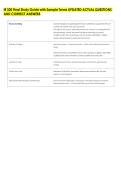
IR 320 Final Study Guide with Sample Terms UPDATED ACTUAL QUESTIONS
AND CORRECT ANSWERS
Thomas Schelling Nuclear strategist who applied game theory to deterrence; argued the threat of
nuclear use matters more than actual use
Distinguished "brute force" (defeating enemy) from "coercion" (changing behavior
through threats); coined "the threat that leaves something to chance"
Underpins MAD, arms control logic, and why mutual vulnerability = stability;
explains brinkmanship by states like North Korea
Evolution of Radar Mechanical radar --> Phased array radar --> AESA (Active Electronically Scanned
Array)
Central to US-China competition; China's near-monopoly on gallium nitride (99%
of global production) threatens US radar capability and production
Mechanical radar rotating physical antenna, discrete radio pulses, minimal data, gaps between
sweeps
Phased array radar fixed array of electronic transceivers, steers beams electronically, far more
signals, no moving parts
AESA (Active Electronically Scanned Array) each transceiver independent, simultaneous multi-target tracking, jam-resistant,
fastest reaction time — F-35's AN/APG-85 uses this with GaN modules
, MIRV Multiple Independently Targetable Re-entry Vehicle — one missile carries multiple
warheads, each directed at a different target; pioneered by the US
Creates first-strike incentives — if one enemy missile can destroy ten of yours,
you're incentivized to launch first before absorbing that strike
D-5 Trident SLBM combined MIRVs with high accuracy and submarine stealth,
cutting warning time from 20-30 minutes to as little as 5 minutes
Deeply destabilizing — erodes MAD stability, complicates arms control (can't
verify warhead count), Kissinger admitted he wished he'd thought through the
implications
Pegasus Spyware developed by Israeli firm NSO Group; zero-click exploit giving attacker
root access to everything on a target's phone
Sold nominally for counter-terrorism; clients included Azerbaijan, Bahrain,
Hungary, India, Saudi Arabia, UAE and others; FBI bought it in 2019 but didn't
deploy it
CIA allegedly used it to rescue a downed US airman in Iran
Illustrates dual-use problem in cyber tools — legitimate law enforcement tech
used against journalists and political opponents; highlights gap in international
law around AI-assisted surveillance
Lightning carrier Concept of operating F-35B stealth fighters off smaller amphibious assault ships
(LHD/LHA class) rather than dedicated supercarriers; F-35B's STOVL capability
makes this possible
Turns a troop-carrying amphibious ship into a light stealth aircraft carrier at far
lower cost
Fits the DMO logic of dispersing the fleet — cheaper, more numerous, harder to
target than concentrating power in a few supercarriers vulnerable to Chinese
hypersonic missiles
APT Advanced Persistent Threat — cyberattack by or on behalf of a state intelligence
service; characterized by stealth, long duration, and high-value specific targets
Examples: China's "Titan Rain" (2003-05), Russia's "Fancy Bear" and "Cozy Bear"
(2016 DNC hack), "The Dukes" behind SolarWinds
SolarWinds was the largest ever — supply chain attack through infected software
update, compromising 18,000 organizations simultaneously
Represents upper tier of state cyber competition; blurs espionage and sabotage;
attribution problems complicate response
Gold-plated systems Military weapons so expensive, complex, and sophisticated they become too
valuable to risk or too costly to produce in sufficient numbers
F-35: $1.7 trillion program, 50% availability rate (falling to 35%), spare parts
shortages, specialized maintenance crisis
Supercarriers: $13B each, $120B total program cost, only 5-6 deployable at a time
US optimizes for technological excellence over quantity and resilience; Ukraine
war proved cheap mass-produced systems can defeat sophisticated ones —
raises fundamental question of whether US is building the right military
AND CORRECT ANSWERS
Thomas Schelling Nuclear strategist who applied game theory to deterrence; argued the threat of
nuclear use matters more than actual use
Distinguished "brute force" (defeating enemy) from "coercion" (changing behavior
through threats); coined "the threat that leaves something to chance"
Underpins MAD, arms control logic, and why mutual vulnerability = stability;
explains brinkmanship by states like North Korea
Evolution of Radar Mechanical radar --> Phased array radar --> AESA (Active Electronically Scanned
Array)
Central to US-China competition; China's near-monopoly on gallium nitride (99%
of global production) threatens US radar capability and production
Mechanical radar rotating physical antenna, discrete radio pulses, minimal data, gaps between
sweeps
Phased array radar fixed array of electronic transceivers, steers beams electronically, far more
signals, no moving parts
AESA (Active Electronically Scanned Array) each transceiver independent, simultaneous multi-target tracking, jam-resistant,
fastest reaction time — F-35's AN/APG-85 uses this with GaN modules
, MIRV Multiple Independently Targetable Re-entry Vehicle — one missile carries multiple
warheads, each directed at a different target; pioneered by the US
Creates first-strike incentives — if one enemy missile can destroy ten of yours,
you're incentivized to launch first before absorbing that strike
D-5 Trident SLBM combined MIRVs with high accuracy and submarine stealth,
cutting warning time from 20-30 minutes to as little as 5 minutes
Deeply destabilizing — erodes MAD stability, complicates arms control (can't
verify warhead count), Kissinger admitted he wished he'd thought through the
implications
Pegasus Spyware developed by Israeli firm NSO Group; zero-click exploit giving attacker
root access to everything on a target's phone
Sold nominally for counter-terrorism; clients included Azerbaijan, Bahrain,
Hungary, India, Saudi Arabia, UAE and others; FBI bought it in 2019 but didn't
deploy it
CIA allegedly used it to rescue a downed US airman in Iran
Illustrates dual-use problem in cyber tools — legitimate law enforcement tech
used against journalists and political opponents; highlights gap in international
law around AI-assisted surveillance
Lightning carrier Concept of operating F-35B stealth fighters off smaller amphibious assault ships
(LHD/LHA class) rather than dedicated supercarriers; F-35B's STOVL capability
makes this possible
Turns a troop-carrying amphibious ship into a light stealth aircraft carrier at far
lower cost
Fits the DMO logic of dispersing the fleet — cheaper, more numerous, harder to
target than concentrating power in a few supercarriers vulnerable to Chinese
hypersonic missiles
APT Advanced Persistent Threat — cyberattack by or on behalf of a state intelligence
service; characterized by stealth, long duration, and high-value specific targets
Examples: China's "Titan Rain" (2003-05), Russia's "Fancy Bear" and "Cozy Bear"
(2016 DNC hack), "The Dukes" behind SolarWinds
SolarWinds was the largest ever — supply chain attack through infected software
update, compromising 18,000 organizations simultaneously
Represents upper tier of state cyber competition; blurs espionage and sabotage;
attribution problems complicate response
Gold-plated systems Military weapons so expensive, complex, and sophisticated they become too
valuable to risk or too costly to produce in sufficient numbers
F-35: $1.7 trillion program, 50% availability rate (falling to 35%), spare parts
shortages, specialized maintenance crisis
Supercarriers: $13B each, $120B total program cost, only 5-6 deployable at a time
US optimizes for technological excellence over quantity and resilience; Ukraine
war proved cheap mass-produced systems can defeat sophisticated ones —
raises fundamental question of whether US is building the right military


