

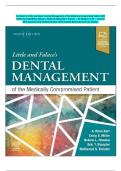
Test Bank for Little and Falace’s Dental Management of the Medically Compromised Patient 10th
Edition by Craig Miller, Nelson L. Rhodus & Nathaniel S. Treister — All Chapters 1–30 — Covered
With Questions And Verified Solutions With Detailed Rationales And Case Studies.
, Table of content
PART ONE: PATIENT EVALUATION AND RISK ASSESSMENT
1. Patient Evaluation and Risk Assessment
PART TWO: CARDIOVASCULAR DISEASE
2. Infective Endocarditis
3. Hypertension
4. Ischemic Heart Disease
5. Cardiac Arrhythmias
6. Heart Failure (or Congestive Heart Failure)
PART THREE: PULMONARY DISEASE
7. Pulmonary Disease
8. Smoking and Tobacco Use Cessation
9. Sleep-Related Breathing Disorders
PART FOUR: GASTROINTESTIAL DISEASE
10. Liver Disease
11. Gastrointestinal Disease
PART FIVE: GENITOURINARY DISEASE
12. Chronic Kidney Disease and Dialysis
13. Sexually Transmitted Diseases
PART SIX: ENDOCRINE AND METABOLIC DISEASE
14. Diabetes Mellitus
15. Adrenal Insufficiency
16. Thyroid Diseases
17. Pregnancy and Breast Feeding
PART SEVEN: IMMUNOLOGIC DISEASE
18. AIDS, HIV Infection, and Related Conditions
19. Allergy
20. Rheumatologic and Connective Tissue Disorders
21. Organ and Bone Marrow Transplantation
PART EIGHT: HEMATOLOGIC AND ONCOLOGIC DISEASE
22. Disorders of Red Blood Cells
23. Disorders of White Blood Cells
24. Acquired Bleeding and Hypercoagulable Disorders
,25. Congenital Bleeding and Hypercoagulable Disorders
26. Cancer and Oral Care of the Patient
PART NINE: NEUROLOGIC, BEHAVIORAL, AND PSYCHIATRIC DISORDERS
27. Neurologic Disorders
28. Anxiety, Eating Disorders, and Behavioral Reactions to Illness
29. Psychiatric Disorders
30. Drug and Alcohol Abuse
CHAPTER 1: PATIENT EVALUATION AND RISK ASSESSMENT – ORIGINAL PRACTICE QUIZ
Section 1: Multiple Choice Questions (21 Questions)
Question 1
A 58-year-old male patient presents for a dental cleaning. His medical history includes hypertension
controlled with lisinopril. Which of the following is the most appropriate first step in his evaluation?
• A) Proceed with dental cleaning without any modification
• B) Check blood pressure before beginning treatment
• C) Contact his physician immediately
• D) Cancel the appointment and refer him to a hospital
Correct Answer: B
*Rationale: Patients with controlled hypertension should have their blood pressure checked at each
dental visit to ensure it is within a safe range (typically <160/100 mmHg for elective dental care).
Option A is incorrect because evaluation is still required. Option C is unnecessary without abnormal
findings. Option D is overly aggressive.*
Question 2
The ASA Physical Status Classification system is used in dentistry primarily to:
• A) Diagnose oral diseases
• B) Assess a patient's overall medical risk before treatment
• C) Determine dental insurance coverage
• D) Classify periodontal disease severity
Correct Answer: B
Rationale: The ASA system categorizes patients based on their systemic health to predict
perioperative risk. It does not diagnose oral disease (A), determine insurance (C), or classify
periodontal disease (D).
, Question 3
A patient with well-controlled diabetes mellitus, no other systemic disease, and no functional
limitations would most likely be classified as:
• A) ASA I
• B) ASA II
• C) ASA III
• D) ASA IV
Correct Answer: B
Rationale: ASA II is for patients with mild to moderate systemic disease that is well-controlled but still
presents some physiological disturbance. Diabetes mellitus, even well-controlled, falls into ASA II. ASA
I is perfectly healthy. ASA III is severe disease. ASA IV is life-threatening disease.
Question 4
Which of the following vital sign values would be considered abnormal and a reason to delay elective
dental treatment?
• A) Blood pressure 118/76 mmHg
• B) Heart rate 72 bpm
• C) Respiratory rate 28 breaths/min
• D) Oxygen saturation 98%
Correct Answer: C
*Rationale: Normal adult respiratory rate is 12–20 breaths/min. A rate of 28 is tachypneic and may
indicate underlying respiratory or metabolic issues. The other values are within normal limits.*
Question 5
During the medical history review, a patient reports fainting during a previous dental injection. This
reaction is most consistent with:
• A) Anaphylaxis
• B) Vasovagal syncope
• C) Local anesthetic toxicity
• D) Angioedema
Correct Answer: B
Rationale: Vasovagal syncope (fainting) is the most common adverse reaction in a dental setting,
often triggered by anxiety, pain, or the sight of a needle. Anaphylaxis (A) involves respiratory
compromise. Local anesthetic toxicity (C) causes neurologic or cardiac symptoms. Angioedema (D)
involves swelling.
Edition by Craig Miller, Nelson L. Rhodus & Nathaniel S. Treister — All Chapters 1–30 — Covered
With Questions And Verified Solutions With Detailed Rationales And Case Studies.
, Table of content
PART ONE: PATIENT EVALUATION AND RISK ASSESSMENT
1. Patient Evaluation and Risk Assessment
PART TWO: CARDIOVASCULAR DISEASE
2. Infective Endocarditis
3. Hypertension
4. Ischemic Heart Disease
5. Cardiac Arrhythmias
6. Heart Failure (or Congestive Heart Failure)
PART THREE: PULMONARY DISEASE
7. Pulmonary Disease
8. Smoking and Tobacco Use Cessation
9. Sleep-Related Breathing Disorders
PART FOUR: GASTROINTESTIAL DISEASE
10. Liver Disease
11. Gastrointestinal Disease
PART FIVE: GENITOURINARY DISEASE
12. Chronic Kidney Disease and Dialysis
13. Sexually Transmitted Diseases
PART SIX: ENDOCRINE AND METABOLIC DISEASE
14. Diabetes Mellitus
15. Adrenal Insufficiency
16. Thyroid Diseases
17. Pregnancy and Breast Feeding
PART SEVEN: IMMUNOLOGIC DISEASE
18. AIDS, HIV Infection, and Related Conditions
19. Allergy
20. Rheumatologic and Connective Tissue Disorders
21. Organ and Bone Marrow Transplantation
PART EIGHT: HEMATOLOGIC AND ONCOLOGIC DISEASE
22. Disorders of Red Blood Cells
23. Disorders of White Blood Cells
24. Acquired Bleeding and Hypercoagulable Disorders
,25. Congenital Bleeding and Hypercoagulable Disorders
26. Cancer and Oral Care of the Patient
PART NINE: NEUROLOGIC, BEHAVIORAL, AND PSYCHIATRIC DISORDERS
27. Neurologic Disorders
28. Anxiety, Eating Disorders, and Behavioral Reactions to Illness
29. Psychiatric Disorders
30. Drug and Alcohol Abuse
CHAPTER 1: PATIENT EVALUATION AND RISK ASSESSMENT – ORIGINAL PRACTICE QUIZ
Section 1: Multiple Choice Questions (21 Questions)
Question 1
A 58-year-old male patient presents for a dental cleaning. His medical history includes hypertension
controlled with lisinopril. Which of the following is the most appropriate first step in his evaluation?
• A) Proceed with dental cleaning without any modification
• B) Check blood pressure before beginning treatment
• C) Contact his physician immediately
• D) Cancel the appointment and refer him to a hospital
Correct Answer: B
*Rationale: Patients with controlled hypertension should have their blood pressure checked at each
dental visit to ensure it is within a safe range (typically <160/100 mmHg for elective dental care).
Option A is incorrect because evaluation is still required. Option C is unnecessary without abnormal
findings. Option D is overly aggressive.*
Question 2
The ASA Physical Status Classification system is used in dentistry primarily to:
• A) Diagnose oral diseases
• B) Assess a patient's overall medical risk before treatment
• C) Determine dental insurance coverage
• D) Classify periodontal disease severity
Correct Answer: B
Rationale: The ASA system categorizes patients based on their systemic health to predict
perioperative risk. It does not diagnose oral disease (A), determine insurance (C), or classify
periodontal disease (D).
, Question 3
A patient with well-controlled diabetes mellitus, no other systemic disease, and no functional
limitations would most likely be classified as:
• A) ASA I
• B) ASA II
• C) ASA III
• D) ASA IV
Correct Answer: B
Rationale: ASA II is for patients with mild to moderate systemic disease that is well-controlled but still
presents some physiological disturbance. Diabetes mellitus, even well-controlled, falls into ASA II. ASA
I is perfectly healthy. ASA III is severe disease. ASA IV is life-threatening disease.
Question 4
Which of the following vital sign values would be considered abnormal and a reason to delay elective
dental treatment?
• A) Blood pressure 118/76 mmHg
• B) Heart rate 72 bpm
• C) Respiratory rate 28 breaths/min
• D) Oxygen saturation 98%
Correct Answer: C
*Rationale: Normal adult respiratory rate is 12–20 breaths/min. A rate of 28 is tachypneic and may
indicate underlying respiratory or metabolic issues. The other values are within normal limits.*
Question 5
During the medical history review, a patient reports fainting during a previous dental injection. This
reaction is most consistent with:
• A) Anaphylaxis
• B) Vasovagal syncope
• C) Local anesthetic toxicity
• D) Angioedema
Correct Answer: B
Rationale: Vasovagal syncope (fainting) is the most common adverse reaction in a dental setting,
often triggered by anxiety, pain, or the sight of a needle. Anaphylaxis (A) involves respiratory
compromise. Local anesthetic toxicity (C) causes neurologic or cardiac symptoms. Angioedema (D)
involves swelling.


