

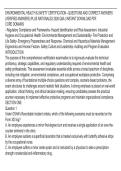
ENVIRONMENTAL HEALTH & SAFETY CERTIFICATION –QUESTIONS AND CORRECT ANSWERS
(VERIFIED ANSWERS) PLUS RATIONALES 2026 Q&A | INSTANT DOWNLOAD PDF.
CORE DOMAINS
- Regulatory Compliance and Frameworks- Hazard Identification and Risk Assessment- Industrial
Hygiene and Occupational Health- Environmental Management and Sustainability- Fire Protection and
Life Safety- Emergency Preparedness and Response- Chemical and Hazardous Materials Management-
Ergonomics and Human Factors- Safety Culture and Leadership- Auditing and Program Evaluation
INTRODUCTION
The purpose of this comprehensive certification examination is to rigorously evaluate the technical
proficiency, strategic capabilities, and regulatory understanding required of environmental health and
safety professionals. This assessment evaluates essential skills across a broad spectrum of disciplines,
including risk mitigation, environmental compliance, and occupational workplace protection. Comprising
a diverse array of foundational multiple-choice questions and complex, scenario-based problems, the
exam structures its challenges around realistic field situations. A strong emphasis is placed on real-world
application, critical thinking, and ethical decision-making, ensuring candidates possess the practical
acumen necessary to implement effective protective programs and maintain organizational compliance.
SECTION ONE
Question 1
Under OSHA's Recordable Incident criteria, which of the following scenarios must be recorded on the
Form 300 log?
A. An employee experiences a minor first-degree burn and receives a single application of an over-the-
counter ointment in the clinic.
B. An employee sustains a superficial laceration that is treated exclusively with butterfly adhesive strips
by the occupational nurse.
C. An employee suffers a minor ankle sprain and is instructed by a physician to take a prescription-
strength nonsteroidal anti-inflammatory drug.
,D. An employee experiences temporary heat exhaustion and is instructed to rest and drink fluids for
twenty minutes before returning to work.
🟢 Correct answer: C
🔴 RATIONALE: Under OSHA recordkeeping regulations (29 CFR 1904.7), medical treatment beyond
first aid makes an injury recordable. Prescription-strength medications, even if they are nonsteroidal anti-
inflammatory drugs (NSAIDs), constitute medical treatment. First aid explicitly includes over-the-counter
medications at non-prescription strength, butterfly bandages, and hot/cold therapy or rest.
Question 2
Which of the following administrative controls is most effective for mitigating worker exposure to localized
industrial noise hazards when engineering controls are technically infeasible?
A. Mandating the simultaneous use of earplugs and earmuffs during the entire work shift.
B. Rotating employees out of high-noise process zones to limit cumulative daily exposure doses.
C. Enclosing the noise-generating machinery within an acoustic barrier curtain system.
D. Conducting annual audiometric testing for all personnel working within the production facility.
🟢 Correct answer: B
🔴 RATIONALE: Job rotation is a classic administrative control that reduces the total duration of time an
individual worker spends in a hazardous environment, thereby lowering their time-weighted average
(TWA) exposure. Dual hearing protection is a form of personal protective equipment (PPE). Acoustic
enclosures represent an engineering control. Audiometric testing is a medical surveillance tool, not a
control measure.
Question 3
A safety manager evaluates a chemical manufacturing process that generates significant volumes of
volatile organic compounds. According to the hierarchy of controls, which action should be investigated
first?
A. Installing a local exhaust ventilation system with activated carbon filtration beds.
B. Requiring operators to wear positive-pressure supplied-air respirators during processing.
,C. Substituting the current solvent with a water-based alternative that exhibits negligible vapor pressure.
D. Implementing a rigorous preventive maintenance program to check for piping leaks every week.
🟢 Correct answer: C
🔴 RATIONALE: The hierarchy of controls prioritizes actions by their effectiveness. Elimination and
substitution occupy the highest level of this hierarchy. Replacing a volatile solvent with a non-volatile,
water-based substance removes the hazard at its source, making it superior to engineering controls
(ventilation), administrative controls (maintenance schedules), or PPE (respirators).
Question 4
What is the primary toxicological mechanism by which carbon monoxide inflicts systemic cellular hypoxia
within the human body?
A. Irreversible inhibition of the acetylcholinesterase enzyme in nervous tissues.
B. Competitive binding to hemoglobin molecules, forming carboxyhemoglobin and blocking oxygen
transport.
C. Direct destruction of pulmonary alveolar membranes through oxidative lipid peroxidation.
D. Chemical binding to cytochrome c oxidase, paralyzing the mitochondrial electron transport chain.
🟢 Correct answer: B
🔴 RATIONALE: Carbon monoxide (CO) has an affinity for hemoglobin that is roughly 200 to 250 times
greater than that of oxygen. When inhaled, it preferentially binds to hemoglobin to form
carboxyhemoglobin, which drastically reduces the oxygen-carrying capacity of the blood and prevents
oxygen delivery to vital tissues. Cytochrome c oxidase inhibition is the primary mechanism of hydrogen
cyanide, not carbon monoxide.
Question 5
During a routine safety audit of a warehouse facility, a specialist observes a technician operating an
electric forklift. Which of the following observations represents a direct regulatory non-compliance issue
regarding industrial truck operations?
A. The operator sounds the horn when approaching a blind intersection where two main aisles cross.
B. The operator travels in reverse because the loaded pallet obstructs forward visibility.
, C. The operator leaves the forklift unattended with the load elevated two feet off the ground to grab a
tool.
D. The operator slows down and maneuvers carefully across wet concrete flooring surfaces.
🟢 Correct answer: C
🔴 RATIONALE: According to standard industrial truck safety regulations (such as OSHA 29 CFR
1910.178), a powered industrial truck is considered unattended when the operator is 25 feet or more
away or when the vehicle is out of view. However, regardless of distance, whenever a forklift is left, the
load must be fully lowered to the ground, controls neutralized, brakes set, and power shut off to prevent
accidental lowering or movement hazards.
Question 6
Which type of radiation possesses the highest ionizing power but the lowest penetrating ability, requiring
only a simple sheet of paper or the outer layer of human skin to be stopped?
A. Beta particles
B. Gamma rays
C. X-rays
D. Alpha particles
🟢 Correct answer: D
🔴 RATIONALE: Alpha particles consist of two protons and two neutrons (a helium nucleus), making
them relatively large and highly charged. This results in high ionizing power because they interact
strongly with surrounding matter, but it also gives them very low penetrating capability. They are easily
stopped by a sheet of paper or the dead outer layer of human skin. Beta particles are more penetrating,
while gamma and X-rays have very high penetrating power.
Question 7
An industrial hygiene sampling campaign indicates that workers in a grinding workshop are exposed to
respirable crystalline silica at a concentration of 0.08 mg/m3 over an 8-hour shift. If the regulatory
Permissible Exposure Limit (PEL) is 0.05 mg/m3, what is the calculated exposure severity ratio?
(VERIFIED ANSWERS) PLUS RATIONALES 2026 Q&A | INSTANT DOWNLOAD PDF.
CORE DOMAINS
- Regulatory Compliance and Frameworks- Hazard Identification and Risk Assessment- Industrial
Hygiene and Occupational Health- Environmental Management and Sustainability- Fire Protection and
Life Safety- Emergency Preparedness and Response- Chemical and Hazardous Materials Management-
Ergonomics and Human Factors- Safety Culture and Leadership- Auditing and Program Evaluation
INTRODUCTION
The purpose of this comprehensive certification examination is to rigorously evaluate the technical
proficiency, strategic capabilities, and regulatory understanding required of environmental health and
safety professionals. This assessment evaluates essential skills across a broad spectrum of disciplines,
including risk mitigation, environmental compliance, and occupational workplace protection. Comprising
a diverse array of foundational multiple-choice questions and complex, scenario-based problems, the
exam structures its challenges around realistic field situations. A strong emphasis is placed on real-world
application, critical thinking, and ethical decision-making, ensuring candidates possess the practical
acumen necessary to implement effective protective programs and maintain organizational compliance.
SECTION ONE
Question 1
Under OSHA's Recordable Incident criteria, which of the following scenarios must be recorded on the
Form 300 log?
A. An employee experiences a minor first-degree burn and receives a single application of an over-the-
counter ointment in the clinic.
B. An employee sustains a superficial laceration that is treated exclusively with butterfly adhesive strips
by the occupational nurse.
C. An employee suffers a minor ankle sprain and is instructed by a physician to take a prescription-
strength nonsteroidal anti-inflammatory drug.
,D. An employee experiences temporary heat exhaustion and is instructed to rest and drink fluids for
twenty minutes before returning to work.
🟢 Correct answer: C
🔴 RATIONALE: Under OSHA recordkeeping regulations (29 CFR 1904.7), medical treatment beyond
first aid makes an injury recordable. Prescription-strength medications, even if they are nonsteroidal anti-
inflammatory drugs (NSAIDs), constitute medical treatment. First aid explicitly includes over-the-counter
medications at non-prescription strength, butterfly bandages, and hot/cold therapy or rest.
Question 2
Which of the following administrative controls is most effective for mitigating worker exposure to localized
industrial noise hazards when engineering controls are technically infeasible?
A. Mandating the simultaneous use of earplugs and earmuffs during the entire work shift.
B. Rotating employees out of high-noise process zones to limit cumulative daily exposure doses.
C. Enclosing the noise-generating machinery within an acoustic barrier curtain system.
D. Conducting annual audiometric testing for all personnel working within the production facility.
🟢 Correct answer: B
🔴 RATIONALE: Job rotation is a classic administrative control that reduces the total duration of time an
individual worker spends in a hazardous environment, thereby lowering their time-weighted average
(TWA) exposure. Dual hearing protection is a form of personal protective equipment (PPE). Acoustic
enclosures represent an engineering control. Audiometric testing is a medical surveillance tool, not a
control measure.
Question 3
A safety manager evaluates a chemical manufacturing process that generates significant volumes of
volatile organic compounds. According to the hierarchy of controls, which action should be investigated
first?
A. Installing a local exhaust ventilation system with activated carbon filtration beds.
B. Requiring operators to wear positive-pressure supplied-air respirators during processing.
,C. Substituting the current solvent with a water-based alternative that exhibits negligible vapor pressure.
D. Implementing a rigorous preventive maintenance program to check for piping leaks every week.
🟢 Correct answer: C
🔴 RATIONALE: The hierarchy of controls prioritizes actions by their effectiveness. Elimination and
substitution occupy the highest level of this hierarchy. Replacing a volatile solvent with a non-volatile,
water-based substance removes the hazard at its source, making it superior to engineering controls
(ventilation), administrative controls (maintenance schedules), or PPE (respirators).
Question 4
What is the primary toxicological mechanism by which carbon monoxide inflicts systemic cellular hypoxia
within the human body?
A. Irreversible inhibition of the acetylcholinesterase enzyme in nervous tissues.
B. Competitive binding to hemoglobin molecules, forming carboxyhemoglobin and blocking oxygen
transport.
C. Direct destruction of pulmonary alveolar membranes through oxidative lipid peroxidation.
D. Chemical binding to cytochrome c oxidase, paralyzing the mitochondrial electron transport chain.
🟢 Correct answer: B
🔴 RATIONALE: Carbon monoxide (CO) has an affinity for hemoglobin that is roughly 200 to 250 times
greater than that of oxygen. When inhaled, it preferentially binds to hemoglobin to form
carboxyhemoglobin, which drastically reduces the oxygen-carrying capacity of the blood and prevents
oxygen delivery to vital tissues. Cytochrome c oxidase inhibition is the primary mechanism of hydrogen
cyanide, not carbon monoxide.
Question 5
During a routine safety audit of a warehouse facility, a specialist observes a technician operating an
electric forklift. Which of the following observations represents a direct regulatory non-compliance issue
regarding industrial truck operations?
A. The operator sounds the horn when approaching a blind intersection where two main aisles cross.
B. The operator travels in reverse because the loaded pallet obstructs forward visibility.
, C. The operator leaves the forklift unattended with the load elevated two feet off the ground to grab a
tool.
D. The operator slows down and maneuvers carefully across wet concrete flooring surfaces.
🟢 Correct answer: C
🔴 RATIONALE: According to standard industrial truck safety regulations (such as OSHA 29 CFR
1910.178), a powered industrial truck is considered unattended when the operator is 25 feet or more
away or when the vehicle is out of view. However, regardless of distance, whenever a forklift is left, the
load must be fully lowered to the ground, controls neutralized, brakes set, and power shut off to prevent
accidental lowering or movement hazards.
Question 6
Which type of radiation possesses the highest ionizing power but the lowest penetrating ability, requiring
only a simple sheet of paper or the outer layer of human skin to be stopped?
A. Beta particles
B. Gamma rays
C. X-rays
D. Alpha particles
🟢 Correct answer: D
🔴 RATIONALE: Alpha particles consist of two protons and two neutrons (a helium nucleus), making
them relatively large and highly charged. This results in high ionizing power because they interact
strongly with surrounding matter, but it also gives them very low penetrating capability. They are easily
stopped by a sheet of paper or the dead outer layer of human skin. Beta particles are more penetrating,
while gamma and X-rays have very high penetrating power.
Question 7
An industrial hygiene sampling campaign indicates that workers in a grinding workshop are exposed to
respirable crystalline silica at a concentration of 0.08 mg/m3 over an 8-hour shift. If the regulatory
Permissible Exposure Limit (PEL) is 0.05 mg/m3, what is the calculated exposure severity ratio?


