,.
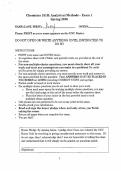
Chemistry 24lH: Analytical Methods - Exam 1
Spring 2026
NAME (LAST, FIRST): i-e, ONYEN:. _
1
Please PRINT as your name appears on the UNC Roster.
DO NOT OPEN OR WRITE ANYTHING UN TIL INSTRUCTED TO
DOSO
INSTRUCTIONS:
• PRINT your name and ONYEN above.
• An equation sheet with t-Table, and periodic table are provided at the end of
the exam.
work and state any assumptions you make in a problem! No credit
• For non-multiple-choice questions, you must. clearly show all your
will be given for simply providing an answer.
• For non-multiple-choice questions, you must provide your work and answer in
the space provided for the question. Final ANSWERS MUST BE PLACED IN
THE BOXES or LINES (including CORRECT UNITS and sig figs).
• Partial credit is based on work shown.
• For multiple-choice questions you do not need to show your work.
o If you need more space for working multiple choice questions, you may
use the blank page at the end of the exam before the equation sheet.
� Place the letter of your choice in the box provided next to each
multiple-choice question.
• Cell phones are not permitted to be out at any point in the exam.
• Double-check your calculations.
• Read and sign the honor pledge when, and only when, you finish
• Return all pages when you complete the exam.
taking the exam.
• You got this!!
Honor Pledge: By signing below, I pledge that I have not violated the UNC
Honor Code by receiving or giving unauthorized assistance on this exam. If I
do not sign, then I acknowledge that I was not honorable in taking the exam
and understand that it will simply not be graded, no questions asked.
(Signature)
1
, 1. (47 points) Answer the below questions.
a. (5 points) Atomic absorption spectroscopy was used to determine the
amount of aluminum in a sample of sunscreen. A blank solution was
measured seven times to determine the detection and quantitation limits of
the spectrometer. The average of the 7 blank readings blank was 0.0112 AU
and the standard deviation was 0.0014 AU. The slope of the calibration
curve created by the researchers was 2.40 x 109 M· 1 . Calculate the signal
detection limit and show all your work. Place your answer in the box
"*- s,+*» *.- [ @s -
3
S,> 0, 017 + (3)(0, 00) 0, 0 54
c� � d+
U- ' A,
b. (4 points) What charge is on the predominate form of aspartic acid found in
a solution buffered at pH 9.00? NOTE: The pKa's are not in any particular
order. Please pay attention to what pKa goes with what group in the
molecule. The given structure is in its fully protonated form. Write letter
choice in box provided.
Aspartic Acid
B
H
]
+H,N-¢-o-om
0
[] a_ pKa (a)= 1.990
pKa (B)= 10.002
LJ2]
D
�� � Ka (y)= 3.900
C-o
[D)-/
A) +2 B)+1 , C)0 1. / E)-2
c. (12 points; 3 points each) Answer the following questions regarding the
triprotic acid, HsA*. For HsA* pKa1 = 4.00, pKa2 = 6.00, and pKa3= 9.00.
[ Cl0w
1. Ac «hetpu is la-1"
11. What is the pli.ncipal species at p H 8.00: H,A+, H,A, HA·, or A•·?
I t)l,A-1
111. What is the second most predominate species at pH 8.00?
lV. What is the p rincip al species at pH 2.00? I �)At I I /-\ 1.-1
ye � A � � � � � A°
� �
2
i,o
Chemistry 24lH: Analytical Methods - Exam 1
Spring 2026
NAME (LAST, FIRST): i-e, ONYEN:. _
1
Please PRINT as your name appears on the UNC Roster.
DO NOT OPEN OR WRITE ANYTHING UN TIL INSTRUCTED TO
DOSO
INSTRUCTIONS:
• PRINT your name and ONYEN above.
• An equation sheet with t-Table, and periodic table are provided at the end of
the exam.
work and state any assumptions you make in a problem! No credit
• For non-multiple-choice questions, you must. clearly show all your
will be given for simply providing an answer.
• For non-multiple-choice questions, you must provide your work and answer in
the space provided for the question. Final ANSWERS MUST BE PLACED IN
THE BOXES or LINES (including CORRECT UNITS and sig figs).
• Partial credit is based on work shown.
• For multiple-choice questions you do not need to show your work.
o If you need more space for working multiple choice questions, you may
use the blank page at the end of the exam before the equation sheet.
� Place the letter of your choice in the box provided next to each
multiple-choice question.
• Cell phones are not permitted to be out at any point in the exam.
• Double-check your calculations.
• Read and sign the honor pledge when, and only when, you finish
• Return all pages when you complete the exam.
taking the exam.
• You got this!!
Honor Pledge: By signing below, I pledge that I have not violated the UNC
Honor Code by receiving or giving unauthorized assistance on this exam. If I
do not sign, then I acknowledge that I was not honorable in taking the exam
and understand that it will simply not be graded, no questions asked.
(Signature)
1
, 1. (47 points) Answer the below questions.
a. (5 points) Atomic absorption spectroscopy was used to determine the
amount of aluminum in a sample of sunscreen. A blank solution was
measured seven times to determine the detection and quantitation limits of
the spectrometer. The average of the 7 blank readings blank was 0.0112 AU
and the standard deviation was 0.0014 AU. The slope of the calibration
curve created by the researchers was 2.40 x 109 M· 1 . Calculate the signal
detection limit and show all your work. Place your answer in the box
"*- s,+*» *.- [ @s -
3
S,> 0, 017 + (3)(0, 00) 0, 0 54
c� � d+
U- ' A,
b. (4 points) What charge is on the predominate form of aspartic acid found in
a solution buffered at pH 9.00? NOTE: The pKa's are not in any particular
order. Please pay attention to what pKa goes with what group in the
molecule. The given structure is in its fully protonated form. Write letter
choice in box provided.
Aspartic Acid
B
H
]
+H,N-¢-o-om
0
[] a_ pKa (a)= 1.990
pKa (B)= 10.002
LJ2]
D
�� � Ka (y)= 3.900
C-o
[D)-/
A) +2 B)+1 , C)0 1. / E)-2
c. (12 points; 3 points each) Answer the following questions regarding the
triprotic acid, HsA*. For HsA* pKa1 = 4.00, pKa2 = 6.00, and pKa3= 9.00.
[ Cl0w
1. Ac «hetpu is la-1"
11. What is the pli.ncipal species at p H 8.00: H,A+, H,A, HA·, or A•·?
I t)l,A-1
111. What is the second most predominate species at pH 8.00?
lV. What is the p rincip al species at pH 2.00? I �)At I I /-\ 1.-1
ye � A � � � � � A°
� �
2
i,o