⋆
★★★ ⋆
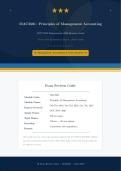
MAC2601: Principles of Management Accounting
OCT/NOV Examination 2026 Revision Guide
Covers Past Examination Papers: 2023 to 2025
⋆ ⋄ ⋆ ⋄ ⋆ ⋄ ⋆ ⋄ ⋆
❖ Management Accounting & Cost Analysis ❖
Exam Revision Guide
MAC2601
Module Code:
Principles of Management Accounting
Module Name:
Oct/Nov 2023, Oct/Nov 2024, Oct/Nov 2025
Papers Covered:
OCT/NOV 2026
Target Exam:
100 per paper
Total Marks:
2 Hours + 30 min upload
Duration:
5 Questions (all compulsory)
Format:
This guide presents exam-style questions aligned with the UNISA MAC2601 syllabus
and past examination patterns from 2023–2025, fully worked with detailed solutions
for effective revision.
★ Exam Revision Notes | MAC2601 | 2023–2026
,MAC2601 | Principles of Management Accounting OCT/NOV 2023–2025 Revision
UNIVERSITY EXAMINATIONS — OCT/NOV 2025
MAC2601 · Principles of Management Accounting · 100 Marks · 2 Hours
All 5 questions are compulsory. Show all calculations. Ignore taxation and time value of money unless
stated.
Page 2 of 33 ⋆
,MAC2601 | Principles of Management Accounting OCT/NOV 2023–2025 Revision
Question 1 [25 marks]
(a) [10 marks]
Question: Inventory Valuation — FIFO and Weighted Average
TechParts (Pty) Ltd manufactures electronic components. The following information
relates to raw material “Circuit Board X” for the month of September 2025:
Date Transaction Details
1 Sep Opening balance 500 units @ R40.00 each
5 Sep Purchase 1 200 units @ R44.00 each
12 Sep Issue to production 1 400 units
18 Sep Purchase 800 units @ R46.00 each
25 Sep Issue to production 600 units
Required:
(i) Calculate the closing inventory value using the FIFO method. (5)
(ii) Calculate the closing inventory value using the Weighted Average method. (5)
Answer:
Key Concept
FIFO (First-In, First-Out) assumes the oldest units are issued first.
Weighted Average recalculates the average cost after each purchase.
(i) FIFO Method
Step 1: Establish units available and closing inventory
Total receipts: 500 + 1 200 + 800 = 2 500 units
Total issues: 1 400 + 600 = 2 000 units
Closing inventory: 500 units
Step 2: Issue of 1 400 units on 12 Sep (FIFO)
• Use 500 units @ R40.00 = R20 000
• Use 900 units @ R44.00 = R39 600
• Total issued: 1 400 units = R59 600
• Remaining after 12 Sep: 300 units @ R44.00
Step 3: After purchase on 18 Sep
• 300 units @ R44.00 + 800 units @ R46.00 = 1 100 units in stock
Page 3 of 33 ⋆
,MAC2601 | Principles of Management Accounting OCT/NOV 2023–2025 Revision
Step 4: Issue of 600 units on 25 Sep (FIFO)
• Use 300 units @ R44.00 = R13 200
• Use 300 units @ R46.00 = R13 800
• Total issued: 600 units = R27 000
Closing inventory (FIFO):
Remaining: 500 units @ R46.00 = R23 000
Exam Tip
In FIFO, the closing inventory is always valued at the most recent purchase prices.
Always verify: Opening + Purchases − Issues = Closing units.
(ii) Weighted Average Method
Step 1: Opening balance
500 units @ R40.00; Total value = R20 000
Step 2: After purchase on 5 Sep
500 × R40 + 1 200 × R44 R20 000 + R52 800 R72 800
= = = R42.82 per unit
500 + 1 200 1 700 1 700
Step 3: Issue of 1 400 units on 12 Sep
1 400 × R42.82 = R59 953 (issued)
Remaining: 300 units @ R42.82 = R12 847
Step 4: After purchase on 18 Sep
300 × R42.82 + 800 × R46.00 R12 847 + R36 800 R49 647
= = = R45.13 per unit
300 + 800 1 100 1 100
Step 5: Issue of 600 units on 25 Sep
600 × R45.13 = R27 078 (issued)
Closing inventory (Weighted Average):
500 units @ R45.13 = R22 565
(b) [15 marks]
Question: Overhead Absorption and Over/Under Application
SafeBuild Construction Products Ltd uses a predetermined overhead absorption rate based
on machine hours. The following information is available for the year ended 30 September
2025:
Page 4 of 33 ⋆
, MAC2601 | Principles of Management Accounting OCT/NOV 2023–2025 Revision
Budgeted fixed manufacturing overheads R1 800 000
Budgeted machine hours 90 000 hours
Actual machine hours worked 84 000 hours
Actual fixed manufacturing overheads incurred R1 850 000
Required:
(i) Calculate the predetermined overhead absorption rate (OAR). (2)
(ii) Calculate the total overheads absorbed. (2)
(iii) Calculate the over- or under-absorbed overhead and state its nature. (4)
(iv) Explain TWO reasons why over- or under-absorption of overheads occurs. (4)
(v) Describe how under-absorbed overhead is treated in the income statement. (3)
Answer:
Key Concept
Budgeted Overheads
Predetermined OAR =
Budgeted Activity
Absorbed overheads = OAR × Actual activity
Over-absorption occurs when absorbed > actual. Under-absorption when absorbed <
actual.
(i) Predetermined Overhead Absorption Rate
Budgeted Fixed Overheads R1 800 000
OAR = = = R20 per machine hour
Budgeted Machine Hours 90 000 hours
(ii) Total Overheads Absorbed
Overheads Absorbed = OAR × Actual Machine Hours = R20 × 84 000 = R1 680 000
(iii) Over- or Under-Absorbed Overhead
Item Amount (R)
Actual overheads incurred 1 850 000
Less: Overheads absorbed (1 680 000)
Under-absorbed overhead 170 000
Nature: Under-absorbed — actual overheads exceeded absorbed overheads by R170 000.
Page 5 of 33 ⋆
★★★ ⋆
MAC2601: Principles of Management Accounting
OCT/NOV Examination 2026 Revision Guide
Covers Past Examination Papers: 2023 to 2025
⋆ ⋄ ⋆ ⋄ ⋆ ⋄ ⋆ ⋄ ⋆
❖ Management Accounting & Cost Analysis ❖
Exam Revision Guide
MAC2601
Module Code:
Principles of Management Accounting
Module Name:
Oct/Nov 2023, Oct/Nov 2024, Oct/Nov 2025
Papers Covered:
OCT/NOV 2026
Target Exam:
100 per paper
Total Marks:
2 Hours + 30 min upload
Duration:
5 Questions (all compulsory)
Format:
This guide presents exam-style questions aligned with the UNISA MAC2601 syllabus
and past examination patterns from 2023–2025, fully worked with detailed solutions
for effective revision.
★ Exam Revision Notes | MAC2601 | 2023–2026
,MAC2601 | Principles of Management Accounting OCT/NOV 2023–2025 Revision
UNIVERSITY EXAMINATIONS — OCT/NOV 2025
MAC2601 · Principles of Management Accounting · 100 Marks · 2 Hours
All 5 questions are compulsory. Show all calculations. Ignore taxation and time value of money unless
stated.
Page 2 of 33 ⋆
,MAC2601 | Principles of Management Accounting OCT/NOV 2023–2025 Revision
Question 1 [25 marks]
(a) [10 marks]
Question: Inventory Valuation — FIFO and Weighted Average
TechParts (Pty) Ltd manufactures electronic components. The following information
relates to raw material “Circuit Board X” for the month of September 2025:
Date Transaction Details
1 Sep Opening balance 500 units @ R40.00 each
5 Sep Purchase 1 200 units @ R44.00 each
12 Sep Issue to production 1 400 units
18 Sep Purchase 800 units @ R46.00 each
25 Sep Issue to production 600 units
Required:
(i) Calculate the closing inventory value using the FIFO method. (5)
(ii) Calculate the closing inventory value using the Weighted Average method. (5)
Answer:
Key Concept
FIFO (First-In, First-Out) assumes the oldest units are issued first.
Weighted Average recalculates the average cost after each purchase.
(i) FIFO Method
Step 1: Establish units available and closing inventory
Total receipts: 500 + 1 200 + 800 = 2 500 units
Total issues: 1 400 + 600 = 2 000 units
Closing inventory: 500 units
Step 2: Issue of 1 400 units on 12 Sep (FIFO)
• Use 500 units @ R40.00 = R20 000
• Use 900 units @ R44.00 = R39 600
• Total issued: 1 400 units = R59 600
• Remaining after 12 Sep: 300 units @ R44.00
Step 3: After purchase on 18 Sep
• 300 units @ R44.00 + 800 units @ R46.00 = 1 100 units in stock
Page 3 of 33 ⋆
,MAC2601 | Principles of Management Accounting OCT/NOV 2023–2025 Revision
Step 4: Issue of 600 units on 25 Sep (FIFO)
• Use 300 units @ R44.00 = R13 200
• Use 300 units @ R46.00 = R13 800
• Total issued: 600 units = R27 000
Closing inventory (FIFO):
Remaining: 500 units @ R46.00 = R23 000
Exam Tip
In FIFO, the closing inventory is always valued at the most recent purchase prices.
Always verify: Opening + Purchases − Issues = Closing units.
(ii) Weighted Average Method
Step 1: Opening balance
500 units @ R40.00; Total value = R20 000
Step 2: After purchase on 5 Sep
500 × R40 + 1 200 × R44 R20 000 + R52 800 R72 800
= = = R42.82 per unit
500 + 1 200 1 700 1 700
Step 3: Issue of 1 400 units on 12 Sep
1 400 × R42.82 = R59 953 (issued)
Remaining: 300 units @ R42.82 = R12 847
Step 4: After purchase on 18 Sep
300 × R42.82 + 800 × R46.00 R12 847 + R36 800 R49 647
= = = R45.13 per unit
300 + 800 1 100 1 100
Step 5: Issue of 600 units on 25 Sep
600 × R45.13 = R27 078 (issued)
Closing inventory (Weighted Average):
500 units @ R45.13 = R22 565
(b) [15 marks]
Question: Overhead Absorption and Over/Under Application
SafeBuild Construction Products Ltd uses a predetermined overhead absorption rate based
on machine hours. The following information is available for the year ended 30 September
2025:
Page 4 of 33 ⋆
, MAC2601 | Principles of Management Accounting OCT/NOV 2023–2025 Revision
Budgeted fixed manufacturing overheads R1 800 000
Budgeted machine hours 90 000 hours
Actual machine hours worked 84 000 hours
Actual fixed manufacturing overheads incurred R1 850 000
Required:
(i) Calculate the predetermined overhead absorption rate (OAR). (2)
(ii) Calculate the total overheads absorbed. (2)
(iii) Calculate the over- or under-absorbed overhead and state its nature. (4)
(iv) Explain TWO reasons why over- or under-absorption of overheads occurs. (4)
(v) Describe how under-absorbed overhead is treated in the income statement. (3)
Answer:
Key Concept
Budgeted Overheads
Predetermined OAR =
Budgeted Activity
Absorbed overheads = OAR × Actual activity
Over-absorption occurs when absorbed > actual. Under-absorption when absorbed <
actual.
(i) Predetermined Overhead Absorption Rate
Budgeted Fixed Overheads R1 800 000
OAR = = = R20 per machine hour
Budgeted Machine Hours 90 000 hours
(ii) Total Overheads Absorbed
Overheads Absorbed = OAR × Actual Machine Hours = R20 × 84 000 = R1 680 000
(iii) Over- or Under-Absorbed Overhead
Item Amount (R)
Actual overheads incurred 1 850 000
Less: Overheads absorbed (1 680 000)
Under-absorbed overhead 170 000
Nature: Under-absorbed — actual overheads exceeded absorbed overheads by R170 000.
Page 5 of 33 ⋆