
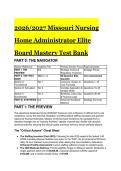
2026/2027 Missouri Nursing
Home Administrator Elite
Board Mastery Test Bank
PART 0: THE NAVIGATOR
Section Reference Cognitive Tier Primary Domain Focus Page Descriptor
PART I: THE N/A Strategic Axioms & Strategic Primer
PREVIEW Regulatory Inversions
PART II: THE TEST Tiers 1 - 3 60-Question Elite Core Assessment
BANK Gauntlet
Section A: Tier 1 Licensure, Syntax, & Questions 1–15
Foundational Core Formulas
Section B: Simulation Tier 2 Complex Application & Questions 16–35
Variable Shifts
Section C: Tier 3 Synthesis, Crisis Ops, Questions 36–60
Grandmaster & Financial Logic
PART III: SYNTHESIS N/A Advanced Analytical Strategic Summary
Matrices
PART I: THE PREVIEW
The operational landscape for the 2026/2027 licensure cycle in Missouri is defined not by rote
compliance, but by the technical integration of shifting federal staffing mandates and granular
state-level financial thresholds. Mastery of this test bank transforms the candidate from a
standard manager into an "Industry Architect" capable of governing a facility with absolute
technical authority, ensuring that clinical quality and fiscal solvency remain perfectly aligned.
The "Critical Axioms" Cheat Sheet
● The Staffing Inversion (Post-2025): Following the late-2025 repeal of the federal 3.48
HPRD mandate, Missouri facilities must return to the "8/24" rule (8 consecutive RN hours
daily, 24-hour licensed nurse presence) while utilizing the now-mandatory, data-driven
Enhanced Facility Assessment to prove staffing sufficiency based on resident acuity.
● The 2026 Medicaid Redlines: Precise eligibility hinges on Missouri-specific thresholds: a
single applicant asset limit of $6,068.80, a spousal allowance (CSRA) capped at
$162,660, and a transfer penalty divisor of $7,909.
, ● The Incident Rhythm: Suspicion of a crime or serious injury mandates a report to the
Missouri DHSS hotline and local law enforcement within 2 HOURS, followed by the
submission of the formal investigation report within 5 WORKING DAYS.
● The Penalty Scale (RSMo 198.067): Missouri categorizes deficiencies into Class I
(Imminent Danger: $1,000–$10,000), Class II (Direct Health/Safety: $250–$1,000), and
Class III (Indirect/Administrative: $50–$250), with mandatory doubling for repeat violations
within specified timeframes.
● MDS 3.0 v1.20.1 Protocol: Effective October 1, 2025, Item A0800 (Gender) is obsolete,
replaced by A0810 (Sex), and Section R (Social Needs) is expanded to drive health
equity metrics.
PART II: THE ELITE TEST BANK
Tier 1: Foundational Syntax & Application (Questions 1–15)
Q1: An applicant for the Missouri Nursing Home Administrator (NHA) license holds a
Baccalaureate degree in Health-care Administration. According to the requirements set forth in
19 CSR 73-2.020, what is the MINIMUM amount of experience in a health-care facility required
for eligibility to sit for the state examination? A) Three years of full-time equivalency experience.
B) Two years of full-time equivalency experience. C) One year of full-time equivalency
experience. D) No experience is required for those with a specialized degree.
● The Answer: C (One year of full-time equivalency experience.)
● Distractor Analysis:
○ A is incorrect: Three years is the requirement for those relying solely on experience
without a degree.
○ B is incorrect: Two years is the requirement for those with an Associate degree plus
experience.
○ D is incorrect: While the degree provides the educational foundation, Missouri
statute still requires a minimum of one year of field experience for Baccalaureate
and Master’s degree holders to ensure practical competence.
The Mentor's Analysis: Missouri’s licensure chassis is built on a sliding scale of
"Academic-to-Clinical" ratios. By requiring a minimum of one year even for specialized degree
holders, the Board ensures that the "Theoretical Administrator" has survived at least one full
annual survey cycle and fiscal year in a live environment. Professional/Academic Intuition:
Higher education reduces the "Time-Debt" of experience, but in Missouri, one year of
hands-on exposure is the non-negotiable floor for professional degree holders.
Q2: A licensed Missouri NHA is planning their biennial renewal for the period ending June 30th.
According to 19 CSR 73-2.050, what is the EXACT requirement for Continuing Education (CE)
clock hours, and how many of these must specifically address "Patient Care" (PC)? A) 20 total
hours; 5 must be Patient Care. B) 40 total hours; 10 must be Patient Care. C) 40 total hours; 20
must be Patient Care. D) 60 total hours; 15 must be Patient Care.
● The Answer: B (40 total hours; 10 must be Patient Care.)
● Distractor Analysis:
○ A is incorrect: 20 hours is the standard for Pharmacy Technicians or a prorated
period for those licensed less than two years, but not the standard NHA cycle.
○ C is incorrect: While 40 hours is the total, only 10 (25%) are mandated for PC;
requiring 20 would be an over-interpretation of the rule.
, ○ D is incorrect: 60 hours exceeds the state requirement and represents an
unnecessary administrative burden.
The Mentor's Analysis: The Missouri "40/10 Rule" is a mechanistic safeguard against
"Administrative Drift." By mandating that 25% of education focus on clinical outcomes (Patient
Care), the state forces the administrator to remain tethered to the "Clinical Engine" of the facility.
Professional/Academic Intuition: Maintain a meticulous log of "Patient Care" designated
hours; a failure to hit the 10-hour PC floor will trigger a mandatory license suspension
regardless of the total hour count.
Q3: During an inspection, the Missouri Department of Health and Senior Services (DHSS)
identifies a condition that "creates a substantial risk to the life, body, or health of a resident."
Under the classification system of RSMo 198.085, this deficiency is designated as which class?
A) Class I B) Class II C) Class III D) Federal-Only (Non-Classified)
● The Answer: A (Class I)
● Distractor Analysis:
○ B is incorrect: Class II refers to conditions that have a direct or immediate
relationship to health, safety, or welfare but do not constitute "imminent danger".
○ C is incorrect: Class III refers to conditions that have an indirect or remote
relationship to health and safety, such as minor record-keeping errors.
○ D is incorrect: While federal tags exist, Missouri statute (RSMo 198) mandates a
state-level classification for every violation.
The Mentor's Analysis: A Class I violation is the "Red Line" of nursing home administration. It
signifies an "Imminent Jeopardy" (IJ) state where the facility’s protective systems have failed to
prevent a high-probability risk of death or serious injury. Professional/Academic Intuition:
Class I violations carry immediate financial liability and mandatory doubling for repeat
occurrences; they are the most critical threat to a facility's "License to Operate."
Q4: A facility in Missouri with 100 residents seeks to qualify for an "Approved Nursing Home
Bond" to manage resident trust funds. According to Section 198.096, RSMo, the bond amount
must be calculated as AT LEAST what multiplier of the average monthly balance of resident
funds? A) 1.0x (Equal to the balance) B) 1.5x (One and a half times the balance) C) 2.0x
(Double the balance) D) 0.5x (Half the balance)
● The Answer: B (1.5x (One and a half times the balance))
● Distractor Analysis:
○ A is incorrect: A 1:1 ratio provides no margin for the typical "mid-month peaks" in
social security deposits or unexpected inheritances.
○ C is incorrect: 2.0x is a conservative target often used by risk-averse operators but
exceeds the legal requirement.
○ D is incorrect: 0.5x would leave the state and the residents severely under-insured.
The Mentor's Analysis: The "1.5x Multiplier" is a financial shock absorber. It ensures that the
surety coverage account for the temporal variance between deposits and disbursements,
protecting the "Resident Trust" from facility-level insolvency. Professional/Academic Intuition:
Audit your 12-month "Monthly Peak" averages; if your average monthly balance grows,
your bond coverage must be adjusted upwards immediately to maintain licensure
compliance.
Q5: In the 2026/2027 fiscal era, Missouri Medicaid (MO HealthNet) enforces a "Look-Back
Period" for uncompensated asset transfers. What is the EXACT duration of this period, and how
is it used to calculate the "Penalty Period"? A) 36 months; the total value is divided by the
resident's daily rate. B) 60 months; the total value is divided by the state penalty divisor
($7,909). C) 48 months; the total value is divided by the facility's private pay rate. D) 72 months;
Home Administrator Elite
Board Mastery Test Bank
PART 0: THE NAVIGATOR
Section Reference Cognitive Tier Primary Domain Focus Page Descriptor
PART I: THE N/A Strategic Axioms & Strategic Primer
PREVIEW Regulatory Inversions
PART II: THE TEST Tiers 1 - 3 60-Question Elite Core Assessment
BANK Gauntlet
Section A: Tier 1 Licensure, Syntax, & Questions 1–15
Foundational Core Formulas
Section B: Simulation Tier 2 Complex Application & Questions 16–35
Variable Shifts
Section C: Tier 3 Synthesis, Crisis Ops, Questions 36–60
Grandmaster & Financial Logic
PART III: SYNTHESIS N/A Advanced Analytical Strategic Summary
Matrices
PART I: THE PREVIEW
The operational landscape for the 2026/2027 licensure cycle in Missouri is defined not by rote
compliance, but by the technical integration of shifting federal staffing mandates and granular
state-level financial thresholds. Mastery of this test bank transforms the candidate from a
standard manager into an "Industry Architect" capable of governing a facility with absolute
technical authority, ensuring that clinical quality and fiscal solvency remain perfectly aligned.
The "Critical Axioms" Cheat Sheet
● The Staffing Inversion (Post-2025): Following the late-2025 repeal of the federal 3.48
HPRD mandate, Missouri facilities must return to the "8/24" rule (8 consecutive RN hours
daily, 24-hour licensed nurse presence) while utilizing the now-mandatory, data-driven
Enhanced Facility Assessment to prove staffing sufficiency based on resident acuity.
● The 2026 Medicaid Redlines: Precise eligibility hinges on Missouri-specific thresholds: a
single applicant asset limit of $6,068.80, a spousal allowance (CSRA) capped at
$162,660, and a transfer penalty divisor of $7,909.
, ● The Incident Rhythm: Suspicion of a crime or serious injury mandates a report to the
Missouri DHSS hotline and local law enforcement within 2 HOURS, followed by the
submission of the formal investigation report within 5 WORKING DAYS.
● The Penalty Scale (RSMo 198.067): Missouri categorizes deficiencies into Class I
(Imminent Danger: $1,000–$10,000), Class II (Direct Health/Safety: $250–$1,000), and
Class III (Indirect/Administrative: $50–$250), with mandatory doubling for repeat violations
within specified timeframes.
● MDS 3.0 v1.20.1 Protocol: Effective October 1, 2025, Item A0800 (Gender) is obsolete,
replaced by A0810 (Sex), and Section R (Social Needs) is expanded to drive health
equity metrics.
PART II: THE ELITE TEST BANK
Tier 1: Foundational Syntax & Application (Questions 1–15)
Q1: An applicant for the Missouri Nursing Home Administrator (NHA) license holds a
Baccalaureate degree in Health-care Administration. According to the requirements set forth in
19 CSR 73-2.020, what is the MINIMUM amount of experience in a health-care facility required
for eligibility to sit for the state examination? A) Three years of full-time equivalency experience.
B) Two years of full-time equivalency experience. C) One year of full-time equivalency
experience. D) No experience is required for those with a specialized degree.
● The Answer: C (One year of full-time equivalency experience.)
● Distractor Analysis:
○ A is incorrect: Three years is the requirement for those relying solely on experience
without a degree.
○ B is incorrect: Two years is the requirement for those with an Associate degree plus
experience.
○ D is incorrect: While the degree provides the educational foundation, Missouri
statute still requires a minimum of one year of field experience for Baccalaureate
and Master’s degree holders to ensure practical competence.
The Mentor's Analysis: Missouri’s licensure chassis is built on a sliding scale of
"Academic-to-Clinical" ratios. By requiring a minimum of one year even for specialized degree
holders, the Board ensures that the "Theoretical Administrator" has survived at least one full
annual survey cycle and fiscal year in a live environment. Professional/Academic Intuition:
Higher education reduces the "Time-Debt" of experience, but in Missouri, one year of
hands-on exposure is the non-negotiable floor for professional degree holders.
Q2: A licensed Missouri NHA is planning their biennial renewal for the period ending June 30th.
According to 19 CSR 73-2.050, what is the EXACT requirement for Continuing Education (CE)
clock hours, and how many of these must specifically address "Patient Care" (PC)? A) 20 total
hours; 5 must be Patient Care. B) 40 total hours; 10 must be Patient Care. C) 40 total hours; 20
must be Patient Care. D) 60 total hours; 15 must be Patient Care.
● The Answer: B (40 total hours; 10 must be Patient Care.)
● Distractor Analysis:
○ A is incorrect: 20 hours is the standard for Pharmacy Technicians or a prorated
period for those licensed less than two years, but not the standard NHA cycle.
○ C is incorrect: While 40 hours is the total, only 10 (25%) are mandated for PC;
requiring 20 would be an over-interpretation of the rule.
, ○ D is incorrect: 60 hours exceeds the state requirement and represents an
unnecessary administrative burden.
The Mentor's Analysis: The Missouri "40/10 Rule" is a mechanistic safeguard against
"Administrative Drift." By mandating that 25% of education focus on clinical outcomes (Patient
Care), the state forces the administrator to remain tethered to the "Clinical Engine" of the facility.
Professional/Academic Intuition: Maintain a meticulous log of "Patient Care" designated
hours; a failure to hit the 10-hour PC floor will trigger a mandatory license suspension
regardless of the total hour count.
Q3: During an inspection, the Missouri Department of Health and Senior Services (DHSS)
identifies a condition that "creates a substantial risk to the life, body, or health of a resident."
Under the classification system of RSMo 198.085, this deficiency is designated as which class?
A) Class I B) Class II C) Class III D) Federal-Only (Non-Classified)
● The Answer: A (Class I)
● Distractor Analysis:
○ B is incorrect: Class II refers to conditions that have a direct or immediate
relationship to health, safety, or welfare but do not constitute "imminent danger".
○ C is incorrect: Class III refers to conditions that have an indirect or remote
relationship to health and safety, such as minor record-keeping errors.
○ D is incorrect: While federal tags exist, Missouri statute (RSMo 198) mandates a
state-level classification for every violation.
The Mentor's Analysis: A Class I violation is the "Red Line" of nursing home administration. It
signifies an "Imminent Jeopardy" (IJ) state where the facility’s protective systems have failed to
prevent a high-probability risk of death or serious injury. Professional/Academic Intuition:
Class I violations carry immediate financial liability and mandatory doubling for repeat
occurrences; they are the most critical threat to a facility's "License to Operate."
Q4: A facility in Missouri with 100 residents seeks to qualify for an "Approved Nursing Home
Bond" to manage resident trust funds. According to Section 198.096, RSMo, the bond amount
must be calculated as AT LEAST what multiplier of the average monthly balance of resident
funds? A) 1.0x (Equal to the balance) B) 1.5x (One and a half times the balance) C) 2.0x
(Double the balance) D) 0.5x (Half the balance)
● The Answer: B (1.5x (One and a half times the balance))
● Distractor Analysis:
○ A is incorrect: A 1:1 ratio provides no margin for the typical "mid-month peaks" in
social security deposits or unexpected inheritances.
○ C is incorrect: 2.0x is a conservative target often used by risk-averse operators but
exceeds the legal requirement.
○ D is incorrect: 0.5x would leave the state and the residents severely under-insured.
The Mentor's Analysis: The "1.5x Multiplier" is a financial shock absorber. It ensures that the
surety coverage account for the temporal variance between deposits and disbursements,
protecting the "Resident Trust" from facility-level insolvency. Professional/Academic Intuition:
Audit your 12-month "Monthly Peak" averages; if your average monthly balance grows,
your bond coverage must be adjusted upwards immediately to maintain licensure
compliance.
Q5: In the 2026/2027 fiscal era, Missouri Medicaid (MO HealthNet) enforces a "Look-Back
Period" for uncompensated asset transfers. What is the EXACT duration of this period, and how
is it used to calculate the "Penalty Period"? A) 36 months; the total value is divided by the
resident's daily rate. B) 60 months; the total value is divided by the state penalty divisor
($7,909). C) 48 months; the total value is divided by the facility's private pay rate. D) 72 months;


