

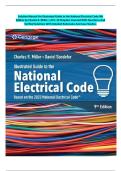
Solution Manual For Illustrated Guide to the National Electrical Code 9th
Edition by Charles R. Miller | All 1-19 Chapters Covered With Questions And
Verified Solutions With Detailed Rationales And Case Studies.
, TABLE OF CONTENT
Part 1: Foundational Provisions & General Requirements
• Chapter 1: National Electrical Code (NEC) Structure and Overview
• Chapter 2: Article 90: Introduction to the National Electrical Code
• Chapter 3: Article 100: Definitions Used Throughout the NEC
• Chapter 4: Article 110: General Requirements for Electrical Installations
Part 2: Wiring and Protection
• Chapter 5: Article 200: Use and Identification of Grounded Conductors
• Chapter 6: Article 210: Branch Circuits
• Chapter 7: Article 215: Feeders
• Chapter 8: Article 220: Branch-Circuit, Feeder, and Service Load Calculations
• Chapter 9: Article 225: Outside Branch Circuits and Feeders
• Chapter 10: Article 230: Services
• Chapter 11: Article 240: Overcurrent Protection
• Chapter 12: Article 250: Grounding and Bonding
Part 3: Wiring Methods and Materials
• Chapter 13: Article 300: General Requirements for Wiring Methods and Materials
• Chapter 14: Article 310: Conductors for General Wiring
• Chapter 15: Article 312 & 314: Cabinets, Cutout Boxes, Meter Socket Enclosures, Outlet,
Device, Pull, and Junction Boxes
• Chapter 16: Article 320–340: Specific Cable Assemblies (AC, MC, NM, NMC, NMS, TC)
• Chapter 17: Article 342–362: Raceways and Conduits (RMC, IMC, EMT, PVC, FMC, LFMC)
• Chapter 18: Article 366–392: Other Wiring Methods (Auxiliary Gutters, Busways, Wireways,
Cable Trays)
Part 4: Equipment for General Use
• Chapter 19: Article 400 & 404: Flexible Cords and Cables, and Switches
,Chapter 1: National Electrical Code (NEC) Structure and Overview
Multiple Choice Questions (21 Questions)
1. The National Electrical Code (NEC) is published by which organization?
• A) International Brotherhood of Electrical Workers (IBEW)
• B) National Fire Protection Association (NFPA)
• C) Occupational Safety and Health Administration (OSHA)
• D) Institute of Electrical and Electronics Engineers (IEEE)
<details> <summary><strong> Correct Answer: B</strong></summary>
Rationale: The NEC (NFPA 70) is published by the National Fire Protection Association (NFPA). It is
revised every 3 years. OSHA (C) adopts the NEC as part of workplace safety regulations but does not
publish it. IEEE (D) publishes other electrical standards (e.g., IEEE Color Books). IBEW (A) is a labor
union.
</details>
2. The NEC is officially known as...
• A) NFPA 70
• B) ANSI C2
• C) IEEE 1584
• D) UL 508A
<details> <summary><strong> Correct Answer: A</strong></summary>
Rationale: The NEC is formally designated as NFPA 70 (National Fire Protection Association Standard
70). ANSI C2 (B) is the National Electrical Safety Code (NESC – for utility lines). IEEE 1584 (C) is for arc
flash calculations. UL 508A (D) is for industrial control panels.
</details>
3. How often is the National Electrical Code (NEC) revised and published?
• A) Every year
, • B) Every 3 years
• C) Every 5 years
• D) Every 10 years
<details> <summary><strong> Correct Answer: B</strong></summary>
Rationale: The NEC is revised on a 3-year cycle (e.g., 2017, 2020, 2023, 2026). This regular update
incorporates new technologies, safety research, and code changes proposed by committees and the
public. Many local jurisdictions adopt the most recent version with a time lag.
</details>
4. The NEC is considered a...
• A) Design specification manual
• B) Minimum safety standard for electrical installations
• C) Manufacturer's instruction guide
• D) Energy efficiency code
<details> <summary><strong> Correct Answer: B</strong></summary>
Rationale: The NEC is not a design manual (A) nor an instruction guide (C). It is a minimum safety
standard for electrical installations to protect people and property from electrical hazards (fire,
shock). Local jurisdictions adopt it into law. Energy efficiency codes (D) are separate (e.g., IECC,
ASHRAE 90.1).
</details>
5. The NEC is divided into how many major parts?
• A) 2
• B) 4
• C) 9
• D) 12
<details> <summary><strong> Correct Answer: C</strong></summary>
Rationale: The NEC is organized into 9 chapters:
• Chapter 1: General
• Chapter 2: Wiring and Protection
• Chapter 3: Wiring Methods and Materials
• Chapter 4: Equipment for General Use
• Chapter 5: Special Occupancies
Edition by Charles R. Miller | All 1-19 Chapters Covered With Questions And
Verified Solutions With Detailed Rationales And Case Studies.
, TABLE OF CONTENT
Part 1: Foundational Provisions & General Requirements
• Chapter 1: National Electrical Code (NEC) Structure and Overview
• Chapter 2: Article 90: Introduction to the National Electrical Code
• Chapter 3: Article 100: Definitions Used Throughout the NEC
• Chapter 4: Article 110: General Requirements for Electrical Installations
Part 2: Wiring and Protection
• Chapter 5: Article 200: Use and Identification of Grounded Conductors
• Chapter 6: Article 210: Branch Circuits
• Chapter 7: Article 215: Feeders
• Chapter 8: Article 220: Branch-Circuit, Feeder, and Service Load Calculations
• Chapter 9: Article 225: Outside Branch Circuits and Feeders
• Chapter 10: Article 230: Services
• Chapter 11: Article 240: Overcurrent Protection
• Chapter 12: Article 250: Grounding and Bonding
Part 3: Wiring Methods and Materials
• Chapter 13: Article 300: General Requirements for Wiring Methods and Materials
• Chapter 14: Article 310: Conductors for General Wiring
• Chapter 15: Article 312 & 314: Cabinets, Cutout Boxes, Meter Socket Enclosures, Outlet,
Device, Pull, and Junction Boxes
• Chapter 16: Article 320–340: Specific Cable Assemblies (AC, MC, NM, NMC, NMS, TC)
• Chapter 17: Article 342–362: Raceways and Conduits (RMC, IMC, EMT, PVC, FMC, LFMC)
• Chapter 18: Article 366–392: Other Wiring Methods (Auxiliary Gutters, Busways, Wireways,
Cable Trays)
Part 4: Equipment for General Use
• Chapter 19: Article 400 & 404: Flexible Cords and Cables, and Switches
,Chapter 1: National Electrical Code (NEC) Structure and Overview
Multiple Choice Questions (21 Questions)
1. The National Electrical Code (NEC) is published by which organization?
• A) International Brotherhood of Electrical Workers (IBEW)
• B) National Fire Protection Association (NFPA)
• C) Occupational Safety and Health Administration (OSHA)
• D) Institute of Electrical and Electronics Engineers (IEEE)
<details> <summary><strong> Correct Answer: B</strong></summary>
Rationale: The NEC (NFPA 70) is published by the National Fire Protection Association (NFPA). It is
revised every 3 years. OSHA (C) adopts the NEC as part of workplace safety regulations but does not
publish it. IEEE (D) publishes other electrical standards (e.g., IEEE Color Books). IBEW (A) is a labor
union.
</details>
2. The NEC is officially known as...
• A) NFPA 70
• B) ANSI C2
• C) IEEE 1584
• D) UL 508A
<details> <summary><strong> Correct Answer: A</strong></summary>
Rationale: The NEC is formally designated as NFPA 70 (National Fire Protection Association Standard
70). ANSI C2 (B) is the National Electrical Safety Code (NESC – for utility lines). IEEE 1584 (C) is for arc
flash calculations. UL 508A (D) is for industrial control panels.
</details>
3. How often is the National Electrical Code (NEC) revised and published?
• A) Every year
, • B) Every 3 years
• C) Every 5 years
• D) Every 10 years
<details> <summary><strong> Correct Answer: B</strong></summary>
Rationale: The NEC is revised on a 3-year cycle (e.g., 2017, 2020, 2023, 2026). This regular update
incorporates new technologies, safety research, and code changes proposed by committees and the
public. Many local jurisdictions adopt the most recent version with a time lag.
</details>
4. The NEC is considered a...
• A) Design specification manual
• B) Minimum safety standard for electrical installations
• C) Manufacturer's instruction guide
• D) Energy efficiency code
<details> <summary><strong> Correct Answer: B</strong></summary>
Rationale: The NEC is not a design manual (A) nor an instruction guide (C). It is a minimum safety
standard for electrical installations to protect people and property from electrical hazards (fire,
shock). Local jurisdictions adopt it into law. Energy efficiency codes (D) are separate (e.g., IECC,
ASHRAE 90.1).
</details>
5. The NEC is divided into how many major parts?
• A) 2
• B) 4
• C) 9
• D) 12
<details> <summary><strong> Correct Answer: C</strong></summary>
Rationale: The NEC is organized into 9 chapters:
• Chapter 1: General
• Chapter 2: Wiring and Protection
• Chapter 3: Wiring Methods and Materials
• Chapter 4: Equipment for General Use
• Chapter 5: Special Occupancies


