

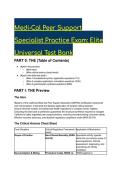
Medi-Cal Peer Support
Specialist Practice Exam: Elite
Universal Test Bank
PART 0: THE (Table of Contents)
● (#part-i-the-preview)
○ (#the-intro)
○ (#the-critical-axioms-cheat-sheet)
● (#part-ii-the-elite-test-bank)
○ (#tier-1-foundational-syntax--application-questions-115)
○ (#tier-2-complex-application--simulation-questions-1635)
○ (#tier-3-grandmaster-synthesis-questions-3660)
PART I: THE Preview
The Intro
Mastery of the California Medi-Cal Peer Support Specialist (CMPSS) certification transcends
rote memorization; it demands the flawless application of dynamic ethical statutes,
trauma-informed models, and behavioral health regulations to complex human realities.
Executing this test bank to perfection guarantees the structural synthesis required to navigate
California’s highly regulated peer support practice, ensuring uncompromising consumer safety,
effective recovery advocacy, and absolute regulatory compliance under BHIN 25-010.
The Critical Axioms Cheat Sheet
Core Discipline Critical Regulatory Framework / Application & Mechanism
Axiom
Scope of Practice Non-Clinical Mutuality (BHIN Specialists strictly operate
25-010) within the non-clinical scope of
lived experience. Clinical
assessment, diagnosing, and
prescribing are strictly
prohibited.
Documentation & Billing Procedure Codes H0038 vs. H0038 applies to
,Core Discipline Critical Regulatory Framework / Application & Mechanism
Axiom
H0025 Self-Help/Peer Services
(Engagement/Therapeutic
Activities). H0025 applies
exclusively to Prevention
Education (Educational
Groups).
Confidentiality 42 CFR Part 2 (SUD Privacy) Substance Use Disorder
records require explicit,
granular written consent for
redisclosure. This supersedes
standard HIPAA exemptions
and standard legal subpoenas.
Legal Compliance Mandated Reporting Suspected child, elder, or
(CANRA) dependent adult abuse
mandates immediate telephone
notification, followed by a
formal written SOC 341 report
within two working days.
Ethical Boundaries Dual Relationships & Specialists must permanently
Exploitation avoid dual relationships that
impair judgment. Engaging in
sexual/romantic activities with
current or former peers triggers
certification revocation.
PART II: THE ELITE TEST BANK
Tier 1: Foundational Syntax & Application (Questions 1–15)
Q1: A newly certified Medi-Cal Peer Support Specialist is preparing to document a session
involving an educational skill-building group focused on relapse prevention. Based on California
Department of Health Care Services (DHCS) billing standards, which procedure code is the
MOST ACCURATE for this specific service component? A) H0038 B) T1017 C) H0025 D)
H2019
● The Answer: C (H0025)
● Distractor Analysis:
○ A is incorrect: Code H0038 is reserved for Self-Help/Peer Services, specifically
Engagement and Therapeutic Activities, not educational skill-building groups.
○ B is incorrect: T1017 is the billing code for Targeted Case Management, falling
outside the primary billing architecture for peer services.
○ D is incorrect: H2019 is utilized for Therapeutic Behavioral Services (TBS), an
entirely different Medi-Cal service category.
The Mentor's Analysis: Billing integrity dictates regulatory compliance and financial viability
within the Medi-Cal system. When documenting educational skill-building groups, the immediate
priority is assigning the distinct prevention education code. By utilizing H0025, the specialist
bypasses the common trap of commingling group education with individual therapeutic
,engagement. Professional/Academic Intuition: H0025 denotes Education; H0038 denotes
Engagement and Therapeutic Activity.
Q2: During an initial meeting, a peer expresses intense dissatisfaction with their current housing
situation and states, "I just want you to find me a new apartment and talk to the landlord for me."
Based on the Medi-Cal Code of Ethics for Peer Support Specialists, which action is the MOST
APPROPRIATE? A) Assure the peer that the specialist will immediately contact local landlords
to secure a new apartment. B) Inform the peer that housing navigation is outside the scope of
peer support and refer them to a social worker. C) Validate their frustration and offer to
collaboratively explore housing resources and role-play landlord interactions. D) Tell the peer
they must address their substance use goals before housing can be discussed.
● The Answer: C (Validate their frustration and offer to collaboratively explore housing
resources and role-play landlord interactions.)
● Distractor Analysis:
○ A is incorrect: Performing the work on behalf of the peer undermines self-advocacy
and violates the person-driven empowerment standard.
○ B is incorrect: Resource linkage and navigation are explicitly outlined within the 17
core competencies of a CMPSS.
○ D is incorrect: Imposing a sequential treatment hierarchy violates the person-driven
ethical standard, which dictates supporting goals based on the individual's specific
needs and wants.
The Mentor's Analysis: True peer support builds independent capacity, not administrative
dependency. When facing a peer requesting direct rescue, the immediate priority is shifting the
dynamic toward self-advocacy. By utilizing collaborative resource navigation, the practitioner
bypasses the common trap of practicing paternalism instead of mutuality.
Professional/Academic Intuition: Support the peer to act for themselves; never act on
their behalf without their active involvement.
Q3: Under the Welfare and Institutions Code governed by BHIN 25-010, Medi-Cal Peer Support
Specialists are mandated to provide services based on which foundational document? A) An
approved, individualized Plan of Care. B) A clinical diagnostic assessment formulated by the
peer. C) A court-mandated probation order detailing treatment. D) A standardized 12-step
recovery protocol template.
● The Answer: A (An approved, individualized Plan of Care.)
● Distractor Analysis:
○ B is incorrect: Peer specialists do not create or dictate clinical diagnostic
assessments, though they may contribute observational information to them.
○ C is incorrect: While a peer may be justice-involved, the Medi-Cal services
themselves must be tied directly to a behavioral health Plan of Care, not dictated
solely by legal mandates.
○ D is incorrect: Peer support recognizes multiple pathways to recovery; forcing a
standardized 12-step protocol violates the ethical mandate to honor alternative or
culturally-specific treatments.
The Mentor's Analysis: Medicaid reimbursement demands structured necessity and planned
interventions. When delivering peer support services, the immediate priority is ensuring all
actions align with documented, peer-driven goals. By utilizing an individualized Plan of Care, the
specialist bypasses the common trap of providing unstructured, unbillable socialization.
Professional/Academic Intuition: If an intervention is not tethered to the Plan of Care, it
cannot be billed as a therapeutic activity.
Q4: A Peer Support Specialist observes a 72-year-old peer with severe bruising on their arms.
, The peer admits their adult child grabbed them forcefully during an argument over money. As a
mandated reporter in California, what is the FIRST legally required action? A) Complete the
written SOC 341 form and submit it to the agency supervisor within 24 hours. B) Confront the
adult child to ensure the peer's immediate physical safety. C) Immediately report the suspected
abuse by telephone to Adult Protective Services (APS) or local law enforcement. D) Wait to see
if the bruising worsens before making a formal allegation to state authorities.
● The Answer: C (Immediately report the suspected abuse by telephone to Adult Protective
Services (APS) or local law enforcement.)
● Distractor Analysis:
○ A is incorrect: The written report (SOC 341) is legally required within two working
days, but it is strictly the secondary step. Telephone notification is required
immediately.
○ B is incorrect: Confrontation places the peer and the specialist in danger and falls
outside the professional scope of practice.
○ D is incorrect: Delaying a report to gather further evidence is a severe violation of
mandated reporter laws, carrying potential legal and criminal penalties.
The Mentor's Analysis: Mandated reporting is an uncompromising legal duty carrying strict
timelines. When facing suspected elder abuse, the immediate priority is verbal notification to
state authorities. By utilizing the immediate telephone report protocol, the reporter bypasses the
common trap of allowing administrative hesitation to endanger a vulnerable adult.
Professional/Academic Intuition: Telephone report immediately; written report within two
working days. No exceptions.
Q5: According to the Medi-Cal Code of Ethics Violation Guidelines (CalMHSA), if a Peer
Support Specialist lends, gives, or receives money from a person being supported, what is the
MINIMUM sanction? A) A verbal warning from their direct clinical supervisor. B) Up to a
six-month suspension of certification and completion of six hours of training in law and ethics. C)
Permanent revocation of certification without the right to appeal. D) A mandatory transfer to a
different employing agency.
● The Answer: B (Up to a six-month suspension of certification and completion of six hours
of training in law and ethics.)
● Distractor Analysis:
○ A is incorrect: Financial misconduct is a codified ethical violation handled by
CalMHSA, resulting in formal state sanctions, not just an internal verbal warning.
○ C is incorrect: Permanent revocation is the defined maximum sanction for this
specific offense, not the minimum baseline.
○ D is incorrect: CalMHSA dictates certification sanctions; the entity does not hold
authority to dictate internal agency transfers.
The Mentor's Analysis: Financial boundaries protect the integrity of the peer relationship from
coercion and exploitation. When facing financial misconduct (Violation H7), the immediate
priority is formal remediation. By utilizing state-mandated sanctions, the certifying entity
bypasses the common trap of minimizing dual financial relationships. Professional/Academic
Intuition: Financial interactions with peers destroy mutuality and invite immediate
certification suspension.
Q6: A CMPSS is working in a Substance Use Disorder (SUD) clinic. A probation officer calls
requesting an update on a peer's attendance. Under 42 CFR Part 2, which action is the MOST
ACCURATE? A) The CMPSS may confirm attendance because probation officers are exempt
from confidentiality laws. B) The CMPSS must refuse to acknowledge the peer's presence
unless a specific, written consent for redisclosure to that exact officer is on file. C) The CMPSS
Specialist Practice Exam: Elite
Universal Test Bank
PART 0: THE (Table of Contents)
● (#part-i-the-preview)
○ (#the-intro)
○ (#the-critical-axioms-cheat-sheet)
● (#part-ii-the-elite-test-bank)
○ (#tier-1-foundational-syntax--application-questions-115)
○ (#tier-2-complex-application--simulation-questions-1635)
○ (#tier-3-grandmaster-synthesis-questions-3660)
PART I: THE Preview
The Intro
Mastery of the California Medi-Cal Peer Support Specialist (CMPSS) certification transcends
rote memorization; it demands the flawless application of dynamic ethical statutes,
trauma-informed models, and behavioral health regulations to complex human realities.
Executing this test bank to perfection guarantees the structural synthesis required to navigate
California’s highly regulated peer support practice, ensuring uncompromising consumer safety,
effective recovery advocacy, and absolute regulatory compliance under BHIN 25-010.
The Critical Axioms Cheat Sheet
Core Discipline Critical Regulatory Framework / Application & Mechanism
Axiom
Scope of Practice Non-Clinical Mutuality (BHIN Specialists strictly operate
25-010) within the non-clinical scope of
lived experience. Clinical
assessment, diagnosing, and
prescribing are strictly
prohibited.
Documentation & Billing Procedure Codes H0038 vs. H0038 applies to
,Core Discipline Critical Regulatory Framework / Application & Mechanism
Axiom
H0025 Self-Help/Peer Services
(Engagement/Therapeutic
Activities). H0025 applies
exclusively to Prevention
Education (Educational
Groups).
Confidentiality 42 CFR Part 2 (SUD Privacy) Substance Use Disorder
records require explicit,
granular written consent for
redisclosure. This supersedes
standard HIPAA exemptions
and standard legal subpoenas.
Legal Compliance Mandated Reporting Suspected child, elder, or
(CANRA) dependent adult abuse
mandates immediate telephone
notification, followed by a
formal written SOC 341 report
within two working days.
Ethical Boundaries Dual Relationships & Specialists must permanently
Exploitation avoid dual relationships that
impair judgment. Engaging in
sexual/romantic activities with
current or former peers triggers
certification revocation.
PART II: THE ELITE TEST BANK
Tier 1: Foundational Syntax & Application (Questions 1–15)
Q1: A newly certified Medi-Cal Peer Support Specialist is preparing to document a session
involving an educational skill-building group focused on relapse prevention. Based on California
Department of Health Care Services (DHCS) billing standards, which procedure code is the
MOST ACCURATE for this specific service component? A) H0038 B) T1017 C) H0025 D)
H2019
● The Answer: C (H0025)
● Distractor Analysis:
○ A is incorrect: Code H0038 is reserved for Self-Help/Peer Services, specifically
Engagement and Therapeutic Activities, not educational skill-building groups.
○ B is incorrect: T1017 is the billing code for Targeted Case Management, falling
outside the primary billing architecture for peer services.
○ D is incorrect: H2019 is utilized for Therapeutic Behavioral Services (TBS), an
entirely different Medi-Cal service category.
The Mentor's Analysis: Billing integrity dictates regulatory compliance and financial viability
within the Medi-Cal system. When documenting educational skill-building groups, the immediate
priority is assigning the distinct prevention education code. By utilizing H0025, the specialist
bypasses the common trap of commingling group education with individual therapeutic
,engagement. Professional/Academic Intuition: H0025 denotes Education; H0038 denotes
Engagement and Therapeutic Activity.
Q2: During an initial meeting, a peer expresses intense dissatisfaction with their current housing
situation and states, "I just want you to find me a new apartment and talk to the landlord for me."
Based on the Medi-Cal Code of Ethics for Peer Support Specialists, which action is the MOST
APPROPRIATE? A) Assure the peer that the specialist will immediately contact local landlords
to secure a new apartment. B) Inform the peer that housing navigation is outside the scope of
peer support and refer them to a social worker. C) Validate their frustration and offer to
collaboratively explore housing resources and role-play landlord interactions. D) Tell the peer
they must address their substance use goals before housing can be discussed.
● The Answer: C (Validate their frustration and offer to collaboratively explore housing
resources and role-play landlord interactions.)
● Distractor Analysis:
○ A is incorrect: Performing the work on behalf of the peer undermines self-advocacy
and violates the person-driven empowerment standard.
○ B is incorrect: Resource linkage and navigation are explicitly outlined within the 17
core competencies of a CMPSS.
○ D is incorrect: Imposing a sequential treatment hierarchy violates the person-driven
ethical standard, which dictates supporting goals based on the individual's specific
needs and wants.
The Mentor's Analysis: True peer support builds independent capacity, not administrative
dependency. When facing a peer requesting direct rescue, the immediate priority is shifting the
dynamic toward self-advocacy. By utilizing collaborative resource navigation, the practitioner
bypasses the common trap of practicing paternalism instead of mutuality.
Professional/Academic Intuition: Support the peer to act for themselves; never act on
their behalf without their active involvement.
Q3: Under the Welfare and Institutions Code governed by BHIN 25-010, Medi-Cal Peer Support
Specialists are mandated to provide services based on which foundational document? A) An
approved, individualized Plan of Care. B) A clinical diagnostic assessment formulated by the
peer. C) A court-mandated probation order detailing treatment. D) A standardized 12-step
recovery protocol template.
● The Answer: A (An approved, individualized Plan of Care.)
● Distractor Analysis:
○ B is incorrect: Peer specialists do not create or dictate clinical diagnostic
assessments, though they may contribute observational information to them.
○ C is incorrect: While a peer may be justice-involved, the Medi-Cal services
themselves must be tied directly to a behavioral health Plan of Care, not dictated
solely by legal mandates.
○ D is incorrect: Peer support recognizes multiple pathways to recovery; forcing a
standardized 12-step protocol violates the ethical mandate to honor alternative or
culturally-specific treatments.
The Mentor's Analysis: Medicaid reimbursement demands structured necessity and planned
interventions. When delivering peer support services, the immediate priority is ensuring all
actions align with documented, peer-driven goals. By utilizing an individualized Plan of Care, the
specialist bypasses the common trap of providing unstructured, unbillable socialization.
Professional/Academic Intuition: If an intervention is not tethered to the Plan of Care, it
cannot be billed as a therapeutic activity.
Q4: A Peer Support Specialist observes a 72-year-old peer with severe bruising on their arms.
, The peer admits their adult child grabbed them forcefully during an argument over money. As a
mandated reporter in California, what is the FIRST legally required action? A) Complete the
written SOC 341 form and submit it to the agency supervisor within 24 hours. B) Confront the
adult child to ensure the peer's immediate physical safety. C) Immediately report the suspected
abuse by telephone to Adult Protective Services (APS) or local law enforcement. D) Wait to see
if the bruising worsens before making a formal allegation to state authorities.
● The Answer: C (Immediately report the suspected abuse by telephone to Adult Protective
Services (APS) or local law enforcement.)
● Distractor Analysis:
○ A is incorrect: The written report (SOC 341) is legally required within two working
days, but it is strictly the secondary step. Telephone notification is required
immediately.
○ B is incorrect: Confrontation places the peer and the specialist in danger and falls
outside the professional scope of practice.
○ D is incorrect: Delaying a report to gather further evidence is a severe violation of
mandated reporter laws, carrying potential legal and criminal penalties.
The Mentor's Analysis: Mandated reporting is an uncompromising legal duty carrying strict
timelines. When facing suspected elder abuse, the immediate priority is verbal notification to
state authorities. By utilizing the immediate telephone report protocol, the reporter bypasses the
common trap of allowing administrative hesitation to endanger a vulnerable adult.
Professional/Academic Intuition: Telephone report immediately; written report within two
working days. No exceptions.
Q5: According to the Medi-Cal Code of Ethics Violation Guidelines (CalMHSA), if a Peer
Support Specialist lends, gives, or receives money from a person being supported, what is the
MINIMUM sanction? A) A verbal warning from their direct clinical supervisor. B) Up to a
six-month suspension of certification and completion of six hours of training in law and ethics. C)
Permanent revocation of certification without the right to appeal. D) A mandatory transfer to a
different employing agency.
● The Answer: B (Up to a six-month suspension of certification and completion of six hours
of training in law and ethics.)
● Distractor Analysis:
○ A is incorrect: Financial misconduct is a codified ethical violation handled by
CalMHSA, resulting in formal state sanctions, not just an internal verbal warning.
○ C is incorrect: Permanent revocation is the defined maximum sanction for this
specific offense, not the minimum baseline.
○ D is incorrect: CalMHSA dictates certification sanctions; the entity does not hold
authority to dictate internal agency transfers.
The Mentor's Analysis: Financial boundaries protect the integrity of the peer relationship from
coercion and exploitation. When facing financial misconduct (Violation H7), the immediate
priority is formal remediation. By utilizing state-mandated sanctions, the certifying entity
bypasses the common trap of minimizing dual financial relationships. Professional/Academic
Intuition: Financial interactions with peers destroy mutuality and invite immediate
certification suspension.
Q6: A CMPSS is working in a Substance Use Disorder (SUD) clinic. A probation officer calls
requesting an update on a peer's attendance. Under 42 CFR Part 2, which action is the MOST
ACCURATE? A) The CMPSS may confirm attendance because probation officers are exempt
from confidentiality laws. B) The CMPSS must refuse to acknowledge the peer's presence
unless a specific, written consent for redisclosure to that exact officer is on file. C) The CMPSS


