
@theibprism
DO NOT SHARE WITHOUT PERMISSION, REPORT TO
IB Chemistry
Stoichiometric Relationships-
SL & HL
SL & HL (combined)
Essential ideas-
a) Physical and chemical properties depend on the ways in which different atoms
combine.
b) The mole makes it possible to correlate the number of particles with the mass that
can be measured.
c) Mole ratios in chemical equations can be used to calculate reacting ratios by mass
and gas volume.
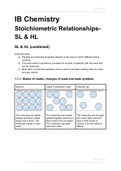
1.1.1: States of matter, changes of state and state symbols
Solid (s) Liquid (l) [Aqueous- (aq)] Gaseous (g)
The molecules are tightly The molecules are loosely The molecules are far apart
packed and have a fixed packed together and have a from each other and don’t
shape and volume. The fixed volume but not shape. have a fixed shape or
molecules vibrate in their The molecules can glide volume. It is more likely to
place. past each other. diffuse.
@theibprism
DO NOT SHARE WITHOUT PERMISSION, REPORT TO
, @theibprism
DO NOT SHARE WITHOUT PERMISSION, REPORT TO
1.1.2: Elements, compounds & mixtures
@theibprism
DO NOT SHARE
WITHOUT
PERMISSION,
REPORT TO
1. Pure substances
a. Elements
An element is a substance which cannot be broken down into a
simpler substance by chemical means.
Some elements exist as diatomic molecules e.g. H2, O2. A molecule is
an electrically neutral group of two or more atoms bonded together
b. Compounds
A compound is a combination of two or more elements, chemically
bonded in a fixed ratio. E.g. NaCl, H2O
2. Mixtures
Mixtures contain more than one element or compound which are not
chemically bonded. There are two types of mixtures- Homogeneous and
Heterogeneous.
a. Homogeneous mixtures
They have a constant composition throughout
b. Heterogeneous mixtures
They have different compositions which are visible throughout
1.1.3: Physical and Chemical changes
In a physical change, no new substances are produced. For example, the melting of ice to
water is a physical change, where no new substances are formed. Other examples of
physical changes include, evaporation and sublimation, where just the state of matter
changes.
@theibprism
DO NOT SHARE WITHOUT PERMISSION, REPORT TO
DO NOT SHARE WITHOUT PERMISSION, REPORT TO
IB Chemistry
Stoichiometric Relationships-
SL & HL
SL & HL (combined)
Essential ideas-
a) Physical and chemical properties depend on the ways in which different atoms
combine.
b) The mole makes it possible to correlate the number of particles with the mass that
can be measured.
c) Mole ratios in chemical equations can be used to calculate reacting ratios by mass
and gas volume.
1.1.1: States of matter, changes of state and state symbols
Solid (s) Liquid (l) [Aqueous- (aq)] Gaseous (g)
The molecules are tightly The molecules are loosely The molecules are far apart
packed and have a fixed packed together and have a from each other and don’t
shape and volume. The fixed volume but not shape. have a fixed shape or
molecules vibrate in their The molecules can glide volume. It is more likely to
place. past each other. diffuse.
@theibprism
DO NOT SHARE WITHOUT PERMISSION, REPORT TO
, @theibprism
DO NOT SHARE WITHOUT PERMISSION, REPORT TO
1.1.2: Elements, compounds & mixtures
@theibprism
DO NOT SHARE
WITHOUT
PERMISSION,
REPORT TO
1. Pure substances
a. Elements
An element is a substance which cannot be broken down into a
simpler substance by chemical means.
Some elements exist as diatomic molecules e.g. H2, O2. A molecule is
an electrically neutral group of two or more atoms bonded together
b. Compounds
A compound is a combination of two or more elements, chemically
bonded in a fixed ratio. E.g. NaCl, H2O
2. Mixtures
Mixtures contain more than one element or compound which are not
chemically bonded. There are two types of mixtures- Homogeneous and
Heterogeneous.
a. Homogeneous mixtures
They have a constant composition throughout
b. Heterogeneous mixtures
They have different compositions which are visible throughout
1.1.3: Physical and Chemical changes
In a physical change, no new substances are produced. For example, the melting of ice to
water is a physical change, where no new substances are formed. Other examples of
physical changes include, evaporation and sublimation, where just the state of matter
changes.
@theibprism
DO NOT SHARE WITHOUT PERMISSION, REPORT TO


