

NURS 3315 Module 1 Quiz | 30 OUT OF 30 | GRADED A | University of Texas, Arlington
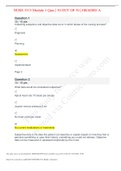
NURS 3315 Module 1 Quiz | 30 OUT OF 30 | GRADED A Collecting subjective and objective data occur in which phase of the nursing process? Diagnosis Planning Assessment Implementat ion Page 2 What data would be considered subjective? Apical heart rate 70 beats per minute Jugular venous pressure 2 cm No heart murmurs noted No current medications or treatments Subjective data is the data the patient can describe or explain based on how they feel or perceive something or upon their history--something you could not witness. Objective data can be measured or assessed empirically by the nurse. What should the nurse do immediately before beginning the physical exam? Establish the client's reliability as historian. Collect all equipment essential to the exam. Practice interviewing skills. Construct the client's family genogram. Page 27 When initiating the collection of the client subjective database, what initial step is most important for the nurse to implement? Determining client strengths Making inferences Establishing a trusting relationship Identifying health problems Page 9 Verifying that data is correct is a method of validating findings to be certain of accuracy. Which methods of validation are best? Select all the apply. When assessing a fully oriented adult patient, ask the accompanying family member to confirm all answers as you collect subjective data. Verify the data by asking another nurse to confirm a specific objective finding. Correct your current assessment findings to correlate with the physical examination done by the physician. Compare your subective and objective data to see if they agree. Re-phrase questions if you didn't understand the patient's meaning. When documenting findings of an abdominal assessment, which of the methods below are best? Abnormal B.S. in 3 of 4 quadrants. Good bowel sounds in all quadrants, fair amount of tenderness on deep palpation. Complains of tenderness in right lower quadrant with deep palpation. Denies pain/tenderness in other quadrants. Signs of appendicitis present, with pain in right lower quadrant. The correct answer uses no inappropriate terms, though in a clinical setting the nurse would use approved abbreviations. However, the incorrect answers use vague terms like good, fair, abnormal--with no description of what the abnormal findings were. Upon entering an exam room, the client states, “Well! I was getting ready to leave. My schedule is very busy and I don't have time to waste waiting until you have the time to see me!” Which response by the nurse would be most appropriate? “Our schedule is very busy also. We got to you as soon as we could.” "I am so sorry! We are working short-handed today, and are doing our best to get everything done!" “No one is forcing you to be here, and you are free to leave at any time.” “I am so sorry that you had to wait, but I am ready to begin your exam now.” Admitting short-handedness isn't recommended--it is not the patient's problem and will diminish their confidence in you. Don't be defensive or rude. Just apologize for their wait and go forward. This method acknowledges their right to be impatient, yet re- focuses attention on the reason they are present in the first place. This answer demonstrates critical thinking and interpersonal skill. The nurse is assessing the vital signs of a client who appears to have an irregular respiratory pattern. Please choose the best response. Count the respirations for full minute noting the rate and rhythm Check the pulse and respirations simultaneously for 30 seconds. Check the client’s respirations for a minimum of 5 minutes to verify variations. Count the client’s reparations for 15 seconds and multiply by 4 to obtain the rate. Page 83 Which of the following are true concerning pain? Select all that apply. A patient who is sleeping is clearly not in significant pain Making certain that patients do not become addicted to analgesics is vital in treating terminal patients with chronic pain. Getting the family's input on how much pain the patient is in is especially for adults. Pain is what the patient says it is. Pain is normal in the elderly. Peripheral nerve endings which transmit pain are called nociceptors Pain is what the patient says it is, and nociceptors are the sensory pain transmitters. Note that we will be using multiple response questions in quizzes because the certifying exams in nearly all specialties are using them...and we want you to become familiar with taking them. Match the terms with the correct description Body Mass Index Cachexia Visceral fat Triceps skinfold Mid-arm circumference Previous Next Submission Details: Quiz Score: 100 out of 100 Show Less
Document information
- Uploaded on
- May 23, 2021
- Number of pages
- 6
- Written in
- 2020/2021
- Type
- Exam (elaborations)
- Contains
- Questions & answers


