

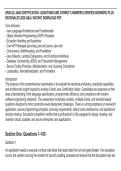
ORACLE JAVA CERTIFICATION –QUESTIONS AND CORRECT ANSWERS (VERIFIED ANSWERS) PLUS
RATIONALES 2026 Q&A | INSTANT DOWNLOAD PDF.
Core Domains:
- Java Language Architecture and Fundamentals
- Object-Oriented Programming (OOP) Principles
- Exception Handling and Assertions
- Core API Packages (java.lang, java.util, java.io, java.nio)
- Concurrency, Multithreading, and Parallelism
- Java Streams, Lambda Expressions, and Functional Interfaces
- Database Connectivity (JDBC) and Transaction Management
- Secure Coding Practices, Modularization, and Licensing Compliance
- Localization, Internationalization, and Formatters
Introduction
The purpose of this comprehensive examination is to evaluate the technical proficiency, analytical capabilities,
and architectural insight required to achieve Oracle Java Certification status. Candidates are assessed on their
deep understanding of the language specification, programmatic efficiency, and compliance with modern
software engineering standards. The assessment comprises complex, multiple-choice, and scenario-based
questions designed to mirror production-level deployment challenges. There is a strong emphasis on real-world
application, secure programming principles, licensing requirements, ethical code maintenance, and operational
decision-making. Successful completion verifies that a professional is fully equipped to design, develop, and
maintain robust, scalable, and secure enterprise Java applications.
Section One: Questions 1–100
Question 1
An application needs to execute a critical code block that reads data from an encrypted stream. If an exception
occurs, the system must log the incident for security auditing purposes and ensure that the decryption keys are
,securely wiped from memory. Which construction represents the best implementation practice regarding robust
exception handling and regulatory compliance?
A. Use a standard try-catch block and manually invoke System.gc() within the catch block to purge the keys.
B. Wrap the stream in a try-with-resources statement, and clear sensitive key arrays within a finally block.
C. Implement the Finalizable interface on the data wrapper class to ensure key erasure during garbage
collection.
D. Use a try-catch-finally block where the catch block suppresses all Throwable types to avoid application
crashing.
🟢 Correct answer: B
🔴 RATIONALE: A try-with-resources statement ensures that resources implementing AutoCloseable are
deterministically closed in the correct order. Sensitive data such as cryptographic keys should be overwritten in
memory (e.g., clearing primitive arrays) immediately after use within a finally block, as garbage collection does
not guarantee when or if memory will be overwritten, posing an unauthorized data retention risk.
Question 2
Consider the following class definition:
Java
public class Tokenizer {
public static void main(String[] args) {
String data = "alpha,beta,,delta";
String[] tokens = data.split(",");
System.out.println(tokens.length);
, }
}
What is the output of executing this code?
A. 3
B. 4
C. 5
D. An ArrayIndexOutOfBoundsException is thrown.
🟢 Correct answer: B
🔴 RATIONALE: The split(String regex) method drops trailing empty strings by default because it internally
calls split(regex, 0). However, empty strings located in the middle of the sequence (such as the empty string
between "beta" and "delta") are preserved as valid elements. Therefore, the resulting array contains "alpha",
"beta", "", and "delta", yielding a length of 4.
Question 3
A development team must ensure that a proprietary Java library cannot be subclassed or modified by third-
party extensions to alter its internal security checks. Which language mechanism directly enforces this
structural constraint?
A. Mark all methods within the class as private.
B. Declare the class with the final modifier.
C. Define the class inside a non-exported named module.
D. Package the class within a sealed interface architecture.
🟢 Correct answer: B
, 🔴 RATIONALE: Applying the final modifier to a class definition completely prohibits inheritance. This prevents
external actors from extending the class, overriding methods, or breaking encapsulation via polymorphic
substitution, which is a foundational security technique for protecting core business logic from unauthorized
tampering.
Question 4
Review the code fragment below:
Java
int x = 5;
int y = 10;
boolean result = (x++ > 5) && (++y > 10);
System.out.println(x + " " + y + " " + result);
What is printed after execution?
A. 6 10 false
B. 5 10 false
C. 6 11 false
D. 6 11 true
🟢 Correct answer: A
🔴 RATIONALE: The conditional AND operator (&&) exhibits short-circuit behavior. The left operand evaluates
(x++ > 5). Since x++ evaluates to the current value of 5 before incrementing, the expression (5 > 5) is false.
RATIONALES 2026 Q&A | INSTANT DOWNLOAD PDF.
Core Domains:
- Java Language Architecture and Fundamentals
- Object-Oriented Programming (OOP) Principles
- Exception Handling and Assertions
- Core API Packages (java.lang, java.util, java.io, java.nio)
- Concurrency, Multithreading, and Parallelism
- Java Streams, Lambda Expressions, and Functional Interfaces
- Database Connectivity (JDBC) and Transaction Management
- Secure Coding Practices, Modularization, and Licensing Compliance
- Localization, Internationalization, and Formatters
Introduction
The purpose of this comprehensive examination is to evaluate the technical proficiency, analytical capabilities,
and architectural insight required to achieve Oracle Java Certification status. Candidates are assessed on their
deep understanding of the language specification, programmatic efficiency, and compliance with modern
software engineering standards. The assessment comprises complex, multiple-choice, and scenario-based
questions designed to mirror production-level deployment challenges. There is a strong emphasis on real-world
application, secure programming principles, licensing requirements, ethical code maintenance, and operational
decision-making. Successful completion verifies that a professional is fully equipped to design, develop, and
maintain robust, scalable, and secure enterprise Java applications.
Section One: Questions 1–100
Question 1
An application needs to execute a critical code block that reads data from an encrypted stream. If an exception
occurs, the system must log the incident for security auditing purposes and ensure that the decryption keys are
,securely wiped from memory. Which construction represents the best implementation practice regarding robust
exception handling and regulatory compliance?
A. Use a standard try-catch block and manually invoke System.gc() within the catch block to purge the keys.
B. Wrap the stream in a try-with-resources statement, and clear sensitive key arrays within a finally block.
C. Implement the Finalizable interface on the data wrapper class to ensure key erasure during garbage
collection.
D. Use a try-catch-finally block where the catch block suppresses all Throwable types to avoid application
crashing.
🟢 Correct answer: B
🔴 RATIONALE: A try-with-resources statement ensures that resources implementing AutoCloseable are
deterministically closed in the correct order. Sensitive data such as cryptographic keys should be overwritten in
memory (e.g., clearing primitive arrays) immediately after use within a finally block, as garbage collection does
not guarantee when or if memory will be overwritten, posing an unauthorized data retention risk.
Question 2
Consider the following class definition:
Java
public class Tokenizer {
public static void main(String[] args) {
String data = "alpha,beta,,delta";
String[] tokens = data.split(",");
System.out.println(tokens.length);
, }
}
What is the output of executing this code?
A. 3
B. 4
C. 5
D. An ArrayIndexOutOfBoundsException is thrown.
🟢 Correct answer: B
🔴 RATIONALE: The split(String regex) method drops trailing empty strings by default because it internally
calls split(regex, 0). However, empty strings located in the middle of the sequence (such as the empty string
between "beta" and "delta") are preserved as valid elements. Therefore, the resulting array contains "alpha",
"beta", "", and "delta", yielding a length of 4.
Question 3
A development team must ensure that a proprietary Java library cannot be subclassed or modified by third-
party extensions to alter its internal security checks. Which language mechanism directly enforces this
structural constraint?
A. Mark all methods within the class as private.
B. Declare the class with the final modifier.
C. Define the class inside a non-exported named module.
D. Package the class within a sealed interface architecture.
🟢 Correct answer: B
, 🔴 RATIONALE: Applying the final modifier to a class definition completely prohibits inheritance. This prevents
external actors from extending the class, overriding methods, or breaking encapsulation via polymorphic
substitution, which is a foundational security technique for protecting core business logic from unauthorized
tampering.
Question 4
Review the code fragment below:
Java
int x = 5;
int y = 10;
boolean result = (x++ > 5) && (++y > 10);
System.out.println(x + " " + y + " " + result);
What is printed after execution?
A. 6 10 false
B. 5 10 false
C. 6 11 false
D. 6 11 true
🟢 Correct answer: A
🔴 RATIONALE: The conditional AND operator (&&) exhibits short-circuit behavior. The left operand evaluates
(x++ > 5). Since x++ evaluates to the current value of 5 before incrementing, the expression (5 > 5) is false.


