
• Wrong document? Swap it for free
  • Written by students who passed
  • Immediately available after payment
  • Read online or as PDF
Sell
Where do you study
Your language
Document preview thumbnail
Preview 2 out of 40 pages
Exam (elaborations)

NR546/ NR 546 Midterm PRACTICE EXAM (Latest 2026/2027 Update) | Complete Exam Questions with Verified Answers and Detailed Rationales | Advanced Psychopharmacology for PMHNP | A+ Graded | Chamberlain University

Document preview thumbnail
Preview 2 out of 40 pages

INSTANT PDF DOWNLOAD - This is the comprehensive Midterm PRACTICE EXAM for NR546 Advanced Psychopharmacology at Chamberlain University (Latest 2026/2027 Update) , featuring 100% verified questions and answers with detailed rationales. Covers functional neuroanatomy (prefrontal cortex, amygdala, hippocampus, basal ganglia, occipital lobe, Broca's area, Wernicke's area) , neurotransmitter systems (dopamine, serotonin, norepinephrine, GABA, glutamate, acetylcholine) , CYP450 enzyme inducers (CRAP GPS) and inhibitors (VISA CKGQ), metabolizer phenotypes (poor/ultrarapid/intermediate) , receptor pharmacology (agonist, partial agonist, antagonist, inverse agonist) , drug classes including antidepressants (SSRIs, SNRIs, TCAs, MAOIs, bupropion), antipsychotics (first-generation FGAs, second-generation SGAs), mood stabilizers (lithium, valproate, lamotrigine, carbamazepine), anxiolytics (benzodiazepines, buspirone), medication adherence (Dell'Osso framework), ethical/legal issues (informed consent, off-label prescribing, restrictive methods), and pharmacogenomic testing applications . Aligned with Chamberlain NR546 curriculum Weeks 1–4 and PMHNP certification standards. INSTANT DIGITAL DOWNLOAD (PDF) immediately upon purchase. Fully text-searchable, printable, and accessible anytime. Trusted by Chamberlain PMHNP students for Midterm exam success. 100% satisfaction guarantee. NR546 Midterm Practice Exam Chamberlain NR 546 Advanced Psychopharmacology PMHNP Practice Test Functional Neuroanatomy Prefrontal Cortex Amygdala Hippocampus Basal Ganglia Occipital Lobe Central Sulcus Broca's Area Speech Production Wernicke's Area Speech Comprehension Grey Matter Cell Bodies Dendrites Synapses White Matter Axons Cerebellum Motor Coordination Thalamus Sensory Relay Neurotransmitters Dopamine Serotonin Norepinephrine GABA Glutamate Acetylcholine Dopamine Pathways Mesolimbic Mesocortical Nigrostriatal Tuberoinfundibular GABA Primary Inhibitory Neurotransmitter Glutamate Primary Excitatory CYP450 Inducers CRAP GPS Carbamazepine Rifampin Alcohol Phenytoin Griseofulvin Phenobarbital CYP450 Inhibitors VISA CKGQ Valproate Isoniazid Sulfonamides Amiodarone Ketoconazole Grapefruit Juice Quinidine Poor Metabolizer Lower Enzyme Concentration Higher Drug Levels Side Effect Risk Ultrarapid Metabolizer Elevated Enzyme Activity Subtherapeutic Levels Pharmacogenomic Testing CYP450 Genotyping Dosage Adjustment Flockhart Table Drug Interactions Cytochrome P450 Receptor Pharmacology Agonist Full Stimulation Partial Agonist Partial Stimulation Antagonist Blocks Action Inverse Agonist Opposite Effect SSRIs Fluoxetine Sertraline Escitalopram Paroxetine Fluvoxamine First Line Depression SNRIs Venlafaxine Duloxetine Desvenlafaxine Bupropion Wellbutrin Norepinephrine Dopamine Reuptake Inhibitor Insomnia Seizure Risk Trazodone Sedation Antidepressant Adjunct Insomnia First Generation Antipsychotics Haloperidol D2 Antagonist EPS Tardive Dyskinesia Second Generation Antipsychotics Clozapine Risperidone Olanzapine Quetiapine Aripiprazole Clozapine Agranulocytosis Black Box Warning ANC Monitoring Mood Stabilizers Lithium Valproate Lamotrigine Carbamazepine Lithium Narrow Therapeutic Window NSAIDs ACE Inhibitors Interaction Lamotrigine Black Box Warning Life Threatening Skin Rash Stevens Johnson Syndrome Anxiolytics Benzodiazepines GABA A Agonist Dependence Risk Buspirone 5HT1A Partial Agonist Beta Blockers Propranolol Atenolol Performance Anxiety Physical Symptoms Nicotine CYP1A2 Inducer Lowers Olanzapine Levels Requires Higher Dose Medication Adherence Dell'Osso Framework Diagnosis Medication Education Monitoring Plan Adherence Reinforcement Ethical Issues Informed Consent Off Label Prescribing Restrictive Methods Chemical Restraints Epigenetic Changes Reversible Gene Expression Environmental Stressors Chamberlain NR546 Test Bank PMHNP Psychopharmacology Midterm Practice Exam A+ Graded PMHNP Study Guide

Content preview

MRETDIM · 645 RN
★ ★
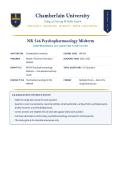
Chamberlain University
C College of Nursing & Public Health
EST. 1889
E X C E L L E N C E · I N N O V AT I O N · I N T E G R I T Y · W O R L D C L A S S S E R V I C E


NR 546 Psychopharmacology Midterm
CO M P R E H E N S I V E 1 0 0 - Q U E ST I O N ST U DY G U I D E

INSTITUTION Chamberlain University COURSE CODE NR 546
PROGRAM Master of Science in Nursing — ACADEMIC YEAR
PMHNP
EXAM TITLE NR 546 Psychopharmacology TOTAL QUESTIONS 100 Questions
Midterm — Comprehensive Study
Guide
COURSE TITLE Psychopharmacology for the FORMAT Multiple Choice — Select the
PMHNP Single Best Answer


EXAMINATION INSTRUCTIONS
▸ Select the single best answer for each question.
▸ Questions cover neuroanatomy, neurotransmitters, pharmacokinetics, antipsychotics, antidepressants,
anxiety disorders, and ethical/legal issues.
▸ Correct answers and detailed clinical rationales appear below each question.
▸ Use these rationales to reinforce key psychopharmacology concepts for clinical practice.
▸ This study guide is for educational purposes only.

, SECTION I — NEUROANATOMY & BRAIN STRUCTURES Questions 1 – 12

1. What is the name of the lobe that controls visual processing?
A. Gyrus
B. Frontal Lobe
C. Occipital Lobe
D. Parietal Lobe
CORRECT ANSWER C. Occipital Lobe
RATIONALE The primary visual cortex is located in the occipital lobe. Damage to this area can
cause cortical blindness or visual field cuts. Visual hallucinations may arise from
occipital lesions.


2. A patient recovering from a stroke has trouble with speech comprehension and works
with a speech therapist twice a week. Which part of the patient's brain has been affected
by the stroke?
A. Broca's area
B. Basal ganglia
C. Limbic system
D. Wernicke's area
CORRECT ANSWER D. Wernicke's area
RATIONALE Wernicke's area (temporal lobe) is responsible for language comprehension.
Damage results in fluent aphasia (word salad, poor comprehension). Broca's area
controls expressive language.


Document information

Uploaded on
May 19, 2026
File latest updated on
July 30, 2026
Number of pages
40
Written in
2025/2026
Type
Exam (elaborations)
Contains
Questions & answers
$12.99

Wrong document? Swap it for free Within 14 days of purchase and before downloading, you can choose a different document. You can simply spend the amount again.
Written by students who passed
Immediately available after payment
Read online or as PDF

Seller avatar
Reputation scores are based on the amount of documents a seller has sold for a fee and the reviews they have received for those documents. There are three levels: Bronze, Silver and Gold. The better the reputation, the more your can rely on the quality of the sellers work.
DoctorKen
3.8
(167)
Sold
916
Followers
121
Items
6650
Last sold
10 hours ago


Reviews from verified buyers

1 month ago

not enough questions and answers


Why students choose Stuvia

Created by fellow students, verified by reviews

Quality you can trust: written by students who passed their tests and reviewed by others who've used these notes.

Didn't get what you expected? Choose another document

No worries! You can instantly pick a different document that better fits what you're looking for.

Pay as you like, start learning right away

No subscription, no commitments. Pay the way you're used to via credit card and download your PDF document instantly.

Student with book image

“Bought, downloaded, and aced it. It really can be that simple.”

Alisha Student

Working on your references?

Create accurate citations in APA, MLA and Harvard with our free citation generator.

Working on your references?

Frequently asked questions

