The Voice of the Genome
• Cells and organelles
• Cell organisation
• The cell cycle and mitosis
• Production of gametes
• Fertilisation
• Stem cells and cell specialisation
• Stem cells and medical therapies
• Variation in phenotype
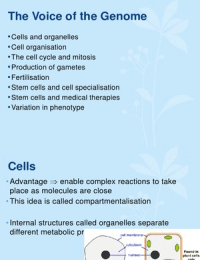
,Cells
• Advantage enable complex reactions to take
place as molecules are close
• This idea is called compartmentalisation
• Internal structures called organelles separate
different metabolic processes
, Multicellular vs. unicellular
Multicellular
• Multicellular organisms are identical cells that stay and
divide together
• The majority of multicellular organisms are like
mammals (the fact that their cells grow and develop to
form a zygote)
• Mammals and plants are multicellular means they
have many cells
Unicellular
• Unicellular organisms = structurally simple but they are
able to perform all the functions and activities of life
within a single cell
• The cell feeds, respires, sensitive to internal/external
conditions, more & may divide and reproduce
• Cells and organelles
• Cell organisation
• The cell cycle and mitosis
• Production of gametes
• Fertilisation
• Stem cells and cell specialisation
• Stem cells and medical therapies
• Variation in phenotype
,Cells
• Advantage enable complex reactions to take
place as molecules are close
• This idea is called compartmentalisation
• Internal structures called organelles separate
different metabolic processes
, Multicellular vs. unicellular
Multicellular
• Multicellular organisms are identical cells that stay and
divide together
• The majority of multicellular organisms are like
mammals (the fact that their cells grow and develop to
form a zygote)
• Mammals and plants are multicellular means they
have many cells
Unicellular
• Unicellular organisms = structurally simple but they are
able to perform all the functions and activities of life
within a single cell
• The cell feeds, respires, sensitive to internal/external
conditions, more & may divide and reproduce