
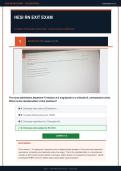
HESI RN EXIT EXAM — 135 QUESTIONS
HESI RN EXIT EXAM
Complete 135-Question Study Guide · Correct Answers & Rationales
1 HESI RN EXIT EXAM · Question 5 of 135
The nurse administers dopamine IV infusion at 3 mcg/kg/min to a critically ill, normotensive client.
Which is the intended effect of this treatment?
■ A. Decrease heart rate to 92 beats/min.
■ B. Increase blood pressure to 140/80.
■ C. Decrease respirations to 18 breaths/min.
✔ D. Increase urine output to 55 ml/hr.
CORRECT: D
● RATIONALE
At low doses (1-5 mcg/kg/min), dopamine acts on dopaminergic receptors in the renal and mesenteric
vasculature, increasing renal perfusion and urine output. This is the intended effect in a normotensive
critically ill client where renal protection is the goal. Higher doses (>5 mcg/kg/min) cause beta-1 effects
(increased HR/BP) and even higher doses cause alpha vasoconstriction.
Page 1 · HESI RN Exit Exam Review · Study Guide
,HESI RN EXIT EXAM — 135 QUESTIONS
2 HESI RN EXIT EXAM · Question 6 of 135
A client with terminal pancreatic cancer is receiving hospice care at home and reports increasing
shortness of breath and associated anxiety. Which prescription should the nurse implement first?
✔ A. Morphine sulfate 5 to 10 mg SL as needed.
■ B. Albuterol 0.5% solution per nebulizer.
■ C. Prednisone 10 mg PO.
■ D. Oxygen 2 to 6 liters per minute using a nasal cannula.
CORRECT: A
● RATIONALE
In hospice/palliative care, morphine is the first-line treatment for dyspnea (shortness of breath) and
associated anxiety in terminal cancer. It reduces the sensation of breathlessness and anxiety
simultaneously. Oxygen (D) is secondary and may not relieve the subjective sensation of dyspnea in
all patients. Albuterol (B) addresses bronchospasm, not terminal dyspnea. Prednisone (C) is for
inflammation, not acute dyspnea management.
Page 2 · HESI RN Exit Exam Review · Study Guide
,HESI RN EXIT EXAM — 135 QUESTIONS
3 HESI RN EXIT EXAM · Question 12 of 135
The nurse is providing discharge teaching about crutch walking to a young adult with a fractured
foot who has a prescription for partial weight-bearing. Which intervention should the nurse
implement before the client is discharged?
■ A. Verify that the crutches fit snugly under the axilla.
■ B. Review the client's most recent serum calcium level.
■ C. Determine if the client lives alone or with others.
✔ D. Observe the client while demonstrating crutch walking.
CORRECT: D
● RATIONALE
Before discharge, the nurse must observe the client actually demonstrating crutch walking to ensure
safe technique with partial weight-bearing. Return demonstration is the most reliable method to verify
learning and competence. Crutches should NOT fit snugly under the axilla (A) — this causes axillary
nerve damage; there should be a 2-3 finger width space. Calcium levels (B) and living situation (C) are
less immediately critical than confirming safe ambulation technique.
Page 3 · HESI RN Exit Exam Review · Study Guide
, HESI RN EXIT EXAM — 135 QUESTIONS
4 HESI RN EXIT EXAM · Question 18 of 135
The nurse observes an empty secondary infusion of diltiazem attached to the client's IV pump, but
realizes that this client has no prescription for diltiazem. In what sequence, from first to last, should
the interventions be implemented?
Correct Order (first to last):
1. Measure the client's vital signs.
2. Review medications client is taking.
3. Notify the healthcare provider.
4. Complete an incident report.
CORRECT ORDER — See above
● RATIONALE
First priority: assess the client (vital signs) to determine if harm occurred from the diltiazem. Second:
review medications to understand the extent of the error. Third: notify the healthcare provider with
assessment findings. Last: complete the incident report (administrative documentation done after
client safety is ensured). This follows the RACE principle — always assess the client first in a
medication error.
Page 4 · HESI RN Exit Exam Review · Study Guide
HESI RN EXIT EXAM
Complete 135-Question Study Guide · Correct Answers & Rationales
1 HESI RN EXIT EXAM · Question 5 of 135
The nurse administers dopamine IV infusion at 3 mcg/kg/min to a critically ill, normotensive client.
Which is the intended effect of this treatment?
■ A. Decrease heart rate to 92 beats/min.
■ B. Increase blood pressure to 140/80.
■ C. Decrease respirations to 18 breaths/min.
✔ D. Increase urine output to 55 ml/hr.
CORRECT: D
● RATIONALE
At low doses (1-5 mcg/kg/min), dopamine acts on dopaminergic receptors in the renal and mesenteric
vasculature, increasing renal perfusion and urine output. This is the intended effect in a normotensive
critically ill client where renal protection is the goal. Higher doses (>5 mcg/kg/min) cause beta-1 effects
(increased HR/BP) and even higher doses cause alpha vasoconstriction.
Page 1 · HESI RN Exit Exam Review · Study Guide
,HESI RN EXIT EXAM — 135 QUESTIONS
2 HESI RN EXIT EXAM · Question 6 of 135
A client with terminal pancreatic cancer is receiving hospice care at home and reports increasing
shortness of breath and associated anxiety. Which prescription should the nurse implement first?
✔ A. Morphine sulfate 5 to 10 mg SL as needed.
■ B. Albuterol 0.5% solution per nebulizer.
■ C. Prednisone 10 mg PO.
■ D. Oxygen 2 to 6 liters per minute using a nasal cannula.
CORRECT: A
● RATIONALE
In hospice/palliative care, morphine is the first-line treatment for dyspnea (shortness of breath) and
associated anxiety in terminal cancer. It reduces the sensation of breathlessness and anxiety
simultaneously. Oxygen (D) is secondary and may not relieve the subjective sensation of dyspnea in
all patients. Albuterol (B) addresses bronchospasm, not terminal dyspnea. Prednisone (C) is for
inflammation, not acute dyspnea management.
Page 2 · HESI RN Exit Exam Review · Study Guide
,HESI RN EXIT EXAM — 135 QUESTIONS
3 HESI RN EXIT EXAM · Question 12 of 135
The nurse is providing discharge teaching about crutch walking to a young adult with a fractured
foot who has a prescription for partial weight-bearing. Which intervention should the nurse
implement before the client is discharged?
■ A. Verify that the crutches fit snugly under the axilla.
■ B. Review the client's most recent serum calcium level.
■ C. Determine if the client lives alone or with others.
✔ D. Observe the client while demonstrating crutch walking.
CORRECT: D
● RATIONALE
Before discharge, the nurse must observe the client actually demonstrating crutch walking to ensure
safe technique with partial weight-bearing. Return demonstration is the most reliable method to verify
learning and competence. Crutches should NOT fit snugly under the axilla (A) — this causes axillary
nerve damage; there should be a 2-3 finger width space. Calcium levels (B) and living situation (C) are
less immediately critical than confirming safe ambulation technique.
Page 3 · HESI RN Exit Exam Review · Study Guide
, HESI RN EXIT EXAM — 135 QUESTIONS
4 HESI RN EXIT EXAM · Question 18 of 135
The nurse observes an empty secondary infusion of diltiazem attached to the client's IV pump, but
realizes that this client has no prescription for diltiazem. In what sequence, from first to last, should
the interventions be implemented?
Correct Order (first to last):
1. Measure the client's vital signs.
2. Review medications client is taking.
3. Notify the healthcare provider.
4. Complete an incident report.
CORRECT ORDER — See above
● RATIONALE
First priority: assess the client (vital signs) to determine if harm occurred from the diltiazem. Second:
review medications to understand the extent of the error. Third: notify the healthcare provider with
assessment findings. Last: complete the incident report (administrative documentation done after
client safety is ensured). This follows the RACE principle — always assess the client first in a
medication error.
Page 4 · HESI RN Exit Exam Review · Study Guide


