
Internationale omgeving
Session 1: Introduction
Session 2:
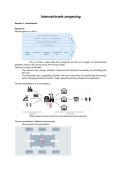
What happens in a firm?
This is Porter’s value chain that represents the firm as a system of transformation
activities. Porter is also known for its Five Forces model.
There are 2 types of activities:
- The vertical ones: primary activities. These are the activities that actually do something with
the input.
- The horizontal ones: supporting activities. We don’t need them for transforming the product,
but for bringing structure in the firm. These allow the primary activities to be performed.
The firm embedded in a set of relations.
Where does the input come from and where does the output go?
The firm embedded in different environments.
We can zoom out even further.
,International environments are as important.
Here you have to deal with different governments and environments and different regulations.
Ex: Uber’s battle for China:
Uber isn’t active anymore in China because of cultural differences.
Firms have different reasons to internationalise.
Market-seeking (globalisation of markets):
- Exploring and discovering new market opportunities.
- Following customers.
Resource-seeking (globalisation of production):
- Exploiting factor-driven location advantages.
- Exploiting demand-driven location advantages.
Using global network (both):
- Global experience.
- Economies of scale in productions, logistics, marketing, and technology.
- Mobility of production.
- Lowering risk.
- Product differentiation.
Internationalisation is not without risk.
- Cultural differences: loyalty to existing brands.
- Competitors.
- Liability of foreignness: this is the liability that every firm carries when entering a new market.
The firm has to compensate this liability, by bringing something into the market that leads
customers to them.
Firms can enter international markets via different entry modes.
The way we enter a new market determines the difficulty.
Dunning’s OLI:
, Each brand can have one of these advantages. Let’s take Tesla as an example:
Ownership: Brand, design, technology.
Location: Presence of high-skilled labour, and low labour costs.
Internalisation: Large synergies in production; processes too complex and sensitive to
describe in contracts and manuals for partners.
Globalisation of markets.
Globalisation: the movement towards a more integrated and mutually dependent global
economy.
Dimensions of globalisation: international economy, international politics and international
culture.
World trade has increased in the previous decades: barriers have reduced and production has
changed.
Observations in the current environment:
Trade war: the US was importing way more from China than China from the US. The US
wanted to reduce imports from China by increasing the import tax called the tariffs. Because of this,
China also increased their tariffs. This happens until the beginning of 2020, when both counties had an
agreement.
We see several examples of external events in business that cause disruptions in the normal
functioning of firms. Think of covid.
How to limit emergence and impact of shocks?
1. Multilateralism: Coordinates relations between nations based on general codes of conduct,
being principles that specify appropriate behaviour without taking the particular interest of
parties into account, or strategic needs that can avoid a specific situation.
2. Bilateralism: Differentiates relations ad hoc based on a priori particular grounds or situational
needs.
3. Unilateralism: Coordinates relations between nations by denying the sovereignty of the
involved states.
Session 3: /
Session 4:
Orientation of this session:
Conflicts come from country differences. These result in challenges for companies for at least
2 reasons:
- They might result in international conflict.
- They are a source of management complexity for internationally operating companies
, What is a multinational enterprise?
Multinational Enterprise (MNE) - any business that has productive activities in two or more
countries. When a business invests in multiple companies in different countries, it isn’t a multinational,
because it hasn’t any activities there. That’s why we talk about productive activities.
Since the 60s, the number of MNE’s has only been rising.
There are some special forms:
Born globals: companies that internationalise very quickly within 3 years.
Emerging Market MNEs: those that are non US, non EU, etc. They come from emerging
markets. They have different approaches.
Example: Toyota’s Worldwide Manufacturing
Characteristics of the international business environment (1): Types of country differences.
Culture: most of the time people in a certain country will only eat typical things from that
country. A Belgian won’t eat Thai on a regular basis.
What is culture?
- Collective programming of the mind which distinguishes the members of one group or
category of people from another
- Patterns of thoughts, feelings, behaviours, symbols, and so forth that recur throughout a
group, give meaning to actions and behaviours, and provide interpretations of situations for
people
- Culture is publicly shared and accepted by a given group at a given time, binding members
together and defining or separating one group from other groups
- Taken for granted beliefs and practices
Session 1: Introduction
Session 2:
What happens in a firm?
This is Porter’s value chain that represents the firm as a system of transformation
activities. Porter is also known for its Five Forces model.
There are 2 types of activities:
- The vertical ones: primary activities. These are the activities that actually do something with
the input.
- The horizontal ones: supporting activities. We don’t need them for transforming the product,
but for bringing structure in the firm. These allow the primary activities to be performed.
The firm embedded in a set of relations.
Where does the input come from and where does the output go?
The firm embedded in different environments.
We can zoom out even further.
,International environments are as important.
Here you have to deal with different governments and environments and different regulations.
Ex: Uber’s battle for China:
Uber isn’t active anymore in China because of cultural differences.
Firms have different reasons to internationalise.
Market-seeking (globalisation of markets):
- Exploring and discovering new market opportunities.
- Following customers.
Resource-seeking (globalisation of production):
- Exploiting factor-driven location advantages.
- Exploiting demand-driven location advantages.
Using global network (both):
- Global experience.
- Economies of scale in productions, logistics, marketing, and technology.
- Mobility of production.
- Lowering risk.
- Product differentiation.
Internationalisation is not without risk.
- Cultural differences: loyalty to existing brands.
- Competitors.
- Liability of foreignness: this is the liability that every firm carries when entering a new market.
The firm has to compensate this liability, by bringing something into the market that leads
customers to them.
Firms can enter international markets via different entry modes.
The way we enter a new market determines the difficulty.
Dunning’s OLI:
, Each brand can have one of these advantages. Let’s take Tesla as an example:
Ownership: Brand, design, technology.
Location: Presence of high-skilled labour, and low labour costs.
Internalisation: Large synergies in production; processes too complex and sensitive to
describe in contracts and manuals for partners.
Globalisation of markets.
Globalisation: the movement towards a more integrated and mutually dependent global
economy.
Dimensions of globalisation: international economy, international politics and international
culture.
World trade has increased in the previous decades: barriers have reduced and production has
changed.
Observations in the current environment:
Trade war: the US was importing way more from China than China from the US. The US
wanted to reduce imports from China by increasing the import tax called the tariffs. Because of this,
China also increased their tariffs. This happens until the beginning of 2020, when both counties had an
agreement.
We see several examples of external events in business that cause disruptions in the normal
functioning of firms. Think of covid.
How to limit emergence and impact of shocks?
1. Multilateralism: Coordinates relations between nations based on general codes of conduct,
being principles that specify appropriate behaviour without taking the particular interest of
parties into account, or strategic needs that can avoid a specific situation.
2. Bilateralism: Differentiates relations ad hoc based on a priori particular grounds or situational
needs.
3. Unilateralism: Coordinates relations between nations by denying the sovereignty of the
involved states.
Session 3: /
Session 4:
Orientation of this session:
Conflicts come from country differences. These result in challenges for companies for at least
2 reasons:
- They might result in international conflict.
- They are a source of management complexity for internationally operating companies
, What is a multinational enterprise?
Multinational Enterprise (MNE) - any business that has productive activities in two or more
countries. When a business invests in multiple companies in different countries, it isn’t a multinational,
because it hasn’t any activities there. That’s why we talk about productive activities.
Since the 60s, the number of MNE’s has only been rising.
There are some special forms:
Born globals: companies that internationalise very quickly within 3 years.
Emerging Market MNEs: those that are non US, non EU, etc. They come from emerging
markets. They have different approaches.
Example: Toyota’s Worldwide Manufacturing
Characteristics of the international business environment (1): Types of country differences.
Culture: most of the time people in a certain country will only eat typical things from that
country. A Belgian won’t eat Thai on a regular basis.
What is culture?
- Collective programming of the mind which distinguishes the members of one group or
category of people from another
- Patterns of thoughts, feelings, behaviours, symbols, and so forth that recur throughout a
group, give meaning to actions and behaviours, and provide interpretations of situations for
people
- Culture is publicly shared and accepted by a given group at a given time, binding members
together and defining or separating one group from other groups
- Taken for granted beliefs and practices


