
What is Photosynthesis By Science and Technology Concepts
<https://ssec.si.edu/science-and-technology-concepts-middle-school>>
When plants require food they have no ready source of food except for the earth materials hence plants need
sunlight, water, and soil to grow, but where do they get their food? they make it themselves!
Plants are hence called the “autotrophs”(that which can make its own food) because they can use energy from
sun light to synthesize, or make, their own food source. Many people believe they are “feeding” a plant when
they put it in soil, water it, or place it outside in the Sun, but none of these things are considered food. Rather,
plants use sunlight, water, and the gases in the air to make glucose, which is a form of sugar that plants need to
survive. This process is called photosynthesis and is performed by all plants, algae, and even some
microorganisms. To perform photosynthesis, plants need three things: carbon dioxide, water, and sunlight.
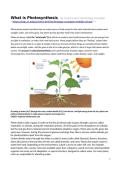
By taking in water (H2O) through the roots, carbon dioxide (CO2) from the air, and light energy from the Sun, plants can
perform photosynthesis to make glucose (sugars) and oxygen (O 2).
CREDIT: mapichai/Shutterstock.com
Plants need to take in gases in order to live like all animals take in gases through a process called
respiration. In animals, during the respiration process, all of the gases in the atmosphere are inhaled,
but the only gas that is retained and not immediately exhaled is oxygen. Plants also use the gases the
same way, however, during the process of gaseous exchange they take in and use carbon dioxide gas
for photosynthesis apart from the oxygen.
Carbon dioxide enters through tiny holes in a plant’s leaves (cells called Stomata), flowers, branches,
stems (the pores in the branches of trees are called lenticels), and roots. Plants also require water to
make their food. Depending on the environment, a plant’s access to water will vary. For example,
desert plants, like a cactus, have less available water than a lilypad in a pond, but every photosynthetic
organism has some sort of adaptation, or special structure, designed to collect water. For most plants,
roots are responsible for absorbing water.
1
, The last requirement for photosynthesis is an important one because it provides the energy to make
sugar.
How does a plant take carbon dioxide and water molecules and make a food molecule?
The Sun! The energy from Sunlight causes a chemical reaction in the Green part of the leaves that
breaks down the molecules of carbon dioxide and water and reorganizes them to make the sugar
(glucose) and oxygen gas. The Carbon dioxide is condensed into a 6 Carbon compound and that is the
sugar that is produced,
To release energy the whole process is reversed by breaking down the Glucose by the mitochondria
into energy that can be used for growth and repair. The oxygen that is produced is released from the
same tiny holes through which the carbon dioxide entered. Even the oxygen that is released serves
another purpose. Other organisms, such as animals, use oxygen to aid in their survival.
If we were to write a formula for photosynthesis, it would look like this:
6CO2 + 6H2O + Light energy → C6H12O6 (sugar) + 6O2
The whole process of photosynthesis is a transfer of energy from the Sun to a plant. In each sugar
molecule created, there is a little bit of the energy from the Sun, which the plant can either use or
store for later.
https://www.livescience.com/51720-photosynthesis.html
Types of photosynthesis:
There are two types of photosynthetic processes: oxygenic photosynthesis and anoxygenic
photosynthesis. The general principles of anoxygenic and oxygenic photosynthesis are very similar, but
oxygenic photosynthesis is the most common and is seen in plants, algae and cyanobacteria.
During oxygenic photosynthesis, light energy transfers electrons from water (H 2O) to carbon dioxide
(CO2), to produce carbohydrates. In this transfer, the CO2 is "reduced," or receives electrons, and the
water becomes "oxidized," or loses electrons. Ultimately, oxygen is produced along with
carbohydrates.Oxygenic photosynthesis functions as a counterbalance to respiration by taking in the
carbon dioxide produced by all breathing organisms and reintroducing oxygen to the atmosphere.
On the other hand, anoxygenic photosynthesis uses electron donors other than water. The process
typically occurs in bacteria such as purple bacteria and green sulfur bacteria, which are primarily found
in various aquatic habitats. "Anoxygenic photosynthesis does not produce oxygen -hence the name,"
Though both types of photosynthesis are complex, multistep affairs, the overall process can be neatly
summarized as a chemical equation.
Oxygenic photosynthesis is written as follows:
6CO2 + 12H2O + Light Energy → C6H12O6 + 6O2 + 6H2O
2


