
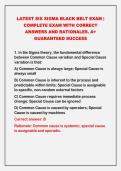
LATEST SIX SIGMA BLACK BELT EXAM |
COMPLETE EXAM WITH CORRECT
ANSWERS AND RATIONALES. A+
GUARANTEED SUCCESS
1. In Six Sigma theory, the fundamental difference
between Common Cause variation and Special Cause
variation is that:
A) Common Cause is always large; Special Cause is
always small
B) Common Cause is inherent to the process and
predictable within limits; Special Cause is assignable
to specific, non-random external factors
C) Common Cause requires immediate process
change; Special Cause can be ignored
D) Common Cause is caused by operators; Special
Cause is caused by machines
Correct answer: B
Rationale: Common cause is systemic; special cause
is assignable and sporadic.
,2. A Black Belt is analyzing a process with a Cp of 1.2
and a Cpk of 0.6. Which of the following conclusions
is most theoretically sound?
A) The process is centered and capable
B) The process is not centered; the mean is shifted
relative to the specification limits
C) The process has excessive common cause
variation
D) The process has no special causes
Correct answer: B
Rationale: Cp measures potential capability; Cpk
measures actual, penalizing centering shift.
3. In the DMAIC framework, the primary purpose of
the Measure phase is to:
A) Implement solutions
B) Define the problem statement
C) Establish baseline process performance and
validate measurement system capability
D) Brainstorm root causes
Correct answer: C
Rationale: Measure phase quantifies current
performance and ensures data reliability.
,4. A Black Belt uses a 2⁴ full factorial design. How
many experimental runs are required without
replication?
A) 4
B) 8
C) 16
D) 32
Correct answer: C
Rationale: 2⁴ factorial has 16 runs (2 factors × 2 levels
each).
5. Which of the following best describes the
theoretical purpose of the "Measurement System
Analysis" (MSA) Gage R&R study?
A) To determine if the process is in control
B) To quantify variation attributable to measurement
system (repeatability and reproducibility) relative to
total variation
C) To identify root causes of defects
D) To implement control charts
Correct answer: B
, Rationale: Gage R&R partitions measurement
variation into repeatability and reproducibility.
6. A Black Belt calculates that the Gage R&R
percentage is 25% of total variation. According to
industry guidelines, this measurement system is:
A) Acceptable without conditions
B) Marginally acceptable (may be acceptable
depending on application criticality)
C) Unacceptable and requires improvement
D) Perfect
Correct answer: B
Rationale: Guidelines: <10% acceptable, 10-30%
marginal, >30% unacceptable.
7. In statistical process control (SPC), a point outside
the control limits on an X-bar chart indicates:
A) Common cause variation only
B) A potential special cause requiring investigation
C) The process is perfectly capable
D) The control limits are incorrectly calculated
Correct answer: B
COMPLETE EXAM WITH CORRECT
ANSWERS AND RATIONALES. A+
GUARANTEED SUCCESS
1. In Six Sigma theory, the fundamental difference
between Common Cause variation and Special Cause
variation is that:
A) Common Cause is always large; Special Cause is
always small
B) Common Cause is inherent to the process and
predictable within limits; Special Cause is assignable
to specific, non-random external factors
C) Common Cause requires immediate process
change; Special Cause can be ignored
D) Common Cause is caused by operators; Special
Cause is caused by machines
Correct answer: B
Rationale: Common cause is systemic; special cause
is assignable and sporadic.
,2. A Black Belt is analyzing a process with a Cp of 1.2
and a Cpk of 0.6. Which of the following conclusions
is most theoretically sound?
A) The process is centered and capable
B) The process is not centered; the mean is shifted
relative to the specification limits
C) The process has excessive common cause
variation
D) The process has no special causes
Correct answer: B
Rationale: Cp measures potential capability; Cpk
measures actual, penalizing centering shift.
3. In the DMAIC framework, the primary purpose of
the Measure phase is to:
A) Implement solutions
B) Define the problem statement
C) Establish baseline process performance and
validate measurement system capability
D) Brainstorm root causes
Correct answer: C
Rationale: Measure phase quantifies current
performance and ensures data reliability.
,4. A Black Belt uses a 2⁴ full factorial design. How
many experimental runs are required without
replication?
A) 4
B) 8
C) 16
D) 32
Correct answer: C
Rationale: 2⁴ factorial has 16 runs (2 factors × 2 levels
each).
5. Which of the following best describes the
theoretical purpose of the "Measurement System
Analysis" (MSA) Gage R&R study?
A) To determine if the process is in control
B) To quantify variation attributable to measurement
system (repeatability and reproducibility) relative to
total variation
C) To identify root causes of defects
D) To implement control charts
Correct answer: B
, Rationale: Gage R&R partitions measurement
variation into repeatability and reproducibility.
6. A Black Belt calculates that the Gage R&R
percentage is 25% of total variation. According to
industry guidelines, this measurement system is:
A) Acceptable without conditions
B) Marginally acceptable (may be acceptable
depending on application criticality)
C) Unacceptable and requires improvement
D) Perfect
Correct answer: B
Rationale: Guidelines: <10% acceptable, 10-30%
marginal, >30% unacceptable.
7. In statistical process control (SPC), a point outside
the control limits on an X-bar chart indicates:
A) Common cause variation only
B) A potential special cause requiring investigation
C) The process is perfectly capable
D) The control limits are incorrectly calculated
Correct answer: B


