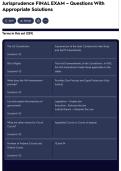
Jurisprudence FINAL EXAM – Questions With
Appropriate Solutions
Save Groups
Terms in this set (329)
The US Constitution Supreme law of the land. Contains the Main Body
and 26/27 Amendments
(Lessons 1-2)
Bill of Rights The first 10 amendments of the Constitution. In 1870,
the 14th Amendment made these applicable to the
(Lessons 1-2) states.
What does the 14th Amendment Provides Due Process and Equal Protection (Also
provide? Justice)
(Lessons 1-2)
List and explain the branches of Legislative - Creates law
government Executive - Enforces the law
Judicial Branch - Interprets the Law
(Lessons 1-2)
What are other names for Circuit Appellate Courts or Courts of Appeal
Courts?
(Lessons 1-2)
Number of Federal Circuits and 13 and 94
District Courts
(Lessons 1-2)
,Explain Precedent A previous case with similar circumstances used for
reference; advisory only, need not be followed
(Lessons 1-2)
Explain Stare Decisis Latin for "let the decision stand." A legal doctine
holding that the ruling of a higher court in the same
(Lessons 1-2) chain or stovepipe will be followed by a lower court
unless:
1) the circumstances have changed
2) the earlier decision was wrong
*Only the court that set the rule can change it.
What is Law? a system of rules that defines socially acceptable
behavior and sets punishments for violations
(Lessons 1-2)
List the Types of Law 1) Statutory
2) Common
(Lessons 1-2) 3) Administrative
4) Public
5) Private
6) Substantive (substance)
7) Procedural (procedures)
8) Criminal
9) Civil
What is the CFR? Code of Federal Regulations (Administrative)
(Lessons 1-2)
Substantive Law is the set of laws that governs how members of a
society are to behave
(Lessons 1-2)
Procedural Law rules of court comprises the rules by which a court
hears and determines what happens in civil, lawsuit,
(Lessons 1-2) criminal or administrative proceedings.
,Statutory Law Law passed by the U.S. Congress or state legislatures
(Lessons 1-2)
Administrative Law Consists of those rules and procedures established
by regulatory agencies.
(Lessons 1-2)
Common Law A system of law based on precedent and customs
based on precedents established by judges'
(Lessons 1-2) decisions
[Insert Name] v. [Insert Name]
Criminal Law Group of laws that defines and sets restriction of
liberty for a public wrong
(Lessons 1-2)
Burden of Proof : Beyond a reasonable doubt
Civil Law Groups of laws covering Contract or Tort law
involving a private wrong
(Lessons 1-2)
Burden of Proof : preponderance; clear & convincing
evidence
What type's of cases are never Court Martials
published in the military justics (MJ)
system?
Keywords for a Federal Statutory Law Act, Code, or Statute
(Lessons 1-2)
Define a Contract A legally binding agreement that the courts will
enforce
(Lessons 1-2) (mutually exclusive - cannot also be Tort)
, Define Tort Law A non-contractual civil wrong committed against a
person or property for which a court may award a
(Lessons 1-2) remedy in damages (think car crash)
Civil Trial/Lawsuit Steps 1) Complaint
2) Answer
(Lessons 1-2) 3) Discovery
4) Pre-Trial Motions
5) Trial (bench or jury)
6) Post-Trial motions
7) Appeal
What is Voir Dire Instructions for the Jury
List the Types of Discovery 1) Motions to Produce Documents
2) Motions for physical examination
(Lessons 1-2) 3) Requests for Admission
4) Interrogatories - Written Questions & Answers
5) Depositions - Questions & Answers
Flow of the Federal Judicial System
(Lessons 1-2)
Explain the flow of the Military Judicial
System
Flow of a typical State System
(Lessons 1-2)
Interpret this citation: Case Name - Furman v. Georgia
Vol No - 408
Furman v. Georgia, 408, U.S. 238 (1972) Reporter/Identifier - U.S.
Page# - 238
(Lessons 1-2) Year Decided (1972)
Appropriate Solutions
Save Groups
Terms in this set (329)
The US Constitution Supreme law of the land. Contains the Main Body
and 26/27 Amendments
(Lessons 1-2)
Bill of Rights The first 10 amendments of the Constitution. In 1870,
the 14th Amendment made these applicable to the
(Lessons 1-2) states.
What does the 14th Amendment Provides Due Process and Equal Protection (Also
provide? Justice)
(Lessons 1-2)
List and explain the branches of Legislative - Creates law
government Executive - Enforces the law
Judicial Branch - Interprets the Law
(Lessons 1-2)
What are other names for Circuit Appellate Courts or Courts of Appeal
Courts?
(Lessons 1-2)
Number of Federal Circuits and 13 and 94
District Courts
(Lessons 1-2)
,Explain Precedent A previous case with similar circumstances used for
reference; advisory only, need not be followed
(Lessons 1-2)
Explain Stare Decisis Latin for "let the decision stand." A legal doctine
holding that the ruling of a higher court in the same
(Lessons 1-2) chain or stovepipe will be followed by a lower court
unless:
1) the circumstances have changed
2) the earlier decision was wrong
*Only the court that set the rule can change it.
What is Law? a system of rules that defines socially acceptable
behavior and sets punishments for violations
(Lessons 1-2)
List the Types of Law 1) Statutory
2) Common
(Lessons 1-2) 3) Administrative
4) Public
5) Private
6) Substantive (substance)
7) Procedural (procedures)
8) Criminal
9) Civil
What is the CFR? Code of Federal Regulations (Administrative)
(Lessons 1-2)
Substantive Law is the set of laws that governs how members of a
society are to behave
(Lessons 1-2)
Procedural Law rules of court comprises the rules by which a court
hears and determines what happens in civil, lawsuit,
(Lessons 1-2) criminal or administrative proceedings.
,Statutory Law Law passed by the U.S. Congress or state legislatures
(Lessons 1-2)
Administrative Law Consists of those rules and procedures established
by regulatory agencies.
(Lessons 1-2)
Common Law A system of law based on precedent and customs
based on precedents established by judges'
(Lessons 1-2) decisions
[Insert Name] v. [Insert Name]
Criminal Law Group of laws that defines and sets restriction of
liberty for a public wrong
(Lessons 1-2)
Burden of Proof : Beyond a reasonable doubt
Civil Law Groups of laws covering Contract or Tort law
involving a private wrong
(Lessons 1-2)
Burden of Proof : preponderance; clear & convincing
evidence
What type's of cases are never Court Martials
published in the military justics (MJ)
system?
Keywords for a Federal Statutory Law Act, Code, or Statute
(Lessons 1-2)
Define a Contract A legally binding agreement that the courts will
enforce
(Lessons 1-2) (mutually exclusive - cannot also be Tort)
, Define Tort Law A non-contractual civil wrong committed against a
person or property for which a court may award a
(Lessons 1-2) remedy in damages (think car crash)
Civil Trial/Lawsuit Steps 1) Complaint
2) Answer
(Lessons 1-2) 3) Discovery
4) Pre-Trial Motions
5) Trial (bench or jury)
6) Post-Trial motions
7) Appeal
What is Voir Dire Instructions for the Jury
List the Types of Discovery 1) Motions to Produce Documents
2) Motions for physical examination
(Lessons 1-2) 3) Requests for Admission
4) Interrogatories - Written Questions & Answers
5) Depositions - Questions & Answers
Flow of the Federal Judicial System
(Lessons 1-2)
Explain the flow of the Military Judicial
System
Flow of a typical State System
(Lessons 1-2)
Interpret this citation: Case Name - Furman v. Georgia
Vol No - 408
Furman v. Georgia, 408, U.S. 238 (1972) Reporter/Identifier - U.S.
Page# - 238
(Lessons 1-2) Year Decided (1972)