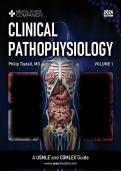
2024
EDITION
CLINICAL
PATHOPHYSIOLOGY
Philip Tisdall, MD VOLUME 1
A USMLE and COMLEX Guide
® ®
www.mscmeded.com
, CLINICAL
PATHOPHYSIOLOGY
The integration of basic sciences with clinical medicine
VOLUME 1
Philip Tisdall M.D.
www.mscmeded.com
,Preface
When this author started medical school in 1972, the knowledge that DNA was double-stranded
was only 20 years old. Anatomy was taught using cadavers because these were the best models
available. The first CT scanner would not be used in North America until 1973. By 1980, there
would be 3 million. With the parallel development of MRI and ultrasound, every doctor would
soon use these tools to see the internal anatomy of their patients. Imaging would radically
decrease the importance of the less sensitive and specific physical examination. In the 1970’s
laboratory testing saw the first of its automated instruments in chemistry and hematology. Now,
an estimated 60-70% of medical decisions are based on laboratory testing. There is non-invasive
testing for glucose, bilirubin, O2 , CO2 and pH. We are just entering the “omics” era of proteomics,
pharmacogenomics, nutrigenomics, and physiogenomics that will individualize patient care. All of
these developments blend clinical care and basic sciences. Despite the fact that clinical medicine
can now be built on a foundation of the basic sciences, medicine is still taught by subjects. These
are learned far from the bedside and are mostly forgotten by the clerkship years of medical
school. This book is an attempt to teach medicine from a patient-centered approach. There is
a list of the more than four dozen of the most important chief complaints and their differential
diagnosis, indexed to the text. Every organ system starts with a clinical pathologic correlation that
shows that organ’s commonest presentations and the associated diseases. There is a review of
each organ’s essential structure and function in its clinical context. Diseases are described through
their presentation, pathophysiology, and natural history. There are no individual subjects, just
the information needed to understand and care for the patient. When I was a clinical clerk, an
outstanding doctor told me that all I needed to learn medicine was my patients and my books.
That is still good advice. This book is intended to help any physician teach themselves medicine
by better understanding what they should be learning from their patient care.
Philip Tisdall
, Clinical Pathophysiology (Volume 1)
©2024 Copyright by Philip Tisdall M.D.
All rights reserved. This book is protected by copyright. No part of this book may be
reproduced in any form or by any means, including photocopying, or utilized by
any information storage and retrieval system without written permission from the
copyright owner.
This publication is not responsible (as a matter of product liability, negligence,
or otherwise) for any injury resulting from any material contained herein. This
publication contains information relating to general principles of medical care that
should not be construed as specific instructions for individual patients.
Library of Congress Cataloging-in-Publication Data
Philip Tisdall M.D.
Clinical Pathophysiology (Volume 1)
Includes index
DISCLAIMER
Care has been taken to confirm the accuracy of the information present and to describe
generally accepted practices. However, the authors, editors, and publisher are not responsible
for errors or omissions or for any consequences from application of the information
in this book and make no warranty, expressed or implied, with respect to the currency,
completeness, or accuracy or the contents of the publication. Application of this information
in a particular situation remains the professional responsibility of the practitioner.
Visit mscmeded.com
EDITION
CLINICAL
PATHOPHYSIOLOGY
Philip Tisdall, MD VOLUME 1
A USMLE and COMLEX Guide
® ®
www.mscmeded.com
, CLINICAL
PATHOPHYSIOLOGY
The integration of basic sciences with clinical medicine
VOLUME 1
Philip Tisdall M.D.
www.mscmeded.com
,Preface
When this author started medical school in 1972, the knowledge that DNA was double-stranded
was only 20 years old. Anatomy was taught using cadavers because these were the best models
available. The first CT scanner would not be used in North America until 1973. By 1980, there
would be 3 million. With the parallel development of MRI and ultrasound, every doctor would
soon use these tools to see the internal anatomy of their patients. Imaging would radically
decrease the importance of the less sensitive and specific physical examination. In the 1970’s
laboratory testing saw the first of its automated instruments in chemistry and hematology. Now,
an estimated 60-70% of medical decisions are based on laboratory testing. There is non-invasive
testing for glucose, bilirubin, O2 , CO2 and pH. We are just entering the “omics” era of proteomics,
pharmacogenomics, nutrigenomics, and physiogenomics that will individualize patient care. All of
these developments blend clinical care and basic sciences. Despite the fact that clinical medicine
can now be built on a foundation of the basic sciences, medicine is still taught by subjects. These
are learned far from the bedside and are mostly forgotten by the clerkship years of medical
school. This book is an attempt to teach medicine from a patient-centered approach. There is
a list of the more than four dozen of the most important chief complaints and their differential
diagnosis, indexed to the text. Every organ system starts with a clinical pathologic correlation that
shows that organ’s commonest presentations and the associated diseases. There is a review of
each organ’s essential structure and function in its clinical context. Diseases are described through
their presentation, pathophysiology, and natural history. There are no individual subjects, just
the information needed to understand and care for the patient. When I was a clinical clerk, an
outstanding doctor told me that all I needed to learn medicine was my patients and my books.
That is still good advice. This book is intended to help any physician teach themselves medicine
by better understanding what they should be learning from their patient care.
Philip Tisdall
, Clinical Pathophysiology (Volume 1)
©2024 Copyright by Philip Tisdall M.D.
All rights reserved. This book is protected by copyright. No part of this book may be
reproduced in any form or by any means, including photocopying, or utilized by
any information storage and retrieval system without written permission from the
copyright owner.
This publication is not responsible (as a matter of product liability, negligence,
or otherwise) for any injury resulting from any material contained herein. This
publication contains information relating to general principles of medical care that
should not be construed as specific instructions for individual patients.
Library of Congress Cataloging-in-Publication Data
Philip Tisdall M.D.
Clinical Pathophysiology (Volume 1)
Includes index
DISCLAIMER
Care has been taken to confirm the accuracy of the information present and to describe
generally accepted practices. However, the authors, editors, and publisher are not responsible
for errors or omissions or for any consequences from application of the information
in this book and make no warranty, expressed or implied, with respect to the currency,
completeness, or accuracy or the contents of the publication. Application of this information
in a particular situation remains the professional responsibility of the practitioner.
Visit mscmeded.com