

⋆ ı̂ ⋆
]]
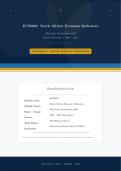
ECS2603: South African Economic Indicators
May/June Examination 2026
Covers Past Papers: 2023 – 2025
⋆ ⋄ ⋆ ⋄ ⋆ ⋄ ⋆ ⋄ ⋆
ECONOMICS – SOUTH AFRICAN INDICATORS
Exam Revision Guide
ECS2603
Module Code:
South African Economic Indicators
Module Name:
May/June Examination 2026
Paper / Exam:
2023 – 2025 Past Papers
Covers:
100 Marks (2 Hours)
Total Marks:
University of South Africa (UNISA)
Institution:
Use this guide to revise thoroughly. Focus on understanding, not memorisation.
Exam Revision Notes | ECS2603 | 2026
,ECS2603 | Exam Revision 2026 South African Economic Indicators
Question 1 (May/June 2023 & 2025) [20 marks]
(a) [5 marks]
Question: Define the concept of an economic indicator and explain why economic in-
dicators are monitored. List FIVE reasons why indicators are monitored by governments,
businesses, and economists.
Answer: An economic indicator is a piece of economic data — usually a statistic —
that gives information about the general state of the economy. Think of indicators as the
economy’s vital signs: on their own they mean little, but compared over time or against
targets they tell a story.
Five reasons indicators are monitored:
• Assess overall performance: Governments track whether the economy is growing,
stagnating, or contracting relative to targets. Without indicators, policy evaluation
is guesswork.
• Formulate and evaluate economic policy: The SARB uses CPI data to decide
on repo rate changes; without inflation data, monetary policy would be rudderless.
• Business planning and forecasting: Firms use GDP growth rates, consumer con-
fidence indices, and interest rate trends to plan production levels, hiring, and capital
expenditure.
• Comparison across countries: Indicators allow international comparisons of per-
formance – for instance, comparing South Africa’s unemployment rate with that of
other emerging economies.
• Market speculation: Financial market participants trade on indicator releases. A
surprise drop in the CPI can move bond markets, while better-than-expected GDP
data strengthens the rand.
Exam Tip
The exam often asks for a list and an explanation. One-word answers score noth-
ing. Always attach one sentence of why to each point.
Page 2 of 24
,ECS2603 | Exam Revision 2026 South African Economic Indicators
(b) [5 marks]
Question: Distinguish between leading, lagging, and coincident indicators. Give ONE
South African example of each.
Answer: The classification comes down to when the indicator moves relative to the
business cycle.
Type Definition SA Example
Leading Moves before the economy; used to New vehicle sales; build-
predict future direction. Rises before a ing plans approved
recovery and falls before a recession.
Coincident Moves with the economy at roughly the Real GDP; retail sales
same time; measures current conditions. volumes
Lagging Moves after the economy has changed Unemployment rate;
direction; used to confirm a trend. bank lending rates
Key Concept
The SARB compiles a composite leading indicator (CLI), composite coincident in-
dicator, and composite lagging indicator. Each combines several individual series
into a single value, reducing the noise of any one variable.
(c) [5 marks]
Question: Name and briefly describe FIVE major sources of South African economic
data that economists and analysts use.
Answer: South Africa has a well-developed statistical infrastructure. The five main
sources:
• Statistics South Africa (Stats SA): The official government statistics agency.
Publishes GDP data, CPI, PPI, employment surveys, and census results. Its P-series
releases are timed to specific dates.
• South African Reserve Bank (SARB): Publishes the Quarterly Bulletin, which
Page 3 of 24
, ECS2603 | Exam Revision 2026 South African Economic Indicators
is probably the most comprehensive single source of South African economic and
financial data. Also releases the Annual Economic Report.
• National Treasury: Budget documentation, Medium Term Budget Policy State-
ment (MTBPS), and fiscal statistics.
• SARB’s Release of Selected Monthly Data: A brief monthly update of key
monetary and banking statistics between Quarterly Bulletin editions.
• Bureau for Economic Research (BER), Stellenbosch: Produces consumer and
business confidence indices and sector-level surveys – not government-official, but
widely cited.
Exam Tip
Also know: the Bulletin of Statistics (Stats SA, quarterly), Stats in Brief (annual
pocket guide, 18 topics), and the Quarterly Labour Force Survey (QLFS) used for
official unemployment figures.
(d) [5 marks]
Question: Explain the FIVE main criteria used to assess macroeconomic performance in
South Africa.
Answer: These five goals form the backbone of what any government tries to achieve:
1. Economic growth: Measured by the rate of change in real GDP. South Africa tar-
gets growth high enough to absorb new labour market entrants (generally above 3%
per year, though actual performance has been well below this since 2012).
2. Full employment: Minimising unemployment. SA uses two definitions – the strict
(narrow) and expanded – measured via the QLFS. The strict rate was around 32–
33% in 2023/24.
3. Price stability: Keeping inflation within the SARB’s target band of 3–6% (CPI-
based). This protects purchasing power and investor confidence.
4. Balance of payments stability: Avoiding persistent deficits on the current ac-
count that could destabilise the rand and deplete reserves. SA typically runs a
current account deficit.
Page 4 of 24
]]
ECS2603: South African Economic Indicators
May/June Examination 2026
Covers Past Papers: 2023 – 2025
⋆ ⋄ ⋆ ⋄ ⋆ ⋄ ⋆ ⋄ ⋆
ECONOMICS – SOUTH AFRICAN INDICATORS
Exam Revision Guide
ECS2603
Module Code:
South African Economic Indicators
Module Name:
May/June Examination 2026
Paper / Exam:
2023 – 2025 Past Papers
Covers:
100 Marks (2 Hours)
Total Marks:
University of South Africa (UNISA)
Institution:
Use this guide to revise thoroughly. Focus on understanding, not memorisation.
Exam Revision Notes | ECS2603 | 2026
,ECS2603 | Exam Revision 2026 South African Economic Indicators
Question 1 (May/June 2023 & 2025) [20 marks]
(a) [5 marks]
Question: Define the concept of an economic indicator and explain why economic in-
dicators are monitored. List FIVE reasons why indicators are monitored by governments,
businesses, and economists.
Answer: An economic indicator is a piece of economic data — usually a statistic —
that gives information about the general state of the economy. Think of indicators as the
economy’s vital signs: on their own they mean little, but compared over time or against
targets they tell a story.
Five reasons indicators are monitored:
• Assess overall performance: Governments track whether the economy is growing,
stagnating, or contracting relative to targets. Without indicators, policy evaluation
is guesswork.
• Formulate and evaluate economic policy: The SARB uses CPI data to decide
on repo rate changes; without inflation data, monetary policy would be rudderless.
• Business planning and forecasting: Firms use GDP growth rates, consumer con-
fidence indices, and interest rate trends to plan production levels, hiring, and capital
expenditure.
• Comparison across countries: Indicators allow international comparisons of per-
formance – for instance, comparing South Africa’s unemployment rate with that of
other emerging economies.
• Market speculation: Financial market participants trade on indicator releases. A
surprise drop in the CPI can move bond markets, while better-than-expected GDP
data strengthens the rand.
Exam Tip
The exam often asks for a list and an explanation. One-word answers score noth-
ing. Always attach one sentence of why to each point.
Page 2 of 24
,ECS2603 | Exam Revision 2026 South African Economic Indicators
(b) [5 marks]
Question: Distinguish between leading, lagging, and coincident indicators. Give ONE
South African example of each.
Answer: The classification comes down to when the indicator moves relative to the
business cycle.
Type Definition SA Example
Leading Moves before the economy; used to New vehicle sales; build-
predict future direction. Rises before a ing plans approved
recovery and falls before a recession.
Coincident Moves with the economy at roughly the Real GDP; retail sales
same time; measures current conditions. volumes
Lagging Moves after the economy has changed Unemployment rate;
direction; used to confirm a trend. bank lending rates
Key Concept
The SARB compiles a composite leading indicator (CLI), composite coincident in-
dicator, and composite lagging indicator. Each combines several individual series
into a single value, reducing the noise of any one variable.
(c) [5 marks]
Question: Name and briefly describe FIVE major sources of South African economic
data that economists and analysts use.
Answer: South Africa has a well-developed statistical infrastructure. The five main
sources:
• Statistics South Africa (Stats SA): The official government statistics agency.
Publishes GDP data, CPI, PPI, employment surveys, and census results. Its P-series
releases are timed to specific dates.
• South African Reserve Bank (SARB): Publishes the Quarterly Bulletin, which
Page 3 of 24
, ECS2603 | Exam Revision 2026 South African Economic Indicators
is probably the most comprehensive single source of South African economic and
financial data. Also releases the Annual Economic Report.
• National Treasury: Budget documentation, Medium Term Budget Policy State-
ment (MTBPS), and fiscal statistics.
• SARB’s Release of Selected Monthly Data: A brief monthly update of key
monetary and banking statistics between Quarterly Bulletin editions.
• Bureau for Economic Research (BER), Stellenbosch: Produces consumer and
business confidence indices and sector-level surveys – not government-official, but
widely cited.
Exam Tip
Also know: the Bulletin of Statistics (Stats SA, quarterly), Stats in Brief (annual
pocket guide, 18 topics), and the Quarterly Labour Force Survey (QLFS) used for
official unemployment figures.
(d) [5 marks]
Question: Explain the FIVE main criteria used to assess macroeconomic performance in
South Africa.
Answer: These five goals form the backbone of what any government tries to achieve:
1. Economic growth: Measured by the rate of change in real GDP. South Africa tar-
gets growth high enough to absorb new labour market entrants (generally above 3%
per year, though actual performance has been well below this since 2012).
2. Full employment: Minimising unemployment. SA uses two definitions – the strict
(narrow) and expanded – measured via the QLFS. The strict rate was around 32–
33% in 2023/24.
3. Price stability: Keeping inflation within the SARB’s target band of 3–6% (CPI-
based). This protects purchasing power and investor confidence.
4. Balance of payments stability: Avoiding persistent deficits on the current ac-
count that could destabilise the rand and deplete reserves. SA typically runs a
current account deficit.
Page 4 of 24


