1
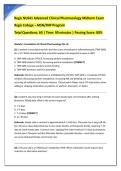
Regis NU641 Advanced Clinical Pharmacology Midterm Exam
Regis College – MSN/FNP Program
Total Questions: 60 | Time: 90 minutes | Passing Score: 80%
Module I: Foundations of Clinical Pharmacology (Q1–8)
Q1: A patient is prescribed warfarin and then starts trimethoprim-sulfamethoxazole (TMP-SMX)
for a UTI. Which pharmacokinetic interaction explains the expected increase in INR?
A. TMP-SMX induces CYP2C9, increasing warfarin metabolism
B. TMP-SMX inhibits CYP2C9, decreasing warfarin metabolism [CORRECT]
C. TMP-SMX increases warfarin protein binding
D. TMP-SMX decreases warfarin absorption
Rationale: Warfarin (S-enantiomer) is metabolized by CYP2C9. TMP-SMX is a moderate CYP2C9
inhibitor, decreasing warfarin metabolism, increasing INR and bleeding risk. Common error:
assuming all antibiotics are enzyme inducers. Clinical pearl: Always check CYP interactions when
adding or stopping medications in patients on warfarin, phenytoin, or statins.
Q2: A patient asks how long it will take to reach steady-state concentration after starting
phenytoin 300mg daily. What is the correct response?
A. 1–2 days
B. 3–5 days
C. 7–14 days [CORRECT]
D. 21–30 days
Rationale: Steady state is reached in approximately 4–5 half-lives. Phenytoin has a long half-life
(12–36 hours, dose-dependent due to zero-order kinetics at therapeutic levels), requiring 7–14
days to reach steady state. Common error: applying first-order kinetics (3–5 days) to phenytoin.
Clinical pearl: Phenytoin exhibits Michaelis-Menten (saturable) kinetics—small dose increases
can cause disproportionate serum level rises.
Q3: A 45-year-old is a CYP2D6 poor metabolizer (PM). Which medication would require dose
reduction or alternative selection?
,2
A. Lisinopril
B. Metoprolol [CORRECT]
C. Amlodipine
D. Hydrochlorothiazide
Rationale: Metoprolol is primarily metabolized by CYP2D6. Poor metabolizers have significantly
higher plasma concentrations, increasing risk of bradycardia, hypotension, and fatigue.
Common error: confusing CYP2D6 substrates with CYP3A4 or renally cleared drugs. Clinical
pearl: Other CYP2D6 substrates include codeine (ineffective in PMs), tramadol, and many
antipsychotics/antidepressants.
Q4: A drug with high therapeutic index and first-order kinetics is discontinued. Which statement
is TRUE regarding its elimination?
A. A fixed amount is eliminated per unit time
B. The time to eliminate 50% of the drug is constant regardless of plasma concentration
[CORRECT]
C. The half-life increases as plasma concentration decreases
D. Zero-order kinetics apply at all concentrations
Rationale: First-order kinetics means a constant fraction (not amount) of drug is eliminated per
unit time; therefore, half-life is constant regardless of concentration. Common error: confusing
first-order with zero-order kinetics. Clinical pearl: Most drugs follow first-order kinetics;
exceptions (phenytoin, aspirin at high doses, ethanol) follow zero-order at high concentrations.
Q5: Which pharmacodynamic concept explains why propranolol causes bronchoconstriction in
patients with asthma?
A. Partial agonist activity at beta-2 receptors
B. Non-selective beta-blockade including beta-2 receptors in bronchial smooth muscle
[CORRECT]
C. Alpha-1 receptor antagonism
D. Muscarinic receptor agonism
Rationale: Propranolol is a non-selective beta-blocker that antagonizes both beta-1 (cardiac)
and beta-2 (bronchial smooth muscle) receptors. Beta-2 blockade prevents bronchodilation and
can precipitate bronchospasm. Common error: forgetting beta-2 receptors mediate
bronchodilation. Clinical pearl: Cardioselective beta-blockers (metoprolol, bisoprolol) are
preferred in patients with reactive airway disease.
, 3
Q6: A 62-year-old on simvastatin 80mg is prescribed clarithromycin for community-acquired
pneumonia. What is the primary concern?
A. Clarithromycin induces CYP3A4, reducing simvastatin efficacy
B. Clarithromycin inhibits CYP3A4, increasing risk of rhabdomyolysis [CORRECT]
C. Clarithromycin increases simvastatin renal clearance
D. Clarithromycin displaces simvastatin from albumin binding sites
Rationale: Simvastatin is a CYP3A4 substrate; clarithromycin is a potent CYP3A4 inhibitor. Co-
administration increases simvastatin levels, raising risk of myopathy and rhabdomyolysis.
Common error: confusing inhibition with induction. Clinical pearl: The FDA recommends
avoiding simvastatin doses >20mg with strong CYP3A4 inhibitors (clarithromycin, itraconazole,
HIV protease inhibitors).
Q7: Which statement about pharmacogenomics and clopidogrel is MOST accurate?
A. CYP2C19 ultra-rapid metabolizers have increased bleeding risk
B. CYP2C19 poor metabolizers have reduced active metabolite formation and increased
cardiovascular events [CORRECT]
C. CYP2D6 polymorphisms affect clopidogrel activation
D. Pharmacogenomic testing is required before all clopidogrel prescriptions
Rationale: Clopidogrel is a prodrug requiring CYP2C19-mediated activation to its active
metabolite. Poor metabolizers have reduced active drug, leading to "clopidogrel resistance" and
higher stent thrombosis/MI rates. Common error: confusing CYP2C19 with CYP2D6. Clinical
pearl: Consider prasugrel or ticagrelor (not CYP2C19-dependent) in poor metabolizers or if
testing unavailable in high-risk PCI patients.
Q8: A drug has a volume of distribution (Vd) of 500L. What does this suggest?
A. The drug is primarily confined to plasma
B. The drug is highly lipophilic and distributes extensively into tissues [CORRECT]
C. The drug has high plasma protein binding
D. The drug is primarily renally excreted unchanged
Rationale: Vd greater than total body water (~42L) indicates extensive tissue distribution,
typical of lipophilic drugs (e.g., amiodarone Vd ~5000L). Common error: confusing high Vd with
high protein binding (actually reduces Vd). Clinical pearl: Drugs with large Vd are not effectively
Regis NU641 Advanced Clinical Pharmacology Midterm Exam
Regis College – MSN/FNP Program
Total Questions: 60 | Time: 90 minutes | Passing Score: 80%
Module I: Foundations of Clinical Pharmacology (Q1–8)
Q1: A patient is prescribed warfarin and then starts trimethoprim-sulfamethoxazole (TMP-SMX)
for a UTI. Which pharmacokinetic interaction explains the expected increase in INR?
A. TMP-SMX induces CYP2C9, increasing warfarin metabolism
B. TMP-SMX inhibits CYP2C9, decreasing warfarin metabolism [CORRECT]
C. TMP-SMX increases warfarin protein binding
D. TMP-SMX decreases warfarin absorption
Rationale: Warfarin (S-enantiomer) is metabolized by CYP2C9. TMP-SMX is a moderate CYP2C9
inhibitor, decreasing warfarin metabolism, increasing INR and bleeding risk. Common error:
assuming all antibiotics are enzyme inducers. Clinical pearl: Always check CYP interactions when
adding or stopping medications in patients on warfarin, phenytoin, or statins.
Q2: A patient asks how long it will take to reach steady-state concentration after starting
phenytoin 300mg daily. What is the correct response?
A. 1–2 days
B. 3–5 days
C. 7–14 days [CORRECT]
D. 21–30 days
Rationale: Steady state is reached in approximately 4–5 half-lives. Phenytoin has a long half-life
(12–36 hours, dose-dependent due to zero-order kinetics at therapeutic levels), requiring 7–14
days to reach steady state. Common error: applying first-order kinetics (3–5 days) to phenytoin.
Clinical pearl: Phenytoin exhibits Michaelis-Menten (saturable) kinetics—small dose increases
can cause disproportionate serum level rises.
Q3: A 45-year-old is a CYP2D6 poor metabolizer (PM). Which medication would require dose
reduction or alternative selection?
,2
A. Lisinopril
B. Metoprolol [CORRECT]
C. Amlodipine
D. Hydrochlorothiazide
Rationale: Metoprolol is primarily metabolized by CYP2D6. Poor metabolizers have significantly
higher plasma concentrations, increasing risk of bradycardia, hypotension, and fatigue.
Common error: confusing CYP2D6 substrates with CYP3A4 or renally cleared drugs. Clinical
pearl: Other CYP2D6 substrates include codeine (ineffective in PMs), tramadol, and many
antipsychotics/antidepressants.
Q4: A drug with high therapeutic index and first-order kinetics is discontinued. Which statement
is TRUE regarding its elimination?
A. A fixed amount is eliminated per unit time
B. The time to eliminate 50% of the drug is constant regardless of plasma concentration
[CORRECT]
C. The half-life increases as plasma concentration decreases
D. Zero-order kinetics apply at all concentrations
Rationale: First-order kinetics means a constant fraction (not amount) of drug is eliminated per
unit time; therefore, half-life is constant regardless of concentration. Common error: confusing
first-order with zero-order kinetics. Clinical pearl: Most drugs follow first-order kinetics;
exceptions (phenytoin, aspirin at high doses, ethanol) follow zero-order at high concentrations.
Q5: Which pharmacodynamic concept explains why propranolol causes bronchoconstriction in
patients with asthma?
A. Partial agonist activity at beta-2 receptors
B. Non-selective beta-blockade including beta-2 receptors in bronchial smooth muscle
[CORRECT]
C. Alpha-1 receptor antagonism
D. Muscarinic receptor agonism
Rationale: Propranolol is a non-selective beta-blocker that antagonizes both beta-1 (cardiac)
and beta-2 (bronchial smooth muscle) receptors. Beta-2 blockade prevents bronchodilation and
can precipitate bronchospasm. Common error: forgetting beta-2 receptors mediate
bronchodilation. Clinical pearl: Cardioselective beta-blockers (metoprolol, bisoprolol) are
preferred in patients with reactive airway disease.
, 3
Q6: A 62-year-old on simvastatin 80mg is prescribed clarithromycin for community-acquired
pneumonia. What is the primary concern?
A. Clarithromycin induces CYP3A4, reducing simvastatin efficacy
B. Clarithromycin inhibits CYP3A4, increasing risk of rhabdomyolysis [CORRECT]
C. Clarithromycin increases simvastatin renal clearance
D. Clarithromycin displaces simvastatin from albumin binding sites
Rationale: Simvastatin is a CYP3A4 substrate; clarithromycin is a potent CYP3A4 inhibitor. Co-
administration increases simvastatin levels, raising risk of myopathy and rhabdomyolysis.
Common error: confusing inhibition with induction. Clinical pearl: The FDA recommends
avoiding simvastatin doses >20mg with strong CYP3A4 inhibitors (clarithromycin, itraconazole,
HIV protease inhibitors).
Q7: Which statement about pharmacogenomics and clopidogrel is MOST accurate?
A. CYP2C19 ultra-rapid metabolizers have increased bleeding risk
B. CYP2C19 poor metabolizers have reduced active metabolite formation and increased
cardiovascular events [CORRECT]
C. CYP2D6 polymorphisms affect clopidogrel activation
D. Pharmacogenomic testing is required before all clopidogrel prescriptions
Rationale: Clopidogrel is a prodrug requiring CYP2C19-mediated activation to its active
metabolite. Poor metabolizers have reduced active drug, leading to "clopidogrel resistance" and
higher stent thrombosis/MI rates. Common error: confusing CYP2C19 with CYP2D6. Clinical
pearl: Consider prasugrel or ticagrelor (not CYP2C19-dependent) in poor metabolizers or if
testing unavailable in high-risk PCI patients.
Q8: A drug has a volume of distribution (Vd) of 500L. What does this suggest?
A. The drug is primarily confined to plasma
B. The drug is highly lipophilic and distributes extensively into tissues [CORRECT]
C. The drug has high plasma protein binding
D. The drug is primarily renally excreted unchanged
Rationale: Vd greater than total body water (~42L) indicates extensive tissue distribution,
typical of lipophilic drugs (e.g., amiodarone Vd ~5000L). Common error: confusing high Vd with
high protein binding (actually reduces Vd). Clinical pearl: Drugs with large Vd are not effectively