
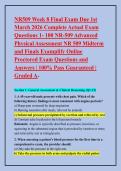
NR509 Week 8 Final Exam Due 1st
March 2026 Complete Actual Exam
Questions 1- 100 NR-509 Advanced
Physical Assessment NR 509 Midterm
and Finals Examplify Online
Proctored Exam Questions and
Answers | 100% Pass Guaranteed |
Graded A+
Section 1: General Assessment & Clinical Reasoning (Q1-15)
1. A 45-year-old male presents with chest pain. Which of the
following history findings is most consistent with angina pectoris?
a) Sharp pain worsened by deep inspiration
b) Burning sensation after meals, relieved by antacids
c) Substernal pressure precipitated by exertion and relieved by rest
d) Constant ache localized to the left pectoral muscle
Rationale: Angina is typically described as pressure, heaviness, or
squeezing in the substernal region that is provoked by exertion or stress
and relieved by rest or nitroglycerin.
2. When assessing a patient's blood pressure for the first time in a
comprehensive exam, the provider should:
a) Only take the pressure in the right arm
b) Take the pressure in both arms and palpate the radial pulses
,simultaneously
c) Take the pressure in the left arm while auscultating the carotid artery
d) Use a Doppler if the patient is over 65
Rationale: Taking BP in both arms helps detect coarctation of the aorta
or subclavian stenosis. Palpating radial pulses assesses for radio-radial
delay.
3. A patient has a positive "Murphy's sign." What is the likely
underlying pathology?
a) Appendicitis
b) Cholecystitis
c) Pancreatitis
d) Hepatitis
Rationale: Murphy's sign is elicited by hooking fingers under the right
costal margin and asking the patient to inhale; pain and inspiratory arrest
indicate gallbladder inflammation.
4. Which of the following is a core competency of the "Clinical
Judgment Model" in advanced physical assessment?
a) Deferring differential diagnoses until lab results return
b) Recognizing cues and analyzing information to form hypotheses
c) Focusing only on the chief complaint to avoid bias
d) Relying solely on technology for assessment
Rationale: Clinical judgment involves cue recognition, hypothesis
formation, prioritization, and outcome evaluation.
5. When performing a comprehensive health history, which of the
following represents the "Review of Systems" (ROS)?
a) Family history of myocardial infarction
b) An inventory of body systems obtained through a series of
questions
c) The patient's chief complaint in their own words
,d) Objective findings from the physical exam
Rationale: ROS is a subjective inventory of symptoms related to each
body system, not the physical exam or past medical history.
6. A patient with a history of alcohol use disorder presents with
palmar erythema, spider angiomas, and gynecomastia. These
findings suggest:
a) Vitamin B12 deficiency
b) Hepatic cirrhosis
c) Renal failure
d) Hyperthyroidism
Rationale: These are classic stigmata of chronic liver disease due to
altered estrogen metabolism.
7. You are assessing the nutritional status of a 70-year-old. Which
finding is most concerning?
a) Weight loss of 10 lbs over 6 months
b) BMI of 23
c) Unintentional weight loss of 10 lbs in 2 months
d) Skin turgor returns immediately
Rationale: Rapid, unintentional weight loss (>5% body weight in 1-3
months) is a red flag for malignancy, depression, or malabsorption.
8. What is the "background" component in the SBAR
communication tool?
a) What is happening right now?
b) What is the problem?
c) Relevant history, diagnosis, and current status
d) What do you think needs to happen?
Rationale: Background includes relevant medical history, diagnosis, and
current status within the SBAR framework.
, 9. A patient has an exaggerated curvature of the thoracic spine,
commonly known as "hunchback." This is termed:
a) Lordosis
b) Kyphosis
c) Scoliosis
d) Spondylosis
Rationale: Kyphosis is an exaggerated posterior curvature of the
thoracic spine. Lordosis is an exaggerated lumbar curvature. Scoliosis is
lateral curvature.
10. To correctly measure a patient's height who cannot stand due to
contractures, you should use:
a) A standard stadiometer
b) Recumbent length measurement (supine)
c) Knee-to-heel length with a tape measure
d) Ask the patient for their last known height
Rationale: For patients unable to stand, recumbent length (lying down)
is the most accurate alternative to standing height.
11. A patient presents with new-onset confusion. Which of the
following is the most appropriate first step in the mental status
exam?
a) Mini-Mental State Examination (MMSE)
b) Observe the patient's level of consciousness and attention during
the interview
c) Montreal Cognitive Assessment (MoCA)
d) Ask about the date and President
Rationale: Assessment of consciousness and attention begins the
moment you interact with the patient and is the foundation of the mental
status exam.
March 2026 Complete Actual Exam
Questions 1- 100 NR-509 Advanced
Physical Assessment NR 509 Midterm
and Finals Examplify Online
Proctored Exam Questions and
Answers | 100% Pass Guaranteed |
Graded A+
Section 1: General Assessment & Clinical Reasoning (Q1-15)
1. A 45-year-old male presents with chest pain. Which of the
following history findings is most consistent with angina pectoris?
a) Sharp pain worsened by deep inspiration
b) Burning sensation after meals, relieved by antacids
c) Substernal pressure precipitated by exertion and relieved by rest
d) Constant ache localized to the left pectoral muscle
Rationale: Angina is typically described as pressure, heaviness, or
squeezing in the substernal region that is provoked by exertion or stress
and relieved by rest or nitroglycerin.
2. When assessing a patient's blood pressure for the first time in a
comprehensive exam, the provider should:
a) Only take the pressure in the right arm
b) Take the pressure in both arms and palpate the radial pulses
,simultaneously
c) Take the pressure in the left arm while auscultating the carotid artery
d) Use a Doppler if the patient is over 65
Rationale: Taking BP in both arms helps detect coarctation of the aorta
or subclavian stenosis. Palpating radial pulses assesses for radio-radial
delay.
3. A patient has a positive "Murphy's sign." What is the likely
underlying pathology?
a) Appendicitis
b) Cholecystitis
c) Pancreatitis
d) Hepatitis
Rationale: Murphy's sign is elicited by hooking fingers under the right
costal margin and asking the patient to inhale; pain and inspiratory arrest
indicate gallbladder inflammation.
4. Which of the following is a core competency of the "Clinical
Judgment Model" in advanced physical assessment?
a) Deferring differential diagnoses until lab results return
b) Recognizing cues and analyzing information to form hypotheses
c) Focusing only on the chief complaint to avoid bias
d) Relying solely on technology for assessment
Rationale: Clinical judgment involves cue recognition, hypothesis
formation, prioritization, and outcome evaluation.
5. When performing a comprehensive health history, which of the
following represents the "Review of Systems" (ROS)?
a) Family history of myocardial infarction
b) An inventory of body systems obtained through a series of
questions
c) The patient's chief complaint in their own words
,d) Objective findings from the physical exam
Rationale: ROS is a subjective inventory of symptoms related to each
body system, not the physical exam or past medical history.
6. A patient with a history of alcohol use disorder presents with
palmar erythema, spider angiomas, and gynecomastia. These
findings suggest:
a) Vitamin B12 deficiency
b) Hepatic cirrhosis
c) Renal failure
d) Hyperthyroidism
Rationale: These are classic stigmata of chronic liver disease due to
altered estrogen metabolism.
7. You are assessing the nutritional status of a 70-year-old. Which
finding is most concerning?
a) Weight loss of 10 lbs over 6 months
b) BMI of 23
c) Unintentional weight loss of 10 lbs in 2 months
d) Skin turgor returns immediately
Rationale: Rapid, unintentional weight loss (>5% body weight in 1-3
months) is a red flag for malignancy, depression, or malabsorption.
8. What is the "background" component in the SBAR
communication tool?
a) What is happening right now?
b) What is the problem?
c) Relevant history, diagnosis, and current status
d) What do you think needs to happen?
Rationale: Background includes relevant medical history, diagnosis, and
current status within the SBAR framework.
, 9. A patient has an exaggerated curvature of the thoracic spine,
commonly known as "hunchback." This is termed:
a) Lordosis
b) Kyphosis
c) Scoliosis
d) Spondylosis
Rationale: Kyphosis is an exaggerated posterior curvature of the
thoracic spine. Lordosis is an exaggerated lumbar curvature. Scoliosis is
lateral curvature.
10. To correctly measure a patient's height who cannot stand due to
contractures, you should use:
a) A standard stadiometer
b) Recumbent length measurement (supine)
c) Knee-to-heel length with a tape measure
d) Ask the patient for their last known height
Rationale: For patients unable to stand, recumbent length (lying down)
is the most accurate alternative to standing height.
11. A patient presents with new-onset confusion. Which of the
following is the most appropriate first step in the mental status
exam?
a) Mini-Mental State Examination (MMSE)
b) Observe the patient's level of consciousness and attention during
the interview
c) Montreal Cognitive Assessment (MoCA)
d) Ask about the date and President
Rationale: Assessment of consciousness and attention begins the
moment you interact with the patient and is the foundation of the mental
status exam.


