Nr 507 Final Study Guide (Revised)| Final Study Guide (2020)
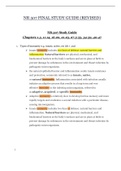
NR 507 FINAL STUDY GUIDE (REVISED) NR-507 Study Guide Chapters 1-5, 11-14, 16-20, 21-25, 27-3-33, 34-39, 40-47 1. Types of immunity-e.g. innate, active, etc (ch 7 ,191) Innate immunity includes two lines of defense: natural barriers and inflammation Natural barriers are physical, mechanical, and biochemical barriers at the body’s surfaces and are in place at birth to prevent damage by substances in the environment and thwart infection by pathogenic microorganisms. the natural epithelial barrier and inflammation confer innate resistance and protection, commonly referred to as innate, native, or natural immunity. Inflammation associated with infection usually initiates an adaptive process that results in a long-term and very effective immunity to the infecting microorganism, referred to as adaptive, acquired, or specific immunity. Adaptive immunity is relatively slow to develop but has memory and more rapidly targets and eradicates a second infection with a particular disease-causing microorganism. Innate immunity includes two lines of defense: natural barriers and inflammation. Natural barriers are physical, mechanical, and biochemical microorganism, referred to as adaptive, acquired, or specific immunity. Adaptive immunity is relatively slow to develop but has memory and more rapidly targets and eradicates a second infection with a particular disease-causing microorganism. Innate immunity includes two lines of defense: natural barriers and inflammation. Natural barriers are physical, mechanical, and biochemical barriers at the body’s surfaces and are in place at birth to prevent damage by substances in the environment and thwart infection by pathogenic microorganisms INNATE IMMUNITY ADAPTIVE (ACQUIRED) IMMUNITY BARRIERS INFLAMMATORY RESPONSE Level of defense First line of defense against infection and tissue injury Second line of defense; occurs as a response to tissue injury or infection Third line ofdefense; initiated when innate immune system signals the cells ofadaptive immunity Timing of defense Constant Immediate response Delay between primary exposure to antigen and maximum response; immediate against secondary exposure to antigen Specificity Broadly specific Broadly specific Response is very specific toward “antigen” Cells Epithelial cells Mast cells, granulocytes (neutrophils, eosinophils, basophils), monocytes/macrophages, natural killer (NK) cells, platelets, endothelial cells T lymphocytes, B lymphocytes, macrophages, dendritic cells Cells Epithelial cells Mast cells, granulocytes (neutrophils, eosinophils, basophils), monocytes/macrophages, natural killer (NK) cells, platelets, endothelial cells T lymphocytes, B lymphocytes, macrophages, dendritic cells Memory No memory involved No memory involved Specific immunologic memory by T and B lymphocytes Peptides Defensins, cathelicidins, collectins, lactoferrin, bacterial toxins Complement, clotting factors, kinins Antibodies, complement Protection Protection includes anatomic barriers (i.e., skin and mucous membranes), cells and secretory molecules or cytokines (e.g., lysozymes, low pH of stomach and urine), and ciliary activity Protection includes vascular responses, cellular components (e.g., mast cells, neutrophils, macrophages), secretory molecules or cytokines, and activation of plasma protein systems Protection includes activated T and B lymphocytes, cytokines, and antibodies 2. Alveolar ventilation/perfusion- (ch, 34,pg 1238) The relationship between arterial perfusion and alveolar gas pressure at the base of the lungs is best described as: arterial perfusion pressure exceeds alveolar gas pressure. Effective gas exchange depends on an approximately even distribution of gas (ventilation) and blood (perfusion) in all portions of the lungs. The lungs are suspended from the hila in the thoracic cavity. When the individual is in an upright position (sitting or standing), gravity pulls the lungs down toward the diaphragm and compresses their lower portions or bases. 3. Dermatologic conditions e.g. pityriasis rosea (ch46, pg 1630/1631) Psoriasis, pityriasis rosea, and lichen planus are inflammatory disorders characterized by papules, scales, plaques, and erythema Psoriasis is a chronic, relapsing, proliferative, inflammatory disorder that involves the skin,
Document information
- Uploaded on
- May 20, 2021
- Number of pages
- 51
- Written in
- 2020/2021
- Type
- Other
- Person
- Unknown