

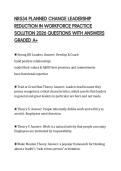
NR534 PLANNED CHANGE LEADERSHIP
REDUCTION IN WORKFORCE PRACTICE
SOLUTION 2026 QUESTIONS WITH ANSWERS
GRADED A+
◉ Strong HR Leaders. Answer: Develop & Coach
build positive relationships
model their values & fulfill their promises and commitments
have functional expertise
◉ Trait or Great Man Theory. Answer: Leaders lead because they
posses recognized, critical characteristics, which asserts that leaders
in general and great leaders in particular are born and not made.
◉ Theory X. Answer: People inherently dislike work and will try to
avoid it. Employees need direction.
◉ Theory Y. Answer: Work is a natural activity that people can enjoy.
Employees are motivated by responsibility.
◉ Blake Mouton Theory. Answer: a popular framework for thinking
about a leader's "task versus person" orientation.
, ◉ Hersey- Blanchard Situational Leader. Answer: No ideal leader.
Leadership styles matches the situation
◉ Fiedler's Contingency Theory. Answer: argues that different
leadership styles work best in different situations.
◉ Authentic leadership. Answer: Leadership grounded in an
individual's values and principles and focused on empowering
others to act.
◉ Business Acumen competency. Answer: The ability to understand
and apply information with which to contribute to the organization's
strategic plan.
◉ Business intelligence. Answer: Ability to gather and analyze data
from inside and outside the organization so that information is
available for decision makers.
◉ Civil law. Answer: Legal system based on written codes (laws,
rules, or regulations).
◉ Common law. Answer: Legal system in which each case is
considered in terms of how it relates to legal decisions that have
already been made; evolves through judicial decisions over time.
REDUCTION IN WORKFORCE PRACTICE
SOLUTION 2026 QUESTIONS WITH ANSWERS
GRADED A+
◉ Strong HR Leaders. Answer: Develop & Coach
build positive relationships
model their values & fulfill their promises and commitments
have functional expertise
◉ Trait or Great Man Theory. Answer: Leaders lead because they
posses recognized, critical characteristics, which asserts that leaders
in general and great leaders in particular are born and not made.
◉ Theory X. Answer: People inherently dislike work and will try to
avoid it. Employees need direction.
◉ Theory Y. Answer: Work is a natural activity that people can enjoy.
Employees are motivated by responsibility.
◉ Blake Mouton Theory. Answer: a popular framework for thinking
about a leader's "task versus person" orientation.
, ◉ Hersey- Blanchard Situational Leader. Answer: No ideal leader.
Leadership styles matches the situation
◉ Fiedler's Contingency Theory. Answer: argues that different
leadership styles work best in different situations.
◉ Authentic leadership. Answer: Leadership grounded in an
individual's values and principles and focused on empowering
others to act.
◉ Business Acumen competency. Answer: The ability to understand
and apply information with which to contribute to the organization's
strategic plan.
◉ Business intelligence. Answer: Ability to gather and analyze data
from inside and outside the organization so that information is
available for decision makers.
◉ Civil law. Answer: Legal system based on written codes (laws,
rules, or regulations).
◉ Common law. Answer: Legal system in which each case is
considered in terms of how it relates to legal decisions that have
already been made; evolves through judicial decisions over time.


