
Berne and Levy Physiology 8th Edition
Koepp
Berne and Levy Physiology 8th Edition KoeppenTest Bank
KoeppenChapter 01: Principles of Cel Function Test Bank F
Multiple Choice
1. The subcellular structure that degrades proteins is called the:
F F F F F F F F
A. Tight junction F
B. Mitochondria
C. Lysosome
D. Plasma membrane F
E. Ribosome
ANS: C
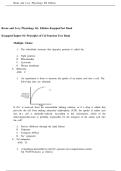
2. An experiment is done to measure the uptake of an amino acid into a cell. The
F F F F F F F F F F F F F F F F
foll owing data are obtained:
F F F F
N
If Na+ is removed from the extracellular bathing solution, or if a drug is added
F F F F F F F F F F F F F F F that F
preve nts the cell from making adenosine triphosphate (ATP), the uptake of amino
F F F F F F F F F F F F F acid F
into th e cell is markedly reduced. According to this information, which of
F F F F F F F F F F F F F the F
followingmechan isms is probably responsible for the transport of the amino acid
F F F F F F F F F F F F into F
the cell?
F
A. Passive diffusion through the lipid bilayer F F F F F
B. Uniporter
C. Transport ATPase F
D. Na+ symporter F
E. Na+ antiporter
F
ANS: D F F
3. A membrane permeable by only Na+ separates two compartments contain
F F F F F F F F F F
ing Na2SO4,shown as follows:
F F F
, Berne and Levy Physiology 8th Edition
Koepp
Electrodes are placed in both compartments, and a voltage is applied (that of
F F F F F F F F F F F F F
compartme nt A is held at 0 mV). What voltage applied to compartment B would
F F F F F F F F F F F F F F F
resultin no net mo vement of Na+ across the membrane separating the compartments?
F F F F F F F F F F F F
A. –60 mV F
B. –30 mV F
C. 0 mVF
D. +30 mV F F
E.
+60 m F F
V ANS: EF F
4. The resting membrane potentN
F ial oRf a Ic e llGis – TV F F F F F F F F
B85.m U S N concentrations of several ions are indicat
CV. The intracellular and extracellular F F F F F F F F F F F
ed in the following table, as is the calculated
F F F F F F F F
Nernst equilibrium potential (Ei) for each of these ions:
F F F F F F F F
Ion Concentration Concentration Ei
Inside Cell F Outside Cell F
+
Na 12 mEq/L F 145 mEq/L F 66 mV
F
K+ 150 mEq/L F 4 mEq/L
F –96 mV F
Cl– 30 mEq/L F 105 mEq/L F –33 mV F
Ca++ 0.0001 mmol/dL F 1 mmol/dL
F 122 mV F
The membrane has channels for Na+, K+, Cl–
F F F F F F F
, and Ca++. The conductance of the membrane is the greatest for which ion
F F F F F F F F F F F F F
?
A. Na+
B. K+
C. Cl–
D. Ca++
ANS:
B
5. A cell contains the following membrane transporters:
F F F F F F
Na+ channelK+ channe
F F
l Na+,K+-ATPase
F
,Berne and Levy Physiology 8th Edition
Koepp
The resting membrane voltage of the cell is –80 mV, and the intracellular and
F F F F F F F F F F F F F
extracellular ion concentrations are as follows:
F F F F F
Ion Intracellular Extracellular
Concentration Concentration
Na+ 10 mEq/L F 145 mEq/L F
K+ 120 mEq/L F 4 mEq/L F
The cell is treated with a drug to inhibit the Na+,K+-
F F F F F F F F F F
ATPase. What would be the effect ofthis drug on the following parameters?
F F F F F F F F F F F
Intracellular [Na+] F Intracellular [K+] F Cell Volume F Membrane Voltage
F
A. Decrease Decrease Decrease Depolarize
B. Increase Decrease Increase Depolarize
C. Increase Increase Increase No change
F
D. Decrease Increase Decrease Hyperpolarize
E. Increase Increase Decrease Hyperpolarize
ANS: B
6. Which of the labeled proteins (shaded) is attached to the membrane
F F F F F F F F F F F
by a glycosylphosphatidylinositol (GPI) anchor?
F F F F
ANS: E
7.
A cell has channels for Na+, K+, and Cl–
F F F F F F F F
in its plasma membrane. The resting membrane potential is –
F F F F F F F F F
60 mV (cell interior negative). The intracellular and extracellular
F F F F F F F F F
concentrations for these ions, as well as the calculated Nernst potentials, are
F F F F F F F F F F F F
listed as follows: F F
, Berne and Levy Physiology 8th Edition
Koepp
Ion Intracellular F Extracellular F Ei
Concentration Concentration
Na+ 14 mEq/L F 140 mEq/L F 60 mV F
K+ 150 mEq/L F 5 mEq/L F –89 mV F
Cl– 10 mEq/L F 100 mEq/L F –60 mV F
A drug is applied to the cell that increases the permeability of the cell by Cl–
F F F F F F F F F F F F F F F
(i.e., it opens Cl–
F F F
channels). What effect will this drug have on the net movement of Cl–
F F F F F F F F F F F F
acrossthe plasma membrane? F F
A. Net Cl– movement out of the cell will be increased.
F F F F F F F F F
B. Net Cl– movement into the cell will be increased.
F
F
F F F F F F
C. There will be no change in the net movement of Cl–.
F F F F F F F F F F
ANS: C
8. Reducing the extracellular [K+] would be expected to have which of the follo wing
F F F F F F F F F F F F F F
effects on the resting membrane potential and on the excitability of ve ntricular
F F F F F F F F F F F F F
myocytes?
Membrane Potential F Excitability
A. Unchanged Unchanged
B. Hyperpolarized GDT
ecBre.aC
seO
d
C. Hyperpolarized Increased
D. Depolarized Decreased
E. Depolarized Increased
ANS: B
9. A cell is bathed in an isotonic NaCl solution that contains 5 mmol/L of
F F F F F F F F F F F F F F
glucose. The intracellular concentration of glucose is 10 mmol/L. What is the
F F F F F F F F F F F F
most likely mechanism for the transport of glucose across the plasma
F F F F F F F F F F F
membrane into this cel l? F F F F
A. Glucose uniporter F
B. Na+-glucose symporter F
C. Na+-glucose antiporter F
D. Diffusion of glucose through the lipid bilayer of the membr
F F F F F F F F F F
ane ANS: B
F F
10. A blood sample is taken from an individual whose blood osmolality is 295
F F F F F F F F F F F F F
mOs m per kilogram of water. Red blood cells from this sample are then
F F F F F F F F F F F F F F
placed in the following solutions: F F F F
Koepp
Berne and Levy Physiology 8th Edition KoeppenTest Bank
KoeppenChapter 01: Principles of Cel Function Test Bank F
Multiple Choice
1. The subcellular structure that degrades proteins is called the:
F F F F F F F F
A. Tight junction F
B. Mitochondria
C. Lysosome
D. Plasma membrane F
E. Ribosome
ANS: C
2. An experiment is done to measure the uptake of an amino acid into a cell. The
F F F F F F F F F F F F F F F F
foll owing data are obtained:
F F F F
N
If Na+ is removed from the extracellular bathing solution, or if a drug is added
F F F F F F F F F F F F F F F that F
preve nts the cell from making adenosine triphosphate (ATP), the uptake of amino
F F F F F F F F F F F F F acid F
into th e cell is markedly reduced. According to this information, which of
F F F F F F F F F F F F F the F
followingmechan isms is probably responsible for the transport of the amino acid
F F F F F F F F F F F F into F
the cell?
F
A. Passive diffusion through the lipid bilayer F F F F F
B. Uniporter
C. Transport ATPase F
D. Na+ symporter F
E. Na+ antiporter
F
ANS: D F F
3. A membrane permeable by only Na+ separates two compartments contain
F F F F F F F F F F
ing Na2SO4,shown as follows:
F F F
, Berne and Levy Physiology 8th Edition
Koepp
Electrodes are placed in both compartments, and a voltage is applied (that of
F F F F F F F F F F F F F
compartme nt A is held at 0 mV). What voltage applied to compartment B would
F F F F F F F F F F F F F F F
resultin no net mo vement of Na+ across the membrane separating the compartments?
F F F F F F F F F F F F
A. –60 mV F
B. –30 mV F
C. 0 mVF
D. +30 mV F F
E.
+60 m F F
V ANS: EF F
4. The resting membrane potentN
F ial oRf a Ic e llGis – TV F F F F F F F F
B85.m U S N concentrations of several ions are indicat
CV. The intracellular and extracellular F F F F F F F F F F F
ed in the following table, as is the calculated
F F F F F F F F
Nernst equilibrium potential (Ei) for each of these ions:
F F F F F F F F
Ion Concentration Concentration Ei
Inside Cell F Outside Cell F
+
Na 12 mEq/L F 145 mEq/L F 66 mV
F
K+ 150 mEq/L F 4 mEq/L
F –96 mV F
Cl– 30 mEq/L F 105 mEq/L F –33 mV F
Ca++ 0.0001 mmol/dL F 1 mmol/dL
F 122 mV F
The membrane has channels for Na+, K+, Cl–
F F F F F F F
, and Ca++. The conductance of the membrane is the greatest for which ion
F F F F F F F F F F F F F
?
A. Na+
B. K+
C. Cl–
D. Ca++
ANS:
B
5. A cell contains the following membrane transporters:
F F F F F F
Na+ channelK+ channe
F F
l Na+,K+-ATPase
F
,Berne and Levy Physiology 8th Edition
Koepp
The resting membrane voltage of the cell is –80 mV, and the intracellular and
F F F F F F F F F F F F F
extracellular ion concentrations are as follows:
F F F F F
Ion Intracellular Extracellular
Concentration Concentration
Na+ 10 mEq/L F 145 mEq/L F
K+ 120 mEq/L F 4 mEq/L F
The cell is treated with a drug to inhibit the Na+,K+-
F F F F F F F F F F
ATPase. What would be the effect ofthis drug on the following parameters?
F F F F F F F F F F F
Intracellular [Na+] F Intracellular [K+] F Cell Volume F Membrane Voltage
F
A. Decrease Decrease Decrease Depolarize
B. Increase Decrease Increase Depolarize
C. Increase Increase Increase No change
F
D. Decrease Increase Decrease Hyperpolarize
E. Increase Increase Decrease Hyperpolarize
ANS: B
6. Which of the labeled proteins (shaded) is attached to the membrane
F F F F F F F F F F F
by a glycosylphosphatidylinositol (GPI) anchor?
F F F F
ANS: E
7.
A cell has channels for Na+, K+, and Cl–
F F F F F F F F
in its plasma membrane. The resting membrane potential is –
F F F F F F F F F
60 mV (cell interior negative). The intracellular and extracellular
F F F F F F F F F
concentrations for these ions, as well as the calculated Nernst potentials, are
F F F F F F F F F F F F
listed as follows: F F
, Berne and Levy Physiology 8th Edition
Koepp
Ion Intracellular F Extracellular F Ei
Concentration Concentration
Na+ 14 mEq/L F 140 mEq/L F 60 mV F
K+ 150 mEq/L F 5 mEq/L F –89 mV F
Cl– 10 mEq/L F 100 mEq/L F –60 mV F
A drug is applied to the cell that increases the permeability of the cell by Cl–
F F F F F F F F F F F F F F F
(i.e., it opens Cl–
F F F
channels). What effect will this drug have on the net movement of Cl–
F F F F F F F F F F F F
acrossthe plasma membrane? F F
A. Net Cl– movement out of the cell will be increased.
F F F F F F F F F
B. Net Cl– movement into the cell will be increased.
F
F
F F F F F F
C. There will be no change in the net movement of Cl–.
F F F F F F F F F F
ANS: C
8. Reducing the extracellular [K+] would be expected to have which of the follo wing
F F F F F F F F F F F F F F
effects on the resting membrane potential and on the excitability of ve ntricular
F F F F F F F F F F F F F
myocytes?
Membrane Potential F Excitability
A. Unchanged Unchanged
B. Hyperpolarized GDT
ecBre.aC
seO
d
C. Hyperpolarized Increased
D. Depolarized Decreased
E. Depolarized Increased
ANS: B
9. A cell is bathed in an isotonic NaCl solution that contains 5 mmol/L of
F F F F F F F F F F F F F F
glucose. The intracellular concentration of glucose is 10 mmol/L. What is the
F F F F F F F F F F F F
most likely mechanism for the transport of glucose across the plasma
F F F F F F F F F F F
membrane into this cel l? F F F F
A. Glucose uniporter F
B. Na+-glucose symporter F
C. Na+-glucose antiporter F
D. Diffusion of glucose through the lipid bilayer of the membr
F F F F F F F F F F
ane ANS: B
F F
10. A blood sample is taken from an individual whose blood osmolality is 295
F F F F F F F F F F F F F
mOs m per kilogram of water. Red blood cells from this sample are then
F F F F F F F F F F F F F F
placed in the following solutions: F F F F


