

Written by students who passed Immediately available after payment Read online or as PDF Wrong document? Swap it for free 4.6 TrustPilot
logo-home
Document preview thumbnail
Preview 2 out of 11 pages
Exam (elaborations)

BKAT Critical Care Review Exam 2026 – Complete Questions and Correct Detailed Answers – Critical Care Nursing

Document preview thumbnail
Preview 2 out of 11 pages

This document contains BKAT Critical Care Review exam questions and verified answers focused on critical care nursing concepts, hemodynamic monitoring, cardiac emergencies, ventilator management, neurological assessment, renal function, and ACLS medications. It covers essential ICU topics including preload and afterload, pulmonary artery pressures, ECG interpretation, shock management, ventilator alarms, stroke care, diabetes emergencies, and emergency pharmacology. The material is designed to help nursing students and critical care nurses prepare for BKAT and ICU-related examinations through concise review questions and detailed answer explanations. The document also reviews advanced cardiovascular monitoring, neurological complications, electrolyte imbalances, and emergency interventions commonly tested in critical care nursing assessments. Keywords BKAT review critical care nursing ICU nursing hemodynamic monitoring ACLS medications ventilator management cardiac output pulmonary artery pressure CVP monitoring ECG interpretation shock management critical care exam neurological assessment ventilator alarms DKA treatment stroke management cardiac medications critical care pharmacology renal failure nursing ICU review questions

Content preview

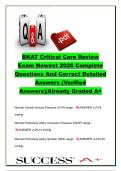
BKAT Critical Care Review
Exam Newest 2026 Complete
Questions And Correct Detailed
Answers (Verified
Answers)|Already Graded A+

Normal Central Venous Pressure (CVP) range - ANSWER ✔✔2-8

mmHg

Normal Pulmonary Artery Occlusion Pressure (PAOP) range -

ANSWER ✔✔6-12 mmHg


Normal Pulmonary Artery Systolic (PAS) range - ANSWER ✔✔20-30

mmHg

, Normal Pulmonary Artery Diastolic (PAD) range - ANSWER ✔✔5-15

mmHg


Normal Pulmonary Artery Mean (PAM) - ANSWER ✔✔11-20 mmHg


Normal Systemic Vascular Resistance (SVR) range - ANSWER

✔✔800-1200 mmHg


Preload - ANSWER ✔✔volume left in the left ventricle at the end of

diastole


What is preload affected by? - ANSWER ✔✔venous return to the

heart, atrial kick, total volume, and ventricular compliance


What drugs can affect preload? - ANSWER ✔✔Furosemide and

nitroglycerin


Afterload - ANSWER ✔✔Amount of pressure heart has to overcome

to pump blood out


What drugs may affect afterload? - ANSWER ✔✔Vasoconstricters

and vasodilators


Contractility - ANSWER ✔✔the contractile force of the heart, how

much will it take to move the preload out against the afterload

Document information

Uploaded on
May 12, 2026
Number of pages
11
Written in
2025/2026
Type
Exam (elaborations)
Contains
Questions & answers
$18.99

Wrong document? Swap it for free Within 14 days of purchase and before downloading, you can choose a different document. You can simply spend the amount again.
Written by students who passed
Immediately available after payment
Read online or as PDF

Seller avatar
Reputation scores are based on the amount of documents a seller has sold for a fee and the reviews they have received for those documents. There are three levels: Bronze, Silver and Gold. The better the reputation, the more your can rely on the quality of the sellers work.
JOSHCLAY
3.5
(83)
Sold
387
Followers
16
Items
20447
Last sold
2 days ago


Why students choose Stuvia

Created by fellow students, verified by reviews

Quality you can trust: written by students who passed their tests and reviewed by others who've used these notes.

Didn't get what you expected? Choose another document

No worries! You can instantly pick a different document that better fits what you're looking for.

Pay as you like, start learning right away

No subscription, no commitments. Pay the way you're used to via credit card and download your PDF document instantly.

Student with book image

“Bought, downloaded, and aced it. It really can be that simple.”

Alisha Student

Working on your references?

Create accurate citations in APA, MLA and Harvard with our free citation generator.

Working on your references?

Frequently asked questions

